There was a blood moon tonight. We watched the eclipse come in as we drove home. First it looked like a dirty black cloud obscuring the bottom corner of the moon. By the time we pulled into the driveway it was a big smudge a quarter of the way across the moon face.
We watched it on-and-off over the next hour, until there was a tiny sliver of light and the beginnings of a nice red moon.
Then the cloud cover moved in and that was the end of our moon watching.
Still, eclipses have always meant good things in our household.
Sure enough, when we turned on the computer what did we see in our twitter feed?
Our first ‘official’ mention of Linesman in our editor’s tweet.
Our editor, tweeting about our book
It’s starting to feel real. This story is going to be published.
As a writer, you learn a lot from the submission process. Reading up on how to query, finessing your letter every time you send it out. Getting to know other writers, finding out what other authors go through—first in getting an agent, and what happens after that.
In fact, early success can cause its own problems through inexperience.
Take this example.
A writer I know netted the interest of an agent on her second query. The agent told her she loved her work and was interested in representing her. They agreed to call a week later to talk about the novel.
The writer was deliriously happy for a week. Then came the phone call. According to the writer,
“She spent fifty minutes trashing my novel.”
There are two responses to that, and it depends how much querying experience you have had as to how you respond.
If you’re new to the writing/querying business then you’ll be sympathetic.
“How awful,” you might say. “You were treated so badly.”
Yet those of us who’ve been querying a while will be thinking (and trying to say, but more tactfully),
“Do you realise what that means? You had an agent who loved your work. She agreed to take you on. She spent fifty minutes on the phone talking about ways to improve your book. Fifty minutes! And you’re insulted.”
Because in that time we’ve spent querying, we’ve haunted the internet, talked with other writers, read about agents, polished up on our queries, polished up our manuscript, and we’ve learned some things we didn’t know when we started out.
Somewhere along the way we come to understand that our book isn’t perfect. That getting the agent is only the first step to getting our novel published. That the agent will want us to fix things before he/she sends it out on submission. The editor will want changes too.
If my writer-friend had been submitting longer, she might have understood this. Instead, she was still too new to the process.
As you can imagine, she promptly parted ways with her agent. Two years on she is still bitter about the whole trad-pub thing and has adopted indie publishing with fervour.
I’m not sure if she’ll ever realise it was her own inexperience that set her along that path.
Even though I write science fiction and fantasy, I am a member of the Romance Writers of Australia (RWA). I’ve been a member for years. I initially joined on the recommendation a fellow fantasy writer, who said she found it the most professional writers’ group she knew of for people who were serious about writing.
She was right.
Obviously, given what we (my co-author and I) write, I’m not the RWA’s target membership. I’m okay with that. I still get value out of the membership. And our stories do have romantic elements, so I’m not completely there under false pretences.
Recently, RWA reclassified their membership groupings. The new classifications are:
Aspiring … developing/writing a romance/romantic elements manuscript, developing their understanding of the craft and/or thinking about or actively entering contests.
Emerging … has had a romantic/romantic elements work commercially available or under contract for fewer than three years or … is consistently making the finals round in writing contests, is submitting and receiving requests from publishers or agents, or who has already secured an agent.
Established … has a romantic/romantic elements work commercially available or under contract, and … consistently/actively publishing longer than three years.
The italics are mine.
Initially all members are ‘aspiring’ authors, unless they reclassify themselves. Herein lies my dilemma. Technically, I would be an ’emerging’ writer. I (we) have an agent. I (we) have a book under contract. Three books, in fact. Except … the book is pure science fiction. It’s a space opera and there isn’t any romance in this first book. (There was, initially, but we took it out to extend the relationship over the whole series.)
Decisions, decisions. Do I leave myself as ‘aspiring’ because I don’t meet the ‘romantic/romantic elements’ component? Or do I reclassify myself as ’emerging’.
We were checking out book covers to see which ones we liked. We started on the internet, until one of us said, “Why don’t we find a bookshop and check them out on there.”
So off we go into town*, to Minotaur, which carries a large range of speculative fiction.
We’re looking at books, discussing individual covers, when the young man at the shelf beside us asks if we’re looking for something in particular and if he could help.
Most of the science fiction and fantasy readers we know are like that. Always happy to talk about books and to offer recommendations.
“We’re just looking at covers,” we say, and explain why.
That starts a conversation about covers. He likes striking covers, preferably without people. After that we move on to what makes him buy a book. Occasionally it’s the cover, but more often it’s the title. We go from there to recommending books for each other, and then move on to world building. Magic systems that work, then valid alien/fantasy races. We finish up discussing the aliens on the computer game, Mass Effect.
The three of us spent an hour discussing it all.
Spec fiction readers are great.
* Technically, ‘town’ is the city of Melbourne. I only realised a few months ago that my workmates thought I was strange whenever I said I was going into town (I live and work in the suburbs) because they go into the ‘city’. Old habits are ingrained. Even though I’ve spent more of my life now in a big city than I have in the country, it’s obvious from my choice of words that I wasn’t initially from a city.
One thing wannabe writers are told is to write a million words. This makes sense. That’s the equivalent of ten novels. Or, if you rewrite—and of course you rewrite, don’t you—at least four or five. If your writing hasn’t improved by the time you have written a million words, you’re doing something wrong.
What they don’t tell you is that the improvement isn’t a steady upward line. At least, it wasn’t for us. We’d write along at the same level for a while, then get a sudden insight and improve a lot, so that the quality of one book was much improved from the previous two or three.
When we finished writing Linesman we thought it one of the best things we’d written to date. But not the best. It was one of three novels we wrote around the same time which were on a par, writing-wise.
It’s definitely the best now, because it’s been through three major rewrites since.
When we sent LINESMAN off to our agent we thought it was pretty good. Our agent made suggestions and we re-wrote chunks of it. After she started sending it out and we got feedback from editors we re-wrote it again. Then, once a publisher took it on, our editor made further suggestions and we rewrote once more.
While the base story is the same, there have been some massive changes to a story we thought was good enough to send out. We have learned a lot from our agent and editor’s input. We hope to use what we have learned to improve our stories in the future.
But your writing doesn’t always improve. The first story we wrote after we got our agent (which our agent hasn’t seen) wasn’t very good. Sometimes you slide backward in ability before you start to climb again.
That’s not to say the story isn’t better than, say, BARRAIN, which is nearly ten years old. Because it is. It’s much, much better. Even we, biased authors that we are, can see that. It’s just that we can also see it clearly needs more work to fix than the book we have just finished.
That’s probably the best part. That we can see it needs more work. Five years ago we probably couldn’t have seen that.
Combined, we’ve done our million words, or close to it. Over that time, our writing has improved. It just hasn’t been the continual ‘always improving’ that we expected it to be.
If you read Chuck Wendig’s blog, Terrible Minds, you’ll recognise the quote in the heading. It comes from a recent post of his on why you should write what you love.
Chuck’s big on lists, and he gives five reasons for writing what you love, rather than writing what you think the market wants. Read the whole list here—Chuck words it better than I can.
He makes valid points:
Don’t write for the market because what the market wants is the stuff you can’t predict, and the stories that start market trends are generally those written by people who wrote what they wanted to
You write better when you’re allowed to write what you want and what you enjoy
Because you were passionate about writing it, the reader is more likely to enjoy reading it
There’s no guarantee you’ll succeed as a writer. Why do something you may not succeed at if you’re not passionate about what you’re doing?
But it’s his last reason that struck a particular chord with me.
Everyone dies in the end. What do you want on your gravestone?
Made mediocre art she didn’t much like because she thought that’s what someone else wanted her to do
I’m a sucker for the Expendables movies, even though I’m sure half the references go over my head. There’s something about Barney Ross and his pals that hits a chord.
Maybe it’s the way the characters laugh at themselves, at the way they laugh (in a good way) about the characters that made them famous. Maybe it’s the banter between them. The set-piece fights are glorious—hopelessly impossible in real life of course, but lots of fun anyway.
And, of course, the names. If ever you want to name-drop, get yourself into an Expendables movie. You’ll be working with some of the best-known action movie stars.
I also love the way they deal with aging. They don’t pretend they’re not getting old, but they kick butt anyway.
If they were books you would reread them over and over and get more out of each reread. You’d have favourite quotes.
“Get out of the seat … Christmas is coming.”
“But it’s only June.”
Yes, we went and saw Expendables 3 yesterday. Enjoyed it too. Even the final fight worked for me. (Not like last time.)
It’s the perennial question people ask of writers. “Where do you get your ideas?”
Everywhere. Anywhere. Ideas come from the strangest places, the most ordinary of places. They pop into your mind suddenly, or come back again and again, sometimes over a period of years.
They don’t all come the same way, they don’t even come when you have pen and paper handy. They just come, whether you’re ready for them or not.
Here’s an idea that popped into my head overnight.
This took me, via Twitter, to a site called ZooBorns—cute baby creatures born in zoos—where I read about a cheetah cub abandoned by its mother who had been paired with a puppy. The cub and the puppy will be raised together, and as they get older the dog’s body language lets the cheetah know that there is nothing to fear in new or strange surroundings. There are four such cheetah-dog pairings at the San Diego Zoo Safari Park.
Cheetah and companion. Photo credit: Ken Bohn, San Diego Zoo Safari Park
This is part of a photo from the ZooBorns site. The picture was taken by Ken Bohn, at the San Diego Zoo Safari Park.
My first thought—after the initial, “Aw, cute,”—was, “Do the cheetahs ever eat the dogs?” I mean, cheetahs are fast and can bring down a sizeable prey.
I didn’t seriously think they would or the zoo wouldn’t pair them, but it’s in the writer’s mind to always wonder what if …
What if a cheetah killed its companion?
What if it killed it in front of an audience of zoo patrons?
That’s when the imagination starts to go wild. What if the dog wanted to be killed and eaten, for it knew that its essence would be taken into the cat and they’d be companions forever?
What if the companion wasn’t a dog at all? What if the cat was alien, and the companion human? What if, in this universe, there were some races who thought of humans as no more than animals?
And then, what if this human had allowed himself to be captured because he needed to meld his soul into the cat’s so that he and the cat between them could overthrow the aliens who considered both races as non-sentient?
What if …
And so it goes? The idea morphs from what it originally was into something else altogether. The final story is likely to end up as something entirely different. Like, maybe an alien feline species who always pair their soul with another sentient species, and chance upon a strange, two-legged race (which they don’t realise is sentient), and one of them accidentally ingests a human soul.
For us, that’s where it stops for this particular idea. Neither of us are enamoured with it. It’s a dead-end. But it’s only one idea.
I’m going to go out on a limb here and say that I believe indie publishing has peaked.
I write science fiction, and science fiction writers always trying to predict trends. And like any science fiction writer I can get it horribly wrong, but I do think that indie publishing has peaked.
At GenreCon last year I noticed that everyone, but everyone, seemed to be pushing the indie-pub option. If you look at conference schedules for the various genres this year every one of them has at least one session devoted to the subject. Many have more. Even San Diego Comic Con had a session.
Even so, I am starting to see a trend away from the enthusiastic, “Forget about traditional publishers, indie is the only way to go,” back to a more measured assessment of whether alternate publishing models work.
I can understand that, because self-publishing isn’t the nirvana everyone wants it to be. From my perspective as both a reader and a writer there’s a lot that doesn’t work for me with the indie publishing model.
As a reader
I used to buy and read a lot of indie author work. I don’t any more. It’s too hard to trawl through the badly-formatted, poorly written stuff to get to the gems. (I shop like that too. I hate sales, with those tables of sale items you have to sift through to find the bargains. I can’t be bothered.)
I used to follow a number of authors whose writing I liked and who showed promise, but their writing never improved, so in the end I gave up on them.
I still occasionally chance on new self-pubbed authors but nowadays most of those I read are authors I liked through traditional publishing who later moved on to publishing for themselves.
It seems to me too that the indie-published authors I do read are finding it hard. I read their blogs and they say it’s a lot of work. A couple have already transitioned back to traditional publishing for some of their work.
As a writer
Self-publishing is hard work. Not only do you have to write the book, you have to edit it (or better yet, organise editors—pay them, even), arrange covers, market it on your own, be your own technical person and so on. In short, you have to be the author, editor, marketing person, sales person, and everything else your agent and publisher do. Me, I just want to write books. That’s enough work on its own.
Plus, don’t discount the value of the work your agent and editor do for you. Our first book improved out of sight after our agent suggested revisions. It improved again after our editor got out her electronic red pen.
There’s also the issue of money. There is no real competitor for Amazon in self-publishing. I can see that the commission they pay on self-published books won’t stay high forever, especially if they win the Hachette-Amazon dispute.
My prediction
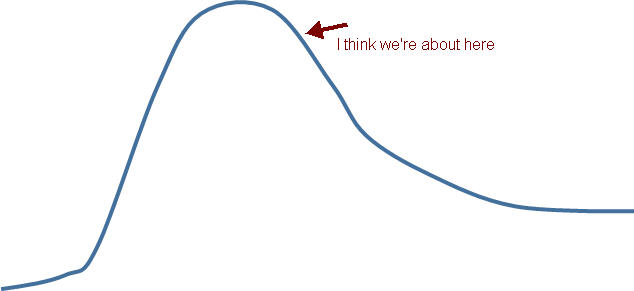
My gut feel is that indie publishing will follow a traditional bacterial growth curve, with logarithmic growth—as we have seen in the last few years—followed by a decline until it settles down to a stable position.
This is where I think we’re at
I don’t think it will go away. It has a place, and will be accepted alongside traditional publishing as a viable publishing option.
I do think, however, that the glory days of indie publishing are past us.
Getting back into a book you’ve left half completed is always interesting. Especially one we’ve left half-way through a draft, which we don’t normally do.
After we delivered the edits on book one we took a few days break and then it was back to book two. When we left it we were 104,000 words and 90% of the way through the story. The last thing we did before we stopped to work on book one was to outline what was going to happen at the end of book two.
Naturally, the first thing we did was read through it again.
It was bad. So very, very bad.
People say the second book is harder to write. I would agree. There’s a different sort of pressure, most of which you put on yourself. You want to deliver a book that’s as good as the first, so you’re trying to write a story like the first one instead of letting the second story fly alone. You have less time to write it in. We started writing Linesman in 2010. It is 2014 now. Linesman 2 has to be delivered in May 2015. That’s four years for the first book, one for the second. We are also trying to match the tone of book one—light-hearted—and it’s a tone you can’t force. Not only that, we provided a synopsis for book two which our editor accepted. We have to write to that basic story. That’s a constraint we’ve never had before.
Our reread showed that we struggled with all these things. The first half was literally a telling of what happened. It was so bad we were starting to think we’d have to rewrite the whole book. Especially those parts involving the main protagonist, which turned out to be one massive info dump after another.
Then, halfway through, the story picked up. It took half a book but we’d found the rhythm.
There were even moments when we went, “Oh, this is fun. I like this story.”
So we’re going to have to rewrite the first half of the book, but there’s a good story in there. One that we’re enjoying coming back to.