Categories
Writing process

Which stories will I nominate?

Dublin’s Samuel Beckett bridge, where I won’t be this August, but everyone going to Worldcon will. (We will be in Wellington next year, though. :-))

I’m a supporting member of Worldcon, which means I don’t get to go to the conference, but I do get to nominate and vote for the Hugo awards.

I read somewhere that less people nominate than vote for the awards, so since I’ve been a member I make a point of nominating, rather than just voting.

I feel as if I haven’t read a lot of the favorites this year. I’m not sure why. Whether we were just too busy writing, or whether I simply read a lot of old books. For example, I read Katherine Addison’s The Goblin Emperor twice. Cried both times, for all that it’s such a hopeful book. Maia is such a beautiful person.

But, that’s not talking about books I’ve read that are eligible to be nominated for this year’s Hugos.

Novels

I enjoyed John Scalzi’s The Collapsing Empire.

I read Naomi Novik’s Spinning Silver. I liked it better than I liked Uprooted, so that’s on my list.

C. L. Polk’s Witchmark, which I thought nobody but me had read by the publicity it was getting, but suddenly it’s popping up on a lot of lists—including the Nebula list.

There are a few 2018 books I have bought to read but haven’t yet. And I can’t vote for our own book, even though it was published last year, too. That would be unethical. So I’ll probably stick with nominating the three above. Unless I get caught up on some reading between now and the middle of the month.

Novellas

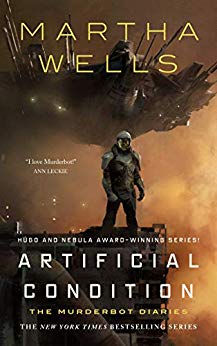
No question here. Martha Well’s Murderbot series. Artificial Condition, which was book two, and Rogue Protocol. Of the two, I preferred Rogue Protocol the most, but I enjoyed them both.

I read somewhere that in a book series like this, people often prefer the last book in the series. I don’t know how true that is, but I did think book three was best (out of two and three. All Systems Red is still my favorite.)

I’m voting for both of these.

If I get time I’d like to read Aliette de Bodard’s The Tea Master and the Detective. I’m intrigued by that one.

Best professional editor long form

It’s no surprise to say one of my nominees will be Anne Sowards. She’s our editor, and she’s great. If you want to see a list of books she edited in 2018, it’s here.

Best series?

I’m still thinking that one through. Still finding my way around the rules on that one.

Best movie

This wasn’t a big year for movies for me. I enjoyed Black Panther.

I won’t nominate Infinity War. It had some good parts, but it was too bitsy for me. There were too many characters to allow one storyline to shine. Except Thanos, so I suppose it was really Thanos’s story. If it was Thanos’s story, then the storyline complete.If it was an Avenger story, it didn’t. Most frustrating.

John W. Campbell

As for the best YA and the Campbell award, I’m still thinking these through. We’ll see what I’ve decided come March 15.
Categories
Writing process

Saving the minutiae of someone’s life

Status this week — so tired I created this post on Sunday and didn’t realize until Tuesday that I hadn’t actually taken it out of draft mode. Beware typos, that’s all I can say. I tend to omit words when I’m tired. Especially at work. The last two days some of my emails haven’t made sense. It’s getting embarrassing.


Packing up the after-effects of someone’s life, especially someone you love, is always depressing.  And you can’t keep everything, even if you want to, you don’t have the room.

It’s taken us a long time—nearly eighteen months—to clean out our mother’s house.  The big items are easy to get rid of.  Give it to someone in the family if they want it, pass it on to a local charity if they don’t.

It’s the little things that are harder.  Like letters.  What do you do with them?

Mum was a big letter writer and receiver, and she kept all the letters she received.  We’d find as we went through them we’d lose hours in the letters.  In the end we just kept moving the pile (that kept growing) as we emptied the house.

But finally, there’s nothing left but the letters, and we still have to make a decision as to what to do with them.

We can’t keep them all.  We don’t have the room. We don’t even want to read them all.  They’re her correspondence with her friends and family.  In some ways it feels rude to read them.

In the end, we’ll probably throw many of these letters out.

All over the world, other people are faced with the same decision we are. 

Mum is from the last generation of people who lived most of their lives offline.

From here on people started to live part of their lives online, and in future I imagine we’ll be able to search and find something about them. (Maybe, if we can get through the overload of information.)

But not for Mum.

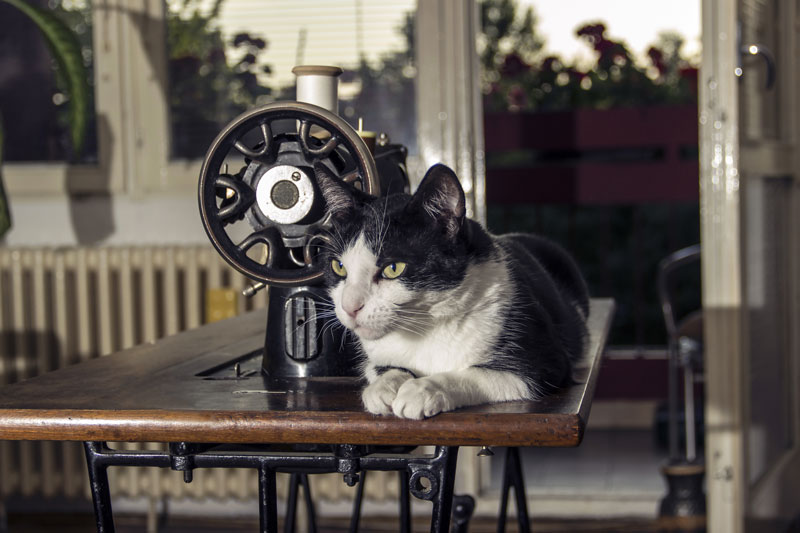
I can’t help wondering if, in years to come, we’ll wish we’d kept those letters instead of making room for the antique sewing machine.

Categories
Writing process

Moving the plot around

Book news

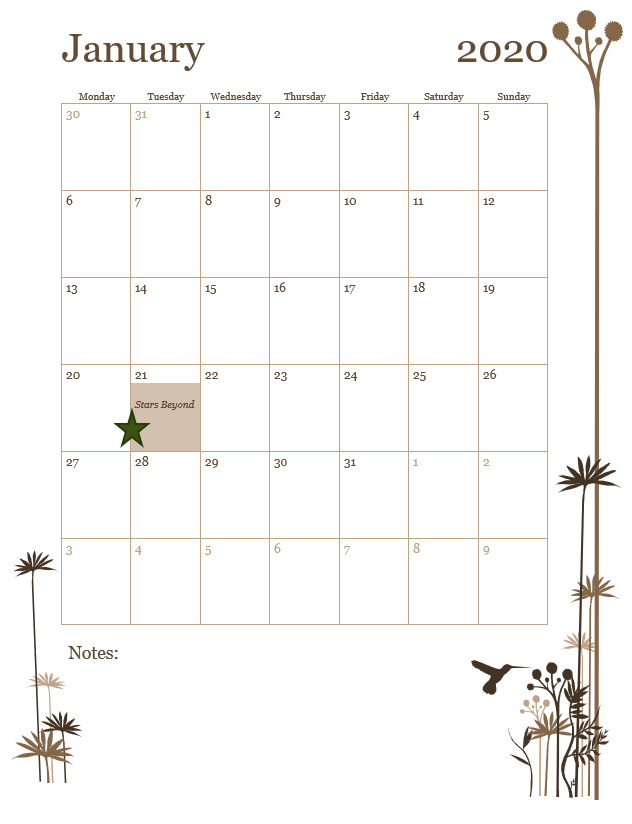
First, some book news. The publication date for Stars Beyond has changed. It’s now January 21, 2020.

The original date we were given was January 20, but that’s the Monday, and Tuesday is normal publication day. I see it’s in all the online bookstores as January 21, so I’m going with that date, rather than the 20th.

Plotting

While we’re waiting for the edits back from Anne, we’re working on another book. (We’re always working on a book.) We haven’t spoken to our agent about this one—yet—as we’d like to get it into better shape before we do. It’s one we’ve been working on a while. Past first draft, onto its fourth of fifth.

Last time we looked at this story, we thought it was okay. One draft away from sending to our agent.

We reread the story, still laughed at the funny bits, and still liked the characters. This time we saw a few things we could change, though. There were a couple of minor continuity issues, plus some very short chapters. One-or-two-page chapters, in fact.

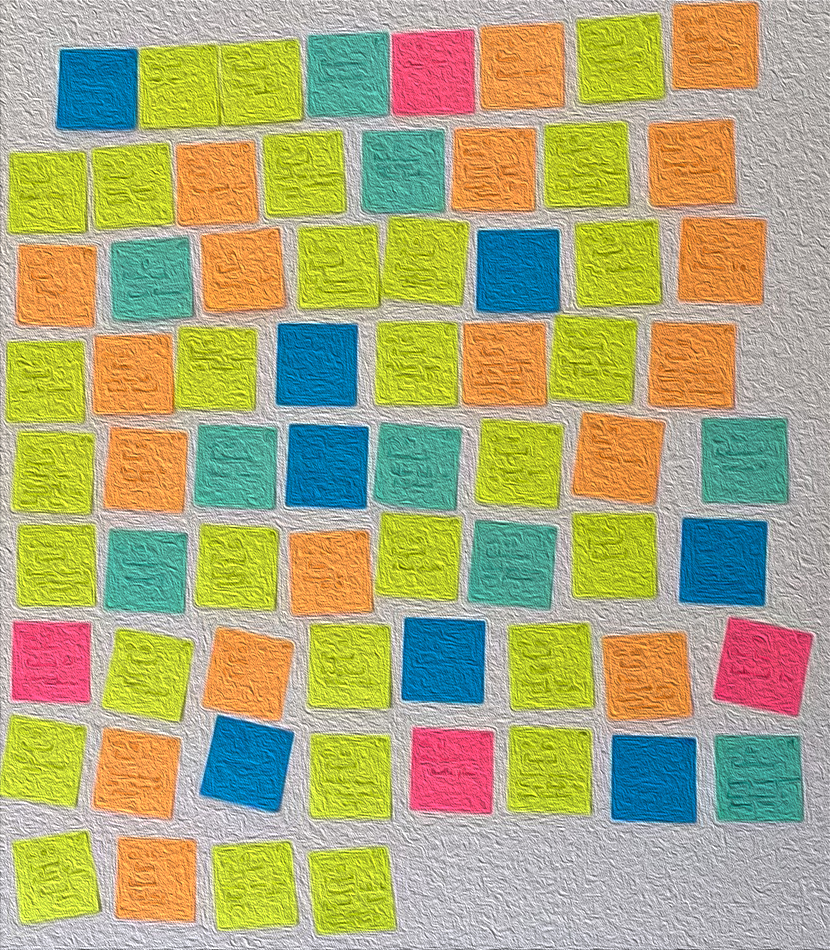
This is the difference time away from a story makes. Around about now in any story, we do a chapter outline. This is to ensure the story works, to see if there are any big holes, and to check if the timing works. Because we knew there were so many short chapters, this time we summarized each chapter in Post-It notes and put the Post-It notes onto a wall so we could move them around.

This is the first round. If you count, you will see sixty-eight Post-It notes. (Note that you can only see the Post-It notes, not the story, as we don’t want to give away the plot. :-))

The story is currently 105,000 words, and we go roughly 250 words per page. That makes each chapter on average around six pages. That’s short. We try to make them around 20 pages per chapter.

A little bit of reorganising is required.

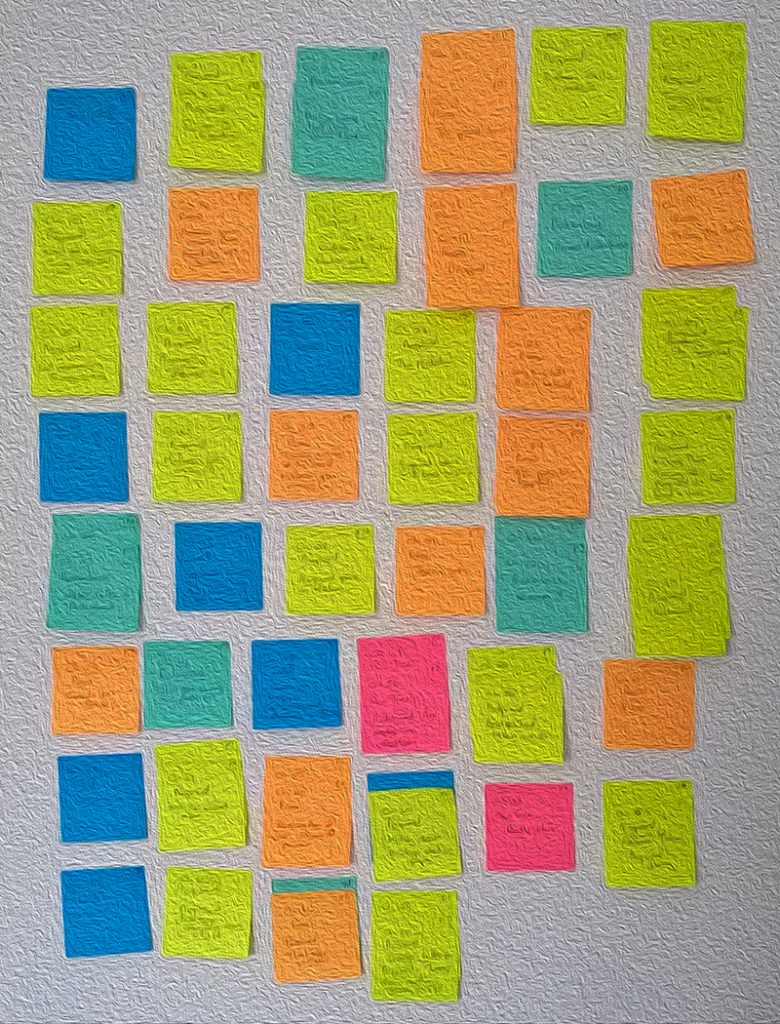
Note too, that the Post-Its are color-coded for character point-of-view. There are five colors on that wall. Two is good, one is better. Not five.

So, we reorganized.

We got down to forty-five Post-Its. That’s still too many, but it’s getting better. We’ll work on it. We even combined points-of-view in two places (the Post-Its that have two colors). We did a lot of moving around the story to get this far.

Maybe we’re not as finished as we think we are.

Categories
Writing process

Evolution of an idea. Maybe.

If dreams are your mind’s subconscious, then my mind is in dire straits right now. Every few weeks I have a dystopian dream. What’s more, I remember it when I wake up.

I find I dream three types of dreams.

Those I remember, those I don’t, and those where I don’t remember dreaming but I go to sleep thinking about something and wake in the morning to find whatever issue I’m thinking about—writing or real life—is solved, and I think I remember dreaming about it, but I’m not really sure.

The dreams I don’t remember are often good story dreams. I wake up and think, “Oh, that’s a brilliant idea. I must write that down.” By the time I have pen and paper in hand I’ve totally forgotten what the dream was about. Yet I know it was a good idea.

Those where my subconscious solves a problem for me may or may not be dreams, but I wake in the morning thinking, “Why is that even a problem, my characters can do this?”.

 Then I have these crazy dreams, roughly one a month, where an idea pops up that’s so horrible and I don’t want to write it.

Like last night’s dream, which was set in a future Earth where sea levels had risen with global warming. The action was all contained in a massive, high-rise former resort that had been built on an island. The lower levels were now flooded, of course, and everyone lived in the upper levels. The lifts didn’t work—of course—so they had to use the stairs, which were well-protected, or the lift wells, which were risky. The island it had been on (all underwater now) was isolated enough that the inhabitants seldom received visitors. There were dangerous storms at various times of the year.

The dream included political machinations, a visitor from beyond, war between the levels. All-in-all, your standard dystopic, closed system that you can read about in any of a hundred (probably thousands of) books right now.

Arrgh.

I told Sherylyn my dream. “If you want it, you can have it,” I said. Because sometimes an idea that one person doesn’t like appeals to the other, and they can turn it into a story both of us like.

“It sounds awful,” she said.

I walk around all morning with the idea still sitting in my mind. And eventually I realise … the dystopia has gone. I can’t remember the politics or the fights, or the visitor. Or not clear enough to describe any more. What I can remember is this massive building—big enough to hold 5,000 people—jutting up out of the ocean. Now that’s something I can use in a story.

Categories
Writing process

Celebrating book milestones

January 31 was a writing deadline for us. The rewrite of Stars Beyond was due to our editor.

There was the usual ‘do not press send’ moment where you open the email attachment—to check if you had sent the right document, and that it was formatted properly—only to see a really clunky, wince-making phrase on the first page, plus two clumsy transition sentences and another clunky turn of phrase on page two.  It’s not as if we haven’t spent months working on the thing, or that we haven’t read that page plenty of times before, but there’s something about that final email that makes poor writing stand out.  I wish my email had recall and resend.

Afterwards we ate dinner. We may have had a glass of wine (three days ago is a long time now), but I don’t recall. Work-wise, I was super busy and had something I needed to finish afterwards.

It got me thinking about how we celebrate book milestones, and what we do celebrate.

It seems to consist mostly of eating out and drinking a lot. 😊

Getting an agent

This was a celebratory dinner and a bottle of wine.

I have to say that so far this has been the most euphoric (as in, so happy) of all the celebrations, because it was the first.

In the twelve months before that our writing had also levelled up, we were writing fast.  We knew we were writing better and getting an agent was proof of that.

On getting the offer

We had a celebratory dinner out when Caitlin’s mail with the offer came through, along with her recommendation we accept.

The actual signing of the contract didn’t happen for months. That was close to the time we had to hand the book in to the editor, so it was much later. We had a nice wine to go with dinner for that.

On delivering the manuscript on the deadline due date

This is the date you are contracted to provide the manuscript to the editor.  We work hard in that month prior (especially Sherylyn) to polish the story. We’re exhausted by the end.

A glass of wine with dinner for that.

Receiving our first ARCs

Advanced reader copies are the pre-final proof versions of the book, sent out for publicity purposes. Until this time, you only ever handle the book electronically. This is the first time you have a physical book in your hand. Because of that, it’s almost a bigger buzz than publication day.

Publication date

Release day for Linesman was Sherylyn’s birthday. Plus, it was our first book, so we combined the two into a weekend shopping tour/overnight stay/celebration in the city.

For other books we’ve celebrated publication day with a home cooked dinner and wine.

We don’t do book launches. Our books are available for sale in the US. They’re difficult to get here in Australia except in specialty bookstores. Regular bookstores have to order them in. Thus publication date is a celebration just between us.

Selling Japanese rights for Linesman

Our first foreign rights. You guessed it. Wine and a nice dinner.

Contract for the two Stars Uncharted books

This time we celebrated when we had the contract in our hands to sign. We went to the Pancake Parlor for breakfast. No wine, because it was breakfast.

Neither of us likes pancakes, but we love the ambience of the restaurant. It is so easy to work on stories in there. It’s our go-to place to work out particularly knotty problems in a manuscript.


As you can see, we eat and drink our milestones. The best dinners, we’ve found, are simple. Nothing too fancy, just basics we love, like homemade pasta (literally, since we bought a pasta machine and love what’s coming out of it) with a simple sauce. Okay wine. Good company. Shared experience. We’ve been through the journey to produce the books, we celebrate the highs together.

Categories
On writing Writing process

What do you hear or see when you read?

Progress report – there’s always one last-minute fix

Sherylyn is doing a final read-through before we send our completed Stars Beyond manuscript in to our editor.

There’s always one change that you have to scramble to fix before the final send.

In this book, it’s this:

Our heroes have defeated one of the bad guys (bad girls) by knocking her out with a strong tranquilizer. Four paragraphs later (at the end of that same fight) up she pops, trying to kill them.

She’s supposed to be unconscious.

Hmm. It needs a little work, I think.

These are the embarrassing mistakes we hope don’t make it into the book. Thank goodness for editors. They pick up a lot of these things if they slip past us.

Now, back to the blog

A few weeks back, on Twitter, @shingworks asked people to vote on whether they heard words or saw images when they read novels. The comments are interesting.

It made me think about what I see/hear when I read books.

I lean toward the visual myself. I see the story as a movie, in scenes—with three important exceptions.

What do I see?

It’s like a dream, where you’re watching something unfold. People speak, and action happens, but I don’t hear them speak, I see their mouths move and know what they’re saying, but there’s no sound. Their words are automatically in my brain.

I also notice that even if the author provides a description of a character, I visualize my own character according to how they ‘sound’ in my head. (‘Sound’ here meaning how I visualize them.) I can sometimes go back and reread a book and find a character is, say, blonde with fair skin where I had imagined them as darker, with dark hair.

Interestingly, as I write this, I find I am reading the words aloud in my head, so I think that I write differently to the way I read.

What are those three exceptions?

I said there were three exceptions.

If the author describes sounds in the book, I often hear the sounds. Cars honking, street noise, the blast of a rocket taking off. Music in the background. (Although, if you describe specific songs that have iconic film clips, I will then also see the film clip. The graveyard and the wedding in Guns ‘N’ Roses November Rain, the faces in Queen’s Bohemian Rhapsody, driving into the country town in Cold Chisel’s Flame Trees.)

Secondly, if I hear an audio-book, sometimes I will hear the characters after that. I know that after hearing Emily Woo Zeller read Stars Uncharted, I have now started to hear Jacques and Carlos speak. They’re great. (The others are too, but she really added an extra dimension to these two.)

And of course, there’s the lines. In the Linesman books the lines have always sung for us.

Categories
Writing process

Revisiting an old post

We get a lot of questions from readers about whether we’d like to write more Linesman books.

We often refer them to an old post we wrote when we were starting to write Stars Uncharted which talks about some of the stories we’d like to cover in that universe.

If you’re interested, and haven’t read it, here’s the link. The post is titled So much to write, so little time.

Categories
Writing process

In the footsteps of the Lord of the Rings

Progress report

The last week has been super busy for us. It’s BICHOK* all the way. We’re onto the next draft of Stars Beyond, very conscious of the looming January deadline, writing fast. A month before the end if the novel and while we’re happy with how it’s going, we’d love two more months to polish it. (We don’t really, we’d just procrastinate until that last month. We always do have this last minute panic.)

The book still hasn’t got its final line. It’s done, and the bad guys vanquished, etc., but we never know how to finish these things properly. We’ll keep playing until the very last day.

In other news, our editor sent us a preview of the cover. We can’t show anyone yet, but we love it.

* BICHOK = Butt in chair, hands on keyboard

In the footsteps of the Lord of the Rings

Did you know that a Weta is a New Zealand insect? I didn’t. I do now.

The second tour we did on our Lord of the Rings New Zealand trip was ‘In the footsteps of the Lord of the Rings’, in Wellington. It included … wait for it … drumroll … you guessed it. A tour of a Weta workshop.

It wasn’t technically the Weta workshop (which was a little disappointing, because I really wanted to see their workspace). It was a purpose-built showroom where they took you around and showed you various bits that they’d built and it was pretty cool.

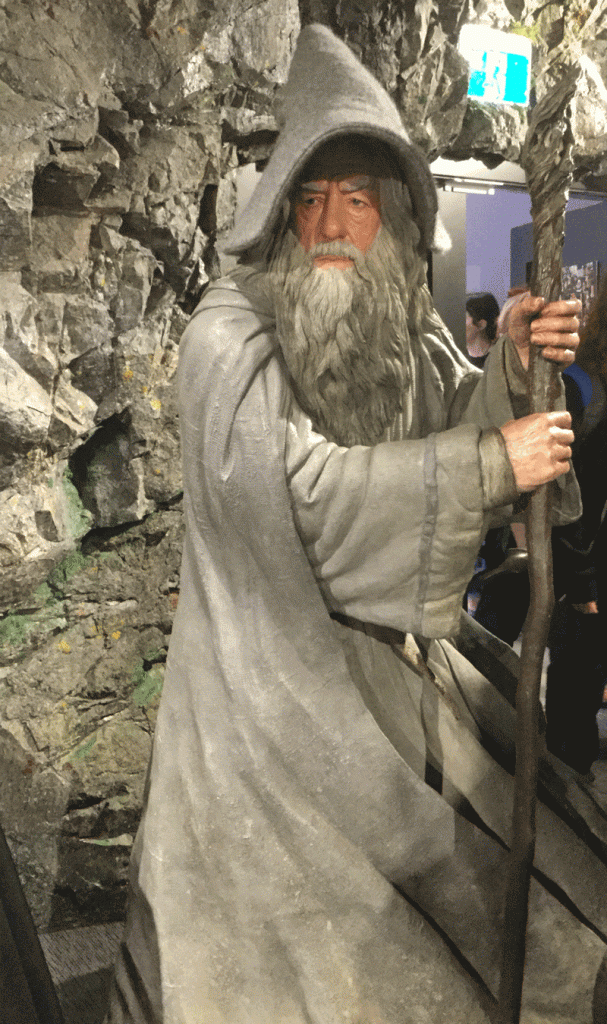
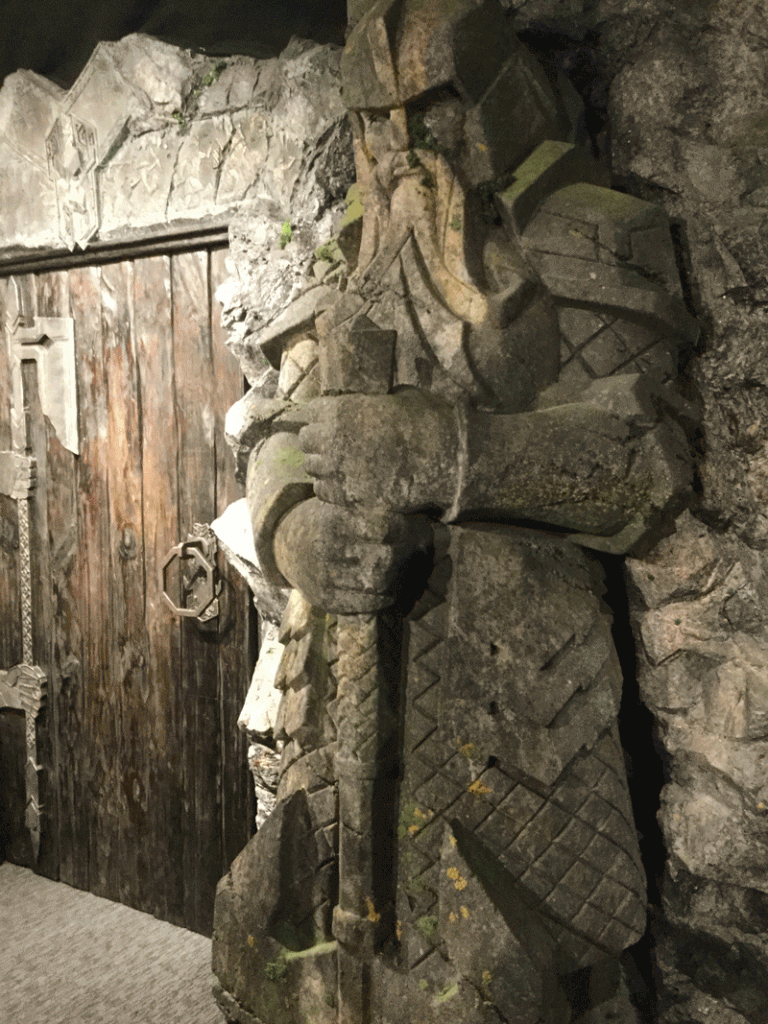
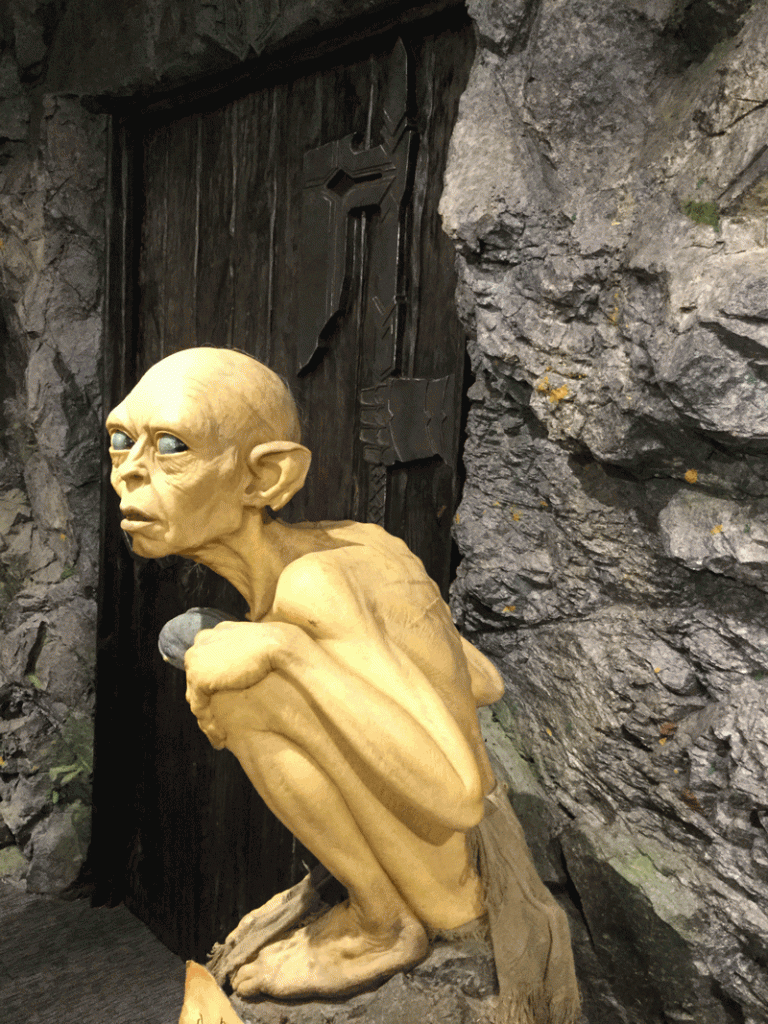
We were allowed to take photographs in the outer room (hence you see Gandalf, and Gollum, and the doorkeeper) but not once you went past the door. Gollum was amazing, by the way. It doesn’t show in the photograph, but his eyes seemed to follow you around the room.

The guide who showed us around worked at Weta (not as a tour guide, as one of the creators). Tip. If you want to work at Weta, I hope you’re at home right now, making things out of matches and pieces of wire and anything you can find around the house. You need to be able to think creatively about everyday objects and show that you can think outside the box.

Past the door we were taken to a series of rooms. I won’t list them all. There was a whole wall of weapons. Actually, I think there were two walls of weapons. One for technological weapons, one for swords and bows and things like that. There were monsters and non-human creatures. (Our guide passed around a hand.) We talked about latex, and how they don’t use it any more, because eventually everyone becomes allergic to it. John Rhys-Davies became particularly allergic, as he was in latex every day. Plus other good stories about the various items—not all of which were Lord of the Rings related.

The two things I loved most. One was the gun was one from District 9, which they passed around for us to hold. It was heavy, deliberately designed with added weight, so the actors didn’t look as if they were carrying around fake weapons. The other was Aragorn’s ranger costume. Sitting in the corner, discreet and quiet and just perfect for a ranger. We weren’t allowed to touch that.

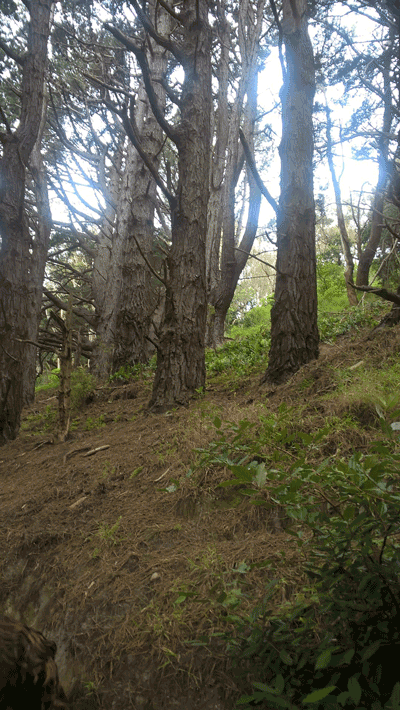
After Weta, we toured some of the locations around Wellington where Lord of the Rings was filmed. Including the site of the very first take. Can you recognise it? I didn’t, but most of the tour did. It’s where the hobbits tumble down the hill. We also saw where they hide from the Nazgul. I’m not sure if that was in the same location, just further down the hill, or another.

Our bus driver regaled us with stories about how, because they didn’t want people to know they were filming LOTR, the crew made the vans up to look like army vehicles and told everyone it was an army exercise. And how they made people up from local martial arts schools like the hobbits do the tumbling. How one of them tumbled the wrong way and missed the mattress below and dislocated his shoulder–and that was the take they used in the film.

On the way we got to see spectacular views of Wellington (including some amazing luxury homes along the beach), and got lots of entertaining gossip. Like how Viggo Mortensen, who is a method actor and used to stay in costume, got arrested at least twice for wearing a sword around the city.

Very entertaining, very interesting, very enjoyable.

Next week—Hobbiton. Come back if you want to hear about it.

Categories
Writing process

Books read 2018

I haven’t forgotten that I promised two more Lord of the Rings tours from New Zealand, but this is the end of the year and it’s time for our annual “Books we read and liked” over 2018.

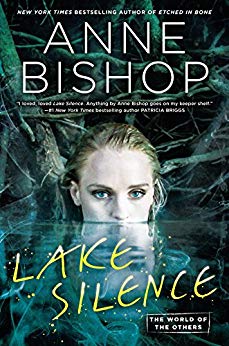
This was a year of classics.  We read, or re-read, a lot of what we deem the modern urban fantasy classics.  Ilona Andrew’s Kate Daniels books, Patricia Briggs’ Mercy Thompson books (first time reading these, and loved them). And, of course, there was a new Anne Bishop Others’ book, Lake Silence, which we read as soon as it came out.

We both read, and loved, the three Murderbot books that Martha Wells put out this year.  Artificial Condition, Rogue Protocol, and Exit Strategy. They were great.

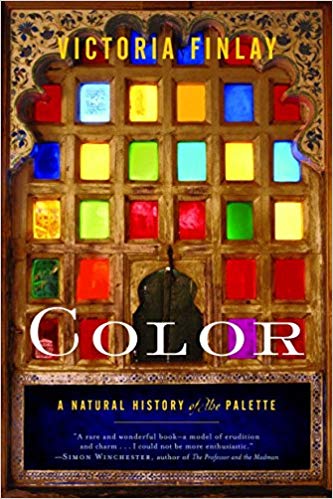
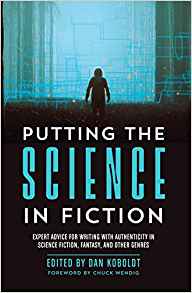
We also picked up a couple of non-fiction volumes. One of them is Color: A Natural History of the Palette by Victoria Finlay. It’s an older book, but very interesting, about how paint colors originally came about.  Highly recommended for any fantasy writer, chock-full of idea generating topics. The other is edited by Dan Koboldt and is called Putting the Science into Science Fiction. It’s posts from a website where experts talk about their fields of expertise, and some of the misconceptions that authors make.  It’s a fantastic book for generating science fiction ideas.

Expect some ideas for our novels to come out of those two books.  Particularly the one talking about color.

Recommendations for this year.  All the above books, of course, but we’ve picked out these two specifically.

Sherylyn recommends

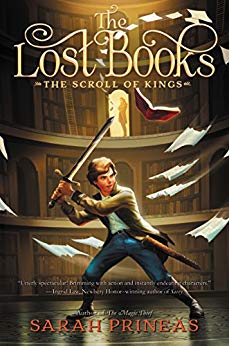
Sarah Prineas’s middle grade novel, The Lost Books, about a boy who wants to be a librarian.  (Funny how there are so many books about libraries and librarians around.)  (I loved it, too.)  One of the things we both loved about it was that even though Alex had run away from home, he still loved his family and they loved him.  (Hope that’s not a spoiler.)  If you like the Magic Thief series, you should like this book, too.

Karen recommends

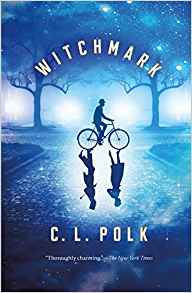
Witchmark by C. L. Polk.  I wanted to like this book because I loved the cover.  I’m glad it turned out to be a good story as well.  It’s a steampunk, WW1 era m/m fantasy, if you can imagine that, about a doctor, also a witch, who runs away from home because he doesn’t want to be enslaved to his sister. It sounds crazy but it works.

Next week, it’s back to New Zealand, and a tour of WETA.

Categories
Writing process

Who’s the smartest?

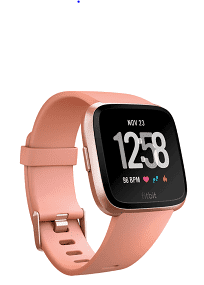
So my smart watch isn’t so smart when it doesn’t have its internet umbilical cord.

We’re cruising from Australia to New Zealand.  We don’t have internet.  (Well, we could have internet, if we choose to pay 79c per minute.  It gets cheaper the more you purchase, but the maximum package is ten hours for $199.  It feels like the internet prices you paid twenty years ago.)

But anyway, time-wise New Zealand is two hours in front of Australia, so we have to put our clocks forward.  And my Versa Fitbit, which is also my watch, can’t manage it.

So far as I can work out, you can’t change the time on the Fitbit. It has to be changed in the controlling program, which is on my pc at home.

There may be a way to change it otherwise, but I don’t know how.  So right now I’m going around with a watch that’s set to permanently two hours too slow.

I’d like to think that the smartphone isn’t that smart, but the phone is controlling me, really. I’m not controlling the phone.

That’s smart.