Categories
Writing tools

Triggering the memories

Sherylyn and I sat down the other night and planned six months’ worth of blogs we could write. Some of the ideas were truly interesting.  We know they were. Except …

We didn’t write them down, and six days later the memories are gone.

Some of them will come back over time, but right now neither of us can remember even one of them.

Many writers keep notebooks.  A scribbled note jotted down can trigger a memory months later that might turn into a book. Or talking through a problem piece—a week later when you need to use the solution you came up with, you need those notes.

Likewise, story ideas. Stars Uncharted, which is the story we just handed in to our editor, was an idea we had back around the time Linesman came out.   We had a contract to write two more books, but we quickly wrote down the first three chapters of this new story, then went back Linesman.

Thus when we were ready to start the new story, we had something to work with.  Because for us, stories take a long time to come together with other ideas, so that we have something to work with.

I was reminded of this the other day when Sherylyn was looking for her ‘ideas’ file.

Now, we’ve been burned with computers going awry in the past. Hard drives dying, computers eating our work, and so on.  We’ve learned.  We do daily backups of our novels now. If we ever become rich and famous someone could do a thesis on how we edit, for believe me, we have all the daily changes.

There are still ‘accidents’, but we’ve got the big stuff sorted.

The small stuff, not so much.  We often do take notes when we’re discussing story plot points or new ideas. Unfortunately, those notes are often on the paper napkins that come with a meal.  We put them into our bag and months later, throw them out. Or maybe use them when we need to wipe our hands.

We’re not super organised.

Likewise, Sherylyn knows her ideas folder is somewhere, she just doesn’t know where.

Every once in a while I do break out and buy a notebook. They’re useful, for a while, until I misplace them.  But I think that if I tried harder, and pulled the notebook out over our dinner talks, how much easier it would be later when I want to refer to what we talked about.

Especially if I was super-organised and transposed the ideas to my PC the following day.  And if I reorganised our files on the PC into something a tad more logical.  So the ideas were in a folder marked, say, ‘Ideas’.

Maybe I’ll give it a try.
Save

Categories
Writing process

Local politics in space opera

“People of Earth, your attention please … As you will no doubt be aware, the plans for development of the outlying regions of the Galaxy require the building of a hyperspatial express route through your star system, and regrettably your planet is one of those scheduled for demolition … There’s no point acting all surprised about it. All the planning charts and demolition orders have been on display in your local planning department in Alpha Centauri for fifty of your Earth years … What do you mean you’ve never been to Alpha Centauri? … it’s only four light years away … if you can’t be bothered to take an interest in local affairs that’s your own lookout.”

Douglas Adams, The Hitchhikers Guide to the Galaxy.

Local politics in space opera

Writing local politics in a space opera is a bit like the scene from The Hitchhikers Guide to the Galaxy, where the Vogon in charge of the destruction of Earth tells humans that Alpha Centauri is only four light years away.

No matter that to humans that distance is an impenetrable barrier, for people from other worlds, it’s not.  What happens on Earth is so insignificant as to mean nothing.  The aliens go down as far as the local planning office, and that’s where they stop.

If you’ve read the Hitchhiker’s Guide, you’ll know that the story starts with a similar planning event, but on a smaller scale.  Arthur Dent is protesting the loss of his own house to make way for an overpass.  This event wouldn’t register to the Vogons.  It’s a local event, too miniscule to matter.

There are close on 200 countries on Earth. Each of these has their own government. Oftentimes, these are broken down further into states, provinces, precincts and the like. But we also have an overarching body, the United Nations, who have representatives from most nations of the world.

If aliens arrived today and demanded to speak with a representative who could speak for all of Earth, who would we choose to represent us?

We have two choices.  If the alien stayed orbiting Earth, we’d probably send in someone from the United Nations.  If the alien landed in a specific country, then the rulers of that country might claim to speak for all humans.  At a guess, they’d land in one of the most populous countries, so the rulers of China or India would be speaking for the human race.

It is highly unlikely the aliens would deal with more than one group.

So going back to writing politics in science fiction.  When you’re dealing with multiple worlds, you don’t want to complicate the story with the small stuff. Even if a world, logically, has a number of governments, you tend to compress it together into one ruling body.

Which is why, in Linesman, Yaolin is ruled by a single council and Lancia is ruled by a single emperor.

Yes, but there are such things as democracies. Shouldn’t Lancia be a democracy?

The current ruling body of Earth (or what would be perceived as our ruling body by people on other worlds), the United Nations, is strongly pro-democracy. To many people—myself included—a well-run democracy is probably the best outcome for the political running of any country.

Even so, it’s not necessarily the logical endpoint for a governing body.

You have to work at democracies. If you don’t, they decay.  Little by little the process gets distorted as people in the government attempt to retain power or benefits for themselves. The people in charge subdue any oppression.  They bring in laws that prevent people from dissenting.  They create states of emergency that allow them to subdue information and dissent.  They stop having elections. Then finally, the leader of this no-longer democracy appoints a successor.  His son, or his daughter. Or some other close relative.

Alternatively, you might have a coup.  The army comes in.  A general takes over, stays in charge.  And finally, appoints a successor.  Guess who.

What about a people’s revolution?  We’ve seen a few of those in the past hundred years.  The revolutionaries put the lead revolutionary in charge. What happens then?  Who does he elect as his successor?

Sound familiar?  Of course it does. It happens over and over again.  We’ve seen it happen ourselves. We’re seeing it all over the world now.

People, once handed power like that, tend to pass that power on to their own family unless there are restrictions in place to prevent it.  Like democracy.

What’s the definition of power handed over from parent to child?

A monarchy.

That’s why Lancia is a monarchy.

Of course, the funny thing about monarchies is they tend to morph into democracies over time.

Save

Save

Categories
Books and movies

Amazon’s weekly charts

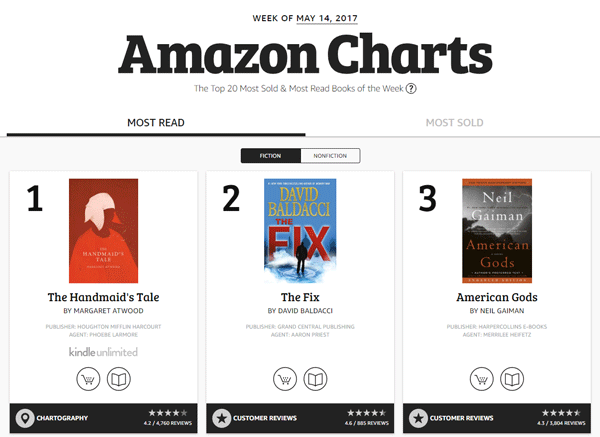
Amazon has started bringing out weekly book charts.  The top 20 books sold, and the top 20 books read

They do fiction and non-fiction. You can find them at https://www.amazon.com/charts.

Looking at the fiction lists, there are few surprises in the Books Sold.  These are the books you see in the display area of any bookshop.  The bestsellers are the same online and off.  Included among these are the books that have television or movie adaptions coming out soon.  Margaret Atwood’s The Handmaid’s Tale and Neil Gaiman’s American Gods.

There is one unexpected (to me) entrant.  Dr Suess’s, Oh, The Places You’ll Go comes in at number eight.

It’s when you get to the Books Read list that the results start to differ.  Putting aside the question of how Amazon knows what you’re reading—Big Brother is definitely watching us—the results are interesting.

Here’s the full May 14 list of the 20 most books read on Amazon.

  1. The Handmaid’s Tale, by Margaret Atwood
  2. The Fix, by David Baldacci
  3. American Gods, by Neil Gaiman
  4. Beneath a Scarlet Sky, by Mark Sullivan
  5. Golden Prey, by John Sandford
  6. Harry Potter and the Order of the Phoenix, by J.K. Rowling
  7. Into the Water, by Paula Hawkins
  8. Harry Potter and the Sorcerer’s Stone, by J.K. Rowling
  9. It, by Stephen King
  10. Harry Potter and the Goblet of Fire, by J.K. Rowling
  11. 16th Seduction, by James Patterson & Maxine Paetro
  12. Big Little Lies, by Liane Moriarty
  13. Beach Lawyer, by Avery Duff
  14. Dead Certain, by Adam Mitzner
  15. A Court of Wings and Ruin, by Sarah J. Maas
  16. Harry Potter and the Deathly Hallows, by J.K. Rowling
  17. A Gentleman in Moscow, by Amor Towles
  18. A Man Called Ove, by Fredrik Backman
  19. Harry Potter and the Half-Blood Prince, by J.K. Rowling
  20. The Black Book, by James Patterson & David Ellis

Sure, the bestsellers are in there, but look how many Harry Potter books there are.  Five.

There also looks to be a slight lag on buying books and reading them. I’m sure if we had charts from the previous weeks we’d see authors like Sarah J. Maas on the Books Sold list.

Movie/television adaptions The Handmaid’s Tale and American Gods are joined by Stephen King’s It.  Again, because we don’t have the prior week charts we can’t tell if these are new readers reading books they have just bought, or if readers who already owned the book are rereading it. I suspect it’s the latter.

It’s Harry Potter that’s the interesting.  I know J. K. Rowling still sells a lot of books, but I think a lot of those reads are rereads. People who own the books already, have read them before, and are re-reading them.

It’s what we do, as readers, with a book we like.

Save

Save

Save

Save

Categories
Fun stuff

It’s May. It must be Eurovision

It’s Eurovision time.

This year has gone fast. It seems only a few months back I was talking about last year’s Eurovision Song Contest. It’s one of the must-watch items on our television calendar, but lest you think all Australians watch it, they don’t.  Enough of us watch it that we’ve had an entrant in each of the last three years, but none of us know what we’d do if Australia won. (I know, we’re not part of Europe. As some journalist once said, just go with it.)  But it’s not a massive event on our social calendar. Not like, say Grand Final, or Melbourne Cup, which everyone watches.

We watch the final, which is on Sunday night Australian time.  It’s a delayed telecast, so we try not to watch until then. Or hear who won.  That’s why, as I post this, the competition is probably over, but I don’t know what’s happened yet, and I’m talking as if the semi-finals haven’t even happened.

So trends?  Men with high voices.  It felt like every second male sang high.

I’m a sucker for a power ballad.  There are a couple that get close, but no standout for me.  This year, my two stand-outs are songs that may not even make the finals.

How does rap yodel sound?

Ilinca, featuring Alex Florea, from Romania.

Or what about a little operatic background from Jaques Houdek, of Croatia? I’ve heard a version of this song without the deeper voice in the background.  I love the slightly-operatic version best.

Enjoy it, if you’re watching it. Have fun.

Categories
Fun stuff

Guardians of the Galaxy 2

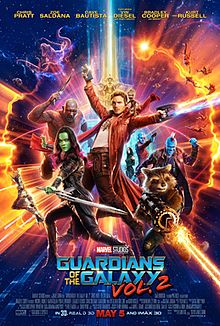
Yesterday we saw the Guardians of the Galaxy 2.

I’ve got a new favourite character.

I adore baby Groot.

The opening scene was gorgeous. A James Bond-style action sequence, with baby Groot dancing along to the music on the sidelines, and each of the main characters stopping in the middle of the battle to pick him up and take him out of danger.

Needless to say, I enjoyed the movie.

As I sat there, watching some of the fight scenes, I couldn’t help being a little envious.  In a movie like Guardians of the Galaxy, the fight scenes are over the top.  A novelist has to justify the odds.  If your characters are fighting and they’re outnumbered or out-skilled, you have to explain how they can win.

(Obviously, this thought comes directly from the fact that we struggled to have our protagonists in our next book win some of the fights when they’re up against some superior forces.)

Stay right till the end of the credits to see all the codas, .

Save

Save

Categories
Writing process

What does Fergus Burns sound like?

Famous non-classical baritones. (This picture comes straight from the Wikipedia entry List of Baritones in Non-Classical Music


The predominant feeling among the line sevens right now was a baritone eddy of hope. It hadn’t been there before, and it sounded a lot like Fergus.

Linesman


Back in Linesman, we never really gave much thought to the sound of line seven.  We knew what it did (even back then), but the sound?  There was that one throwaway line about it being a baritone and not much else.

When you’re writing a trilogy you don’t always consider how what you write in book one will impact what you write in future books.

Sometimes, serendipitously, something you write sparks an idea that becomes ‘the’ idea for a new story.

Terry Rossio, writer on Pirates of the Caribbean, once said, “Who knew the throwaway line, ‘Clearly, you’ve never been to Singapore’ would turn into movie three?” [Paraphrased here, because I can’t find the original quote.]

And sometimes you write throwaway lines like ‘a baritone eddy of hope … sounded a lot like Fergus’ and realise later that you never really thought of Fergus Burns as a baritone.  You’ve always thought of him as a tenor.

You can’t change something that’s written.  It took all of book two and part of book three to get into the mindset.  Fergus is a baritone. Fergus is a baritone. His voice is deeper than you think it is.

We’re getting there.

Elvis Presley was a baritone.  So were David Bowie and Johnny Cash.

Right now, we’re imagining his voice as a cross between Elvis Presley and Teddy Tahu Rhodes.

Save

Save

Save

Save

Save

Categories
Writing process

Answers to last week’s mystery fantasy quiz

Answers to last week’s mystery fantasy quiz.

Stop right here if you haven’t tried to answer the questions yourself, and go to last week’s post first.

Ready?

Categories
Fun stuff

Quiz Time—Fantasy Whodunnit

I love a good mystery novel. Even better, I love a good speculative fiction whodunnit.

Time for a quiz, I thought.  Science fiction mystery novels.

So I started writing the quiz.  Isaac Asimov’s Caves of Steel, Vernor Vinge’s Marooned in Real Time.  They were easy.

I need a minimum of five novels for a quiz.  I googled some more. And stopped, realising that I hadn’t read many of the more modern science fiction mysteries.

O…kay.  Science fiction mystery quiz on hold until I’ve read more of the SF mysteries that have been released in the last ten years, not in the last fifty.

But … I have read some fantasy mysteries more recently.  So, let’s do a quiz about that instead.

This is a mix of urban fantasy, Flintlock fantasy, and what I would call traditional fantasy.  They’re not all murder mysteries.  In at least one of the stories, it’s not a traditional murder but the protagonist is searching for someone. (And that’s as many clues as you get.  🙂 )

These books are from our bookshelves.

Mystery One

Someone is disembowelling children.  Not only that, they’re tattooing the arms (and thighs) of the victims, from wrist to elbow.  I’m from the local policing force; young, but I’ve been around the force a while.  My two companions in the investigation are the man who killed my friends when I was younger (not happy about him being along, as you can imagine), and a dragon.

Mystery Two

I am a constable at the Met (London Metropolitan Police).  While standing guard over a murder site one morning (the victim was beheaded), I speak to a witness.  There’s just a slight problem.  The witness is dead.

Mystery Three

I make a living finding dead people, seeing how they died.  In this first job I get called in to find the body of a missing woman who was murdered in what appears to be a murder-suicide.  Except it wasn’t. It turns out both the victims were murdered.  And in fact, the female victim’s sister was also murdered (a few months earlier).

Mystery Four

I am a disgraced magician.  I draw pictures that tell the truth.  I am forced into taking a lowly-paid job with the town coroner, sketching the newly deceased. My truthful sketch of a young, dead girl shows the child was from a wealthy family, and murdered.

Mystery Five

I live a double life as both myself and my private detective twin brother.  I take a job hunting for a missing aristocrat, who has run off with a mysterious machine that everyone, including the all-powerful Patent Office, is looking for.

How did you go?

Answers next week.

Save

Save

Save

Categories
Writing process

How different would fantasy novels be if there was no tipping?

Australians don’t tip.

Sure we’ll leave the coins at a restaurant after a meal, but that’s as far as we go.

That’s why, whenever you get to a country where tipping is required, you’ll find the first thing the Australians do is talk about tipping. Trying to get a feel of how much to tip, what to tip for, and so on.

We get used to it, but still find it awkward.

I was reminded of this on our recent trip to south-east Asia, because we tipped everywhere, and oftentimes it seemed it wasn’t so much a tip, as actual payment for service.  (I know that’s technically what a tip is, but to me it’s a tip when you are also making another base payment for that service. For example, when you have a meal, you pay for the meal. Then you tip as well.)

It got me thinking about what a tip was, and how different fantasy novels would be if there was no tipping.

Maybe no different at all?

First, we have to decide what is a tip and what is payment for services rendered.

Asking a stranger for information

Petra stopped a man dressed in well-made, but faded, clothing.  A scholar, she guessed, but not in a popular line of study, for otherwise his sponsors would have provided enough to keep him better clothed.

“Excuse me, but could you tell me the way to the Cascades?”

“The Cascades.”  His deep voice didn’t match his skinny frame or the freckles on his face.  He moved, and she saw the purple stains on the inside of his cloak. A chemist.  Definitely not a career someone looking for fame would choose.  “Lady, just follow everyone else.  They’re only going one way.”

Petra glanced at the crowd in front of her. There were six streets off the square. So far as she could see, people were going all ways.

She looked back at the scholar, raised a brow.

He pointed.  Past the square, half-way up the hill on the other side of town.  She could see tiny figures moving over there.  All going uphill.

“Thanks.”  Her feet were sore.  Her legs ached just thinking about the distance.

About now, in a regular fantasy novel, Petra would toss the informant a coin as thanks for his information.

But … in a regular fantasy novel you probably wouldn’t pick this particular guy to get information from, either.  You’d be more likely to choose a beggar, or an innkeeper. Someone who expects to be paid for the information they give.

Paying for bathwater

This one’s easy. Not everyone tips the innkeeper when they bring the hot water and the tub.  Many times you pay beforehand. Fee-for-service.


On reflection, maybe not much would change.  Because often what people do in fantasy is fee-for-service, rather than a tip.

Except perhaps, protagonists might get less information.

Save

Categories
Fun stuff

We’re back

The flight is only eight hours, and the time difference between the two cities is 2-3 hours (depending on daylight saving) so we shouldn’t be jet-lagged, but Singapore Airlines was determined to feed us. By the time we’d had dinner and settled, it was midnight, and they woke us at 4:00am to start breakfast.

We’re home from our international travels. A little bit tired. It’s an overnight trip from Singapore, leaving at 9pm, getting back into Melbourne at 6am. I even manged a couple of hours sleep, but we’re still sleeping most of today. Overnight travel drains you.

We’ve some local travel still to do (then back to work after Easter, sigh), but we’re back with consistent internet access. I can’t believe how much I rely on (reasonably priced) internet access nowadays.

We’ve a few comments and mails from readers. We’ll start replying to those as soon as we’re coherent enough to form full sentences.

Save

Save

Save

Save