Categories
On writing

If you’re an Australian writer who wants to sell in Australia

Is it just me, or is this the best time in years if you’re an Australian author and want to publish traditionally?

Back when we first started trying to sell our stories the major publishers weren’t open to non-agented submissions, they’d only deal with agents. As for agents, there only a handful and most of them had closed their books to new clients.

Nowadays, there seem to be a lot more agencies, and more of them are actively looking for new clients, although that seems to be swinging back the other way at the moment.

In Australia, having an agent is a choice not a necessity. Approximately 60% of books published in Australia are not represented by an agent, and many publishers have avenues available for manuscripts to be submitted directly by authors. Although having an agent will increase your manuscript’s chance of being meaningfully considered, it is not the only avenue.
Alex Adsett Publishing Services

Every major publisher now has a weekly or monthly slot where you can submit your story direct to the publisher. (Thank you, Louise Thurtell.) We have:

Plus there are some good, big prizes that can lead to publication as well.

And that’s all before you even start looking overseas.

Categories
On writing

When the sex of your characters makes you novel book-breakingly different

I have just finished reading my way through Rachel Bach’s Paradox series (Fortune’s Pawn, Honor’s Knight and Heaven’s Queen). It’s a good, rollicking space opera with a tough heroine.

Devi Morris isn’t your average mercenary. She has plans. Big ones. And a ton of ambition. It’s a combination that’s going to get her killed one day – but not just yet.
Fortune’s Pawn

The first thing I did when I’d finished the books was look up Rachel Bach (who also writes as Rachel Aaron) on the internet. As readers do.

I came across a link to an interview she did with Book Smugglers, back when Fortune’s Pawn first came out, where she talks about the question

Would [Fortune’s Pawn] have been [different] if the protagonist had been a man?
The Book Smugglers, ‘Rachel Bach on Upsetting the Default

(My paraphrasing here, combining two questions.)

As she says in the article,

Well, yes. Book-breakingly so, actually. My main character, Devi Morris, is a veteran powered armored mercenary who is extremely good at what she does. As you might expect given that background, she’s cocky, aggressive, and ambitious; a career soldier with a serious ego, major trust issues, and all the subtlety of a bull in a china shop…and if she’d been a dude, I would have hated him.

The very qualities that make Devi Devi–her pride, her pigheaded refusal to back down even when outnumbered, her fierce aggression–would be macho to the point of absurdity in a male character. A guy at the top of the food chain beating his chest at the world is just obnoxious, but the same behavior from a girl who has clawed her way up the ladder on nothing but grit, talent, and ambition is brave and admirable and a little dangerous.

The Book Smugglers, ‘Rachel Bach on Upsetting the Default

She is so right.

Book-breakingly right.

Daniel Swenson talked about how changing the sex of his protagonist from male to female

… changed Orison from a book I thought was merely okay to one I’m really quite proud of. Even my editor said, rather emphatically, “Story could never be a man! Story as a man = boring. Story as a woman = awesome.”

Daniel Swenson, Why I gender flipped my protagonist

Book-breakingly right again.

Amie Kaufman and Meagan Spooner, who are writing the Starbound trilogy, sometimes gender flip some of their characters to avoid stereotypes.

“What we do is go through every single character, gender-flip them and then just ask: ‘Does this bug us?'”

Marama Whyte, ‘These Broken Stars’ author Aime Kaufman on the power of gender-flipping characters

Back when we first sent Linesman off to our agent one of the first suggestions she came back with was, “Have you considered making [major secondary character] female instead of male?”

After a bit of angst (i.e. me saying “No way,” and Sherylyn saying, “That’s not a bad idea, why don’t we try it”) we did.

Now, of course, we cannot imagine this particular character as a male. A male in that position would weaken the whole story, by making it so much more just like every other story out there.

Sometimes an ordinary story can be made so much better by cutting some of the stereotypes that bind us.

Categories
On writing

Procrastinating about writing

From last year’s BuzzFeed’s 29 Words that mean something totally different when you are a writer

Word 13: #amwriting

What it means: A twitter hashtag used to denote when a writer is sitting down to work on a story.

What it means when you’re a writer: #amtweeting.

Yes folks, today and yesterday, I am procrastinating by surfing the net. I went through three years’ worth of Flogging the Quill judging whether I’d read on past the first page or not. Went back and re-read two years of Query Shark queries. Checked Feedly to see any of the bloggers I read regularly had blogged in the interim. Went back to twitter to see what had been tweeted in the interim.

What that means, writing-wise, is that it’s time for the co-writer to step in.

Hooray for co-writers, and sharing the writing load.

Word 14: Weekend

What it means: A break at the end of the working week used primarily for leisure, typically Saturday and Sunday.

What it means when you’re a writer: Something other people have.

Categories
Talking about things

Some sideways thoughts about the Hugos and that Game of Thrones episode

There are many Game of Thrones episodes that could be referred to as that episode but the one I’m talking about today is season five’s ‘Unbowed, Unbent, Unbroken’.

I haven’t read Game of Thrones. I haven’t seen the television series. Like many people I know about the series through osmosis, because you can’t get away from it. I enjoy the surrounding commentary, however. I don’t know what that says about me, because while I enjoy the commentary I have never been tempted to read the books or see the show.

If everyone loved the same stories it would be a boring world.

Thus I had not had much to do with George R. R. Martin until I read his blogs about this year’s Hugo awards and Puppygate*. I thought they were fantastic, and summed it up well.

So I’m using George R. R. Martin as an excuse to combine two disparate topics into one. The Hugos, and the episode that for a lot of viewers might be the turning point for whether they continue to watch Game of Thrones.

The Hugos

Best novel

Many people will vote for Cixin Liu’s Three Body Problem (translated by Ken Liu) because they loved the book. I suspect it will also pick up votes because many people see it as the only untarnished nominee. (Confession, I have never been able to read past the first bit, where the government kills the girl’s father. Like I say, different books appeal to different people.)

Jim Butcher may be an outside chance. A lot of Hugo voters enjoy his work, it would never have occurred to most of them to nominate an urban fantasy like his.

I really hope voters remember that neither Anne Leckie’s Ancillary Sword, nor Katherine Addison’s The Goblin Emperor were on the Sad Puppies slate. These two books were nominated on their own merits, even when they had a whole slate of puppy-nominations against them. I’d love to see either of these books win. Better yet, I’d love to see them as equal winners.

Best dramatic presentation, long form

So many good movies came out last year. Every one of them deserves to be on the list. Edge of Tomorrow is the most underrated of the five movies there, but I thought it was great.

Best editor, long form

Our editor is Anne Sowards, from Ace Roc books at Penguin Random House. We were delighted when we heard she’d been nominated for a Hugo. Then the Puppygate wildfire really took off and what should have been something to enjoy turned into something nasty (my words, for we haven’t spoken to Anne about this), for Anne was one of the people on both the Sad Puppies and Rabid Puppies slates.

I’m sorry about the way it happened, but I believe Anne deserves to be there. (I think Sheila Gilbert does too.) I’d like to see Anne win, but I think that whoever wins this year will feel the award is tarnished.

I hope she’s there next year too, under better circumstances.

That Game of Thrones episode

Unbowed, Unbent, Unbroken

You’d have to be visiting a very different world wide web to me if you haven’t heard about the Game of Thrones episode Unbowed, Unbent, Unbroken.

In this episode, Sansa Stark is raped, and it started a whole storm of protest about rape as a plot device.

The weird thing is, Game of Thrones is all about rape and the disempowerment of women. Chuck Wendig describes it as almost the “Where’s Waldo**” of Game of Thrones (We are not things). As in, where’s the rape in this episode?

It’s one of the reasons the book never appealed.

First, a recap on what happened.

The producers wanted to give Sansa Stark a larger role than she has in the book. Plus they wanted to streamline the plot and reduce the number of characters. So they merged Sansa Stark’s storyline with that of Jeyne Poole. I think (because I haven’t read the books) that Jeyne Poole always was raped at this particular time, by the man who now rapes Sansa.

This isn’t the first rape scene in Game of Thrones. It’s unlikely to be the last. But this one hit a nerve.

Before we dive into why we felt this was a choice which would cause us to stop promoting the show, allow us to say something very important: rape is not a necessary plot device. Really think about that before shouting “creative freedom” in our direction, please.

The show has creators. They make the choices. They chose to use rape as a plot device. Again.

Mary Sue – We will no longer be promoting Game of Thrones

It’s different when it happens to someone you know

Yes, it’s a story, but viewers knew Sansa Stark. They’d spent seasons with her, watching her grow in strength, only to be pushed down to that horrible place she started.

Sure, there were other factors involved. This is the first series where the producers are in front of the book, so viewers didn’t know what to expect.

There’s a bit of series fatigue. Something that might turn your stomach in the earlier episodes, but that you will still watch because it’s a great show and there’s nothing else like it on television, is less tolerable in later episodes. Particularly if you barely held on because of the ick factor in earlier scenes.

It’s repetitive. Same old, same old. Where’s the rape scene in this episode? Enough is enough.

Most of all, it’s different when it’s someone you know. It’s a lot more shocking. It’s a lot more real.

Desensitisation

I read a sickening report in the paper this morning about some children who invited a younger boy to play with them, and who then stoned, strangled and stabbed the boy to death. This happened in a place where thousands of people have been killed in turf wars between the drug cartels. According to the prosecutor,  the children have been desensitised by the violence around them, with the children reflecting what they experience every day.

Television violence desensitises too. If the outcome of what happened to Sansa Stark in Unbowed, Unbent, Unbroken leads to less producers choosing ‘rape as a plot device’, it can only be a good thing.


* I’m only linking to the first one. He wrote a lot of words about it. They’re well worth reading.
** “Where’s Wally?” in Australia.

Categories
Writing process

Reading between the lines

We had dinner with one of our beta readers last night. They’d just read Linesman book two (ALLIANCE), and were giving feedback.

Naturally, conversation revolved around ‘the book’.

Most readers, not counting professional editors, can’t tell you what’s wrong with a story. They can only tell you how they felt about it. I’m the same. For example, I can tell you that I don’t like a character, but sometimes it’s hard to put a finger on what I don’t like.

Our beta reader liked the characters, and was generally positive about the book . He didn’t pick out any specific issues, so it was up to us to pick out what needed fixing.

You can do this, you just have to listen.

He said, quite early on, that he:

“… couldn’t remember the names of the characters from book one for a while. It wasn’t until about chapter six that I started to remember who was who.”

Us: “So what do you think was wrong?”

“Nothing. It was fine once I worked out who was who.”

He mentioned those same chapters a few times during the night, even though he said different things every time.

It’s obvious we have a problem there. Whether it’s people soup, or too much happening without letting the reader pause to reflect, or something else altogether, there’s something wrong with the start of the book.

All we need to do now is work out what it is, and fix it.

Categories
Writing process

Blackberries as weeds

I went to a local craft market today. One stall was selling home-made jams. Blackberry jam, and it looked lovely.

When we were kids, we lived in the country. We’d go blackberrying down by the creek and come home with old ice-cream containers of luscious, ripe berries warmed by the sun. Of course, we’d eat most of them before we got home.

I can’t remember if Mum made blackberry jam. I do remember blackberries and cream. With sugar. In those days everyone put sugar in their cream. We’d never do that now, the fruit is sweet enough.

In Australia, the blackberry is a weed. In fact, it’s one of our most noxious weeds. It’s invasive. Once it takes hold it’s hard to get rid of, and it grows almost anywhere. I don’t remember how they got rid of blackberries when we were young. I remember some patches being burned, and some being bulldozed. As we got older the farmers and the local councils started spraying them. As an adult I remember that we didn’t eat wild blackberries any more, because of the spray.

Even as kids—they were weeds. Sure, they tasted great, and we loved to eat them. But I’ve never been able to buy any.

I turned away to the next stall. The stall-holder there was selling home-made nougat. Salt and chocolate.

Yum.

Categories
Fun stuff

May means Eurovision song contest

It’s May. Eurovision time.

It’s tradition in our household to sit down on Eurovision finals night and score our own winners. Come 23 May, that’s what we’ll be doing, hoping that we haven’t heard the results beforehand because Australia normally has a delayed telecast.

This year Australia has a contestant. I’m not sure how we managed that. We’re on the other side of the world. But … we’ll judge Guy on the same criteria as we’ll judge the other contestants and see how we go.

Personally, I’m a sucker for power ballads. Give me a song that ends strongly and I’ll vote it high every time. I don’t often pick the winner.

Like most songs, your opinion of them changes the more you hear them. I generally like the winner better second time around.

There are some strong songs this year, and I haven’t heard all the participants yet. My power ballad picks so far are Russia and Greece.


Gut feel, Estonia will go close to winning.


Categories
Book news

Book news

ARC_Linesman

ARCs for LINESMAN

Early this week we got advanced reader copies (ARCs) for LINESMAN.

ARCs are the typeset versions of the book before the final proofing. The cover is plain—you can see that by the photo—and it still has some typos in it, but it looks like a book.

We haven’t worked out what to do with all them yet, but we’ll get there.

ALLIANCE delivered

Our second book, tentatively titled ALLIANCE, has been sent to our editor.

From here we sit back and wait* until she comes back with changes for us to make.

We honestly don’t know what she’ll make of book two. We’re still in that newbie stage where we can’t truly judge our own writing.

The story’s probably okay, but does it work as a second book in a series? Have we delivered what the editor was expecting? Is it a book that readers of LINESMAN will like? We’re over our word count, could we have tidied the book up more?

* We don’t wait really. We write. We’re deep into the first draft of book three, which is coming along well.

Book three

According to our writing plan, we should be half-way through the first draft of book three by now. We’re not that far yet, but we’re happy with how it’s going. The writing is first-draft awful, but the story works.

Categories
On writing

The first draft

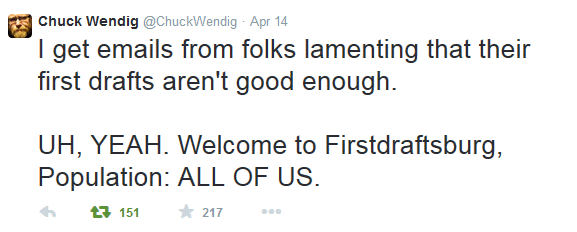
Chuck Wendig dispenses great writing advice. Check him out.
A recent tweet from Chuck Wendig

Yes well.

We’re still writing the first draft of Linesman 3. When I opened it this morning this was where we were up to.

Ean’s stomach flipped queasily.

How on Earth (or should that be how in the lines?) does a stomach flip queasily? I have visions of a stomach with tiny hands and feet, doing somersaults. But how does it do it queasily? Somersaulting like it’s going to be sick?

The mind boggles.

Like the man says. Welcome to Firstdraftsburg.


Categories
On writing

Writers writing together

We’re always interested in how other writers co-write together, and thus read Eric Del Carlo’s roundtable on Locus—When Is the Right Time to Collaborate—with interest.

Eric collaborated with his father. He wrote one character’s point-of-view. His father, Victor, wrote the other.  As Eric says

… was it smart for Vic and I to write a book together? On paper, hell no. It was the endeavor of madmen. You can’t hope to collude on an intricate, character driven novel without an anatomizing outline. A person doesn’t wait until he’s in his post-stroke seventies to make his push at being a novelist. No one does that. I was foolish to suggest it.

Yet we did it. The time was all wrong, but the magic was just right.

We didn’t plan our own writing partnership either. We just ended up writing together.

While I would encourage writers to come up with an agreement and a plan before they start writing together, sometimes it seems that the ones that just ‘happen’ work out the best.