I’ve three old, screwed-up paper serviettes in my bag. I can’t throw them out, because I’ve written on them, and because I come home from work and dump my bag and don’t look into it until the next day. As a result these little notes remain until I remember them. After which they stay on my desk for a few weeks until I finally get around to putting them onto the computer.
They’re my story ideas.
They’re the ideas that I have while I’m out, where I snatch the nearest thing to hand and scribble down the fragment that comes to mind.
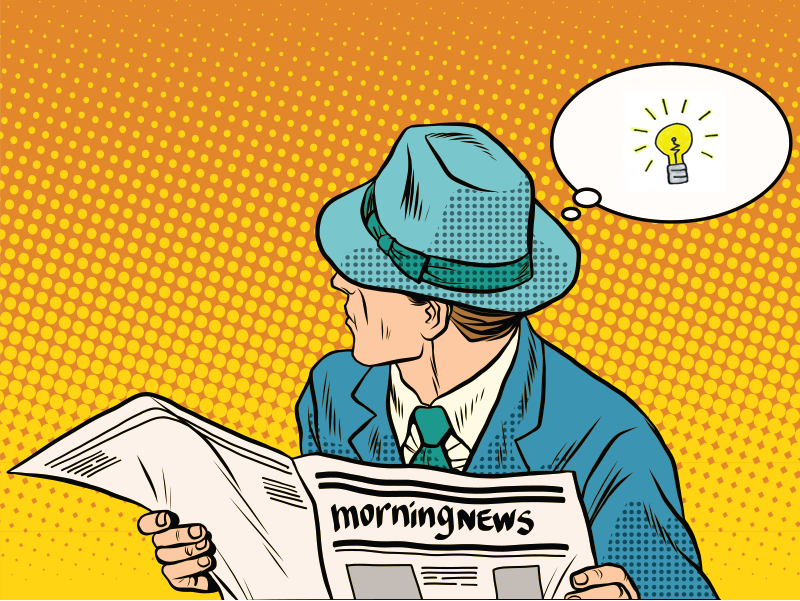
The thing is, I often have these ideas while I’m out, at breakfast, reading the newspaper.
I get most of my news online now. I read the news online, have a number of news sites that I visit, but that only gives you the news you choose to read. Printed newspapers are, and always have been, a major source of ideas for me. For both of us.
That and printed magazines. I used to regularly buy the New Scientist and Scientific American magazines, just for the ideas. Now I look at that online too.
Nowadays, the only time I look at newspapers is when I’m out. Cafes, at breakfast time, are the main places I read on paper now.
There’s something about reading a printed news source. Your eye catches an article—something you wouldn’t even think to read normally. Eye-brain triggers something. An idea pops into your head.
Quick, where’s the notepad? Haven’t got it? Anything will do. What about a spare paper napkin?
Which is how I come to have so many scribbled notes in my bag, waiting to be transferred to the computer.
Of course, my handwriting is so bad, by the time I come to transfer them, there are always a couple of words I have to guess, because I have no idea what I wrote. But sometimes that simply adds to the idea.
“The ebook is a stupid product. It is exactly the same as print, except it’s electronic. There is no creativity, no enhancement, no real digital experience.”
It’s a book. and books took six hundred years to settle into what they are today.
Why do people insist on trying to turn the ebook into something it doesn’t need to be? Is there anything wrong with a book simply in a different format?
As a reader, all I want between me and my imagination is printed words. That’s what makes reading so much fun. I work out the rest. It’s my world, my interpretation of it.
I don’t need to be distracted from that by things that pull me out of the story.
I read ebooks more than I read paperback for two reasons. First, space. Space in my bag, space in my house. Second, portability. I can start reading on my PC at home, or my iPad, but while I’m waiting for the tram I’ll pull out my phone and read it on there, instead. (Space again, because I already carry a computer around in my bag.)
There’s also the added advantage that I get to save a few trees while I’m reading.
Enhanced ebooks. They’re called movies. They’re called computer games. They’re called choose your own adventures. And a whole lot of other things, too.
The book—paper or electronic—is the medium, not the message.
Oh, and by the way, the ebook is evolving, just not the way most people anticipated.
A white room, and how you would see it under infrared.
But first … a Goodreads giveaway.
The advanced reader copies (ARCs) for Stars Uncharted arrived at the editor’s office the other day. We haven’t seen them yet, but our editor says they look good.
Then, lo and behold, Sherylyn is searching Goodreads and what does she see? A giveaway. ARCs for Stars Uncharted. The Ace marketing department is on the ball. And they’re giving away lots of copies.
So, if you want to read an advanced copy of Stars Uncharted, head over to Goodreads and enter the giveaway. They’re giving away 30 copies, so the odds are good.
The giveaway ends on 1 March. Go for it.
And second
Warning: Australian spelling. Colour is one of those words that can jar when you see it spelt with a u if you’re not used to it. The u is meant to be there. (Remember, grey is a colour, but gray is a color. :-))
The internet is a writer’s research paradise
Back in my early working days I worked on online shopping software for a hardware company. It was an old green-screen program, with a modem that plugged into the phone line. (Showing my age here.) I forget how the whole thing worked, all I know is that the buyer logged into the computer, dialled the hardware company’s computer, connected, and then laboriously loaded their order in.
Sometimes the phone line dropped out part-way through. When that happened, the poor buyer had to dial back in and start the whole process again.
Even I, working in the computer industry, wondered if online shopping would ever take off.
Look at us now, buying books and other things online with one click.
Online shopping is wonderful, of course, but there’s another part of the world wide web that is a writer’s paradise.
Research.
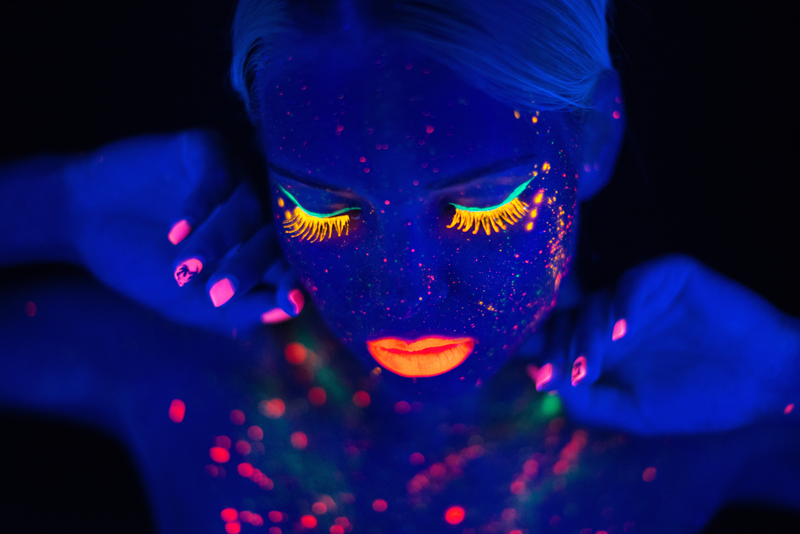
In the second Stars Uncharted book we have a character who can see into the infrared and ultra violet spectrums.
Where do we start even thinking about what he might see?
Once upon a time we’d have hit the libraries. Not just the local library, either, but some of the university libraries. It would be a long and arduous process.
Now we hit the internet first.
Yes, there is a lot of incorrect information on the internet, but it’s a great starting point for research. People put some amazing stuff on there. Especially the science. And the architecture, and the pictures of places, and the … I could go on forever. There is so much good information, good images, good detail.
This is exactly the sort of research we need for our book.
What did we get out of this?
If our guy can see fully through the visible spectrum and into ultra violet and infrared, how might he do it? (He’s been modded. Modding is introduced in Stars Uncharted.)
Here’s what we got just from the Morgans List article above.
Birds are tetrachromats. Their four types of cone cells let them see red, green, blue and ultra violet together
Dogs only have two cones, blue and yellow but not red and green. Their vision can be compared to a human who is colour blind
Mantis shrimps use a set of filters to separate ultraviolet light into discrete colours that get picked up by the animal’s photoreceptors
Bees have colour receptors for blue and green but also for the UV spectrum
There is so much information here.
From here we look up rods and cones and photoreceptors, and the information expands.
Art, created specifically for photographing in ultra-violet light
How much research is enough?
Yes, even soft science fiction requires research.
It’s a rabbit hole, and it’s easy to fall into a research heaven and reader hell.Putting all that lovely research into your book, because it’s interesting, and because you know it now.
That’s why, nowadays, when writing the first draft of a book we stop at the internet research.
We make notes on what we think is important, but enough is enough. Later on, once the book is closer to completion, we go over some of the science to be sure it’s as correct as we can make it. Talk to experts, if we can. Research more.
Science fiction still needs to make that leap from science to fiction
You can research as much as you like, but somewhere along the way, as a science fiction writer, you have to make the leap that takes you away from real science into the science fiction.
We did that with Stars Uncharted.
Elements high in the periodic table are unstable. They take massive equipment to generate, and they only last for a fraction of a second. But there’s a theory called the island of stability, where the protons and neutrons in the atoms balance (magic numbers) and remain stable, meaning that the element might remain stable too.
You won’t find the island of stability or magic numbers in Stars Uncharted (at least, I don’t think you will), but it was such a cool idea. We had to use it.
* Morgans Lists—it’s not clear if Morgans Lists the name of the site or the name of the author. Apologies if I’ve failed to credit the author. (And if you are the author, let me know, because it’s a beautiful list.) The site is now on Google+.
Back when we were writing Alliance there was a schoolgirl helping out at the hairdressing salon Sherylyn goes to. She was in her fifth year at secondary school. Her name was Pearl*. Pearl was a lovely, talented, outgoing girl, and she wanted to be in our book.
“Name one of your characters after me. Please. I’ll take your book to school and show everyone my name is there.”
“We’ll see,” we said. “But we’re not promising anything.”
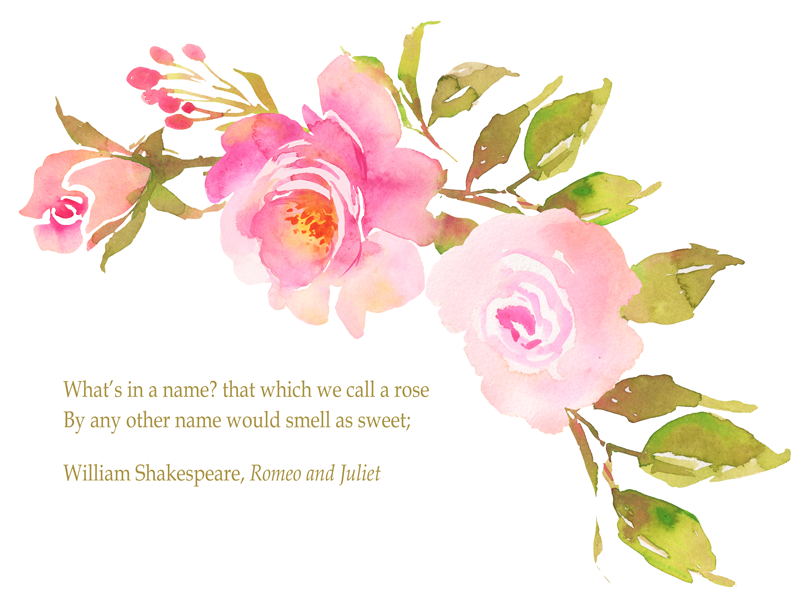
Because for us, naming the character is one of the first things we settle on, and until we have that name, the character isn’t really a character, they’re just a nebulous nonentity. Some people say the character grows to suit their name. For us, the name makes the character who he or she is.
We did think about renaming one of our characters for Pearl, but we knew she’d want to be a main character. Or at least, a secondary character with some page time.
There was only one character she could possibly be.
Spacer Darelani Tinatin.
We couldn’t change Tinatin to Pearl. It would have changed Tinatin’s character altogether.
Pearl Tinatin might have worked, because we only ever used Tinatin’s first name the once, but Pearl wanted something she could point to in the book to show, “Look, this is me.” One mention didn’t cut it.
Pearl wouldn’t even have liked Tinatin. She wanted to be the hero.
Pearl left the salon before we had to make a decision on the names. Which was somewhat of a relief, actually.
It has taught us one thing. Don’t say, “We’ll see,” to a question like that, because people take that to mean, “Yes.”
So if you ask us to put you into one of our books, you’ll understand why our answer will be a flat-out, “Sorry, but no.”
* It wasn’t really, it was another jewel name, but we’ve changed her name so we can write about her.
The Locus Poll and Survey opened on 1 February. This allows you to nominate best science fiction, fantasy, horror, YA and debut novels, among other things. The results are presented at the Locus Awards in June.
The categories are a lot like the Hugos and the Nebulas, except that instead of just a single best novel of speculative fiction, they divide the best novel prize into separate science fiction, fantasy, horror and young adult categories.
When I was younger the awards didn’t seem as prominent as they are now. I don’t know if that’s just my perception, but the internet seems to have made them more dominant that they used to be.
I like the way they showcase the best novels in each major sub-genre of speculative fiction.
It’s the one poll I vote in. (Normally, anyway. This year, for the first time, I became a supporting member of WorldCon, which means I can also vote for the Hugos.)
So I had my list of novels I wanted to vote for. Skipped the ones, like horror, that I don’t read, and went down the list.
For novels, I vote for stories that have the trifecta. Great characters, interesting stories, excellent world-building.
When I got to the shorter stories, however, I have different criteria.
I only need one or two of these to consider a shorter story nomination-worthy.
The story that I marked as my number one novelette choice had a tired plot, and while the main character was good, no one else stood out. But the world-building, and the idea behind it. Oh, wow.
Ghost horses, for reasons which will become clear in the post.
Recently, Sherylyn was reading a book, where halfway through, the protagonist’s horse dies.
That’s fine—well, not fine really, but these things happen in stories—except that, some chapters on, the protagonist is back riding that same horse, and continues to ride it for the rest of the novel.
Books with errors like these take you out of the story. We’ve both been known to stop reading when errors like this happen. This time, Sherylyn just shrugged, and kept reading.
“Sure,” she said. “The horse is supposed to be dead, but it’s easy to make a mistake like that. And I’m enjoying the story.”
Since we got published, we’re a lot more forgiving of continuity errors in books.
We’ve made a few of our own. One particularly egregious one in Linesman—or it might have been Alliance—that nearly slipped through was where Ean and company were attacked by a ship that had been destroyed many pages earlier. That got picked up by the copy editor.
Thank goodness for copy editors, is all I can say.
The thing is, when you’re editing, especially when you’re editing to a deadline, you can make mistakes. Unless you’re a really organised writer (sad to say, not us yet) you’ve read the book so many times you just can’t, possibly, read the whole thing through once more. Or if you do read it through, you’re reading what you expect to see, not what’s really on the page.
There’s one place for errors to creep in.
A beta read will pick them up, or your own reread after you have put the book aside for a while. If you have the time. But what if you’re making edits as a result of the beta read?
Another place for errors to creep in is in the edits you do after you send your finished story away, and your editor letter comes back, with notes and recommendations for changes. We have this mad scramble to make the changes in the time given. We don’t know about other writers, but we move chunks of the book around at this time. And we often add scenes. Like maybe, an extra fight. Which is how we ended up with Ean being chased by a spaceship that had been destroyed earlier.
You’re doing this to a deadline, too. While you try your hardest to fix every single issue that your changes have introduced, you’re always rushed, you’re on a deadline, and you’re too close to the work.
That’s why we’re so grateful for those second and third editing eyes at the publisher.
And why we’re more tolerant nowadays of continuity errors that once would have thrown us out of a story. Especially on a writer’s earlier books. We don’t like them, and work hard to avoid them, but they are so easy to miss.
We’ve updated our website. The old site had been around a while, and didn’t scale super well on mobiles and tablets. So we’ve gone for a new look.
Over the next few weeks we’ll fine-tune it, but the basic design is there.
It has changed the way some images are presented. We have gone back and updated the last few weeks’ posts, but we won’t do them all. As a result, you will see that a lot of the old blogs don’t appear to have images associated with them. They do, but they’re not displayed until you actually view the post itself.
Newsletter
We have also introduced a newsletter. If you want to receive a quarterly newsletter from us, why don’t you subscribe?
It’s hard to test newsletters. Once you subscribe, that’s it. You can’t resend it to yourself, and short of signing up to multiple dummy emails (not something we want to do), we have to believe it’s okay.
If you do sign up, you should receive your first newsletter straight away. If you don’t get that newsletter, please let us know and we’ll see if we can find what the problem is. This is new technology for us, and until we’ve used it a while we’re nervous about it.
Outside of that
We’re still working on the drafts of the book to be delivered after Stars Uncharted. We are both adding lots of words, and taking out just as much. Sherylyn’s really on a roll writing this week, which is good.
The story is starting to settle, and feel like a story we want to read/write.
This year has gone so fast. It feels not all that long since we wrote last year’s Christmas blog.
It’s been a strange year. The world’s political climate is unsettling, and that’s an understatement.
People seem to have been infected by some crazy ‘me’ virus, where it’s all about them, and everyone else be damned. Yet all through, there’s little pockets of decency that make you realize that humans, in general, are pretty decent folk.
The other day, for instance, an ice-addicted maniac drove his car through Christmas crowds near a major Melbourne metropolitan railway station, injuring 18 people. We heard tales of people helping other people. Staying with the injured, comforting them. Of the off-duty policeman who tackled the driver. Of others who helped him, even though they didn’t know at the time how dangerous the driver was. Even the sixteen brand-new police officers who rose to the occasion on the first day of their job.
I hope every one of you reading this had a good year.
For us, it’s been an up and down year, especially the last few months. Mum passed away early in November, so November was a blur of getting over that, combined with lots of driving. We live in Melbourne, she lived in Wangaratta (250km away) and she wanted to be buried with Dad, in Birchip (350km the other way). So a funeral first, and a week later a graveside ceremony on the other side of the state.
I’m really proud of my family, I have to say. We all pulled together to do exactly what Mum wanted, gave her a send-off that was perfect for her, and showed how much we loved her. (Mum would have enjoyed her funeral.) Best of all, the whole family agreed that was what she would have liked. I think that shows we were all still close to her.
I once went to a funeral where the family was so out-of-touch that the deceased’s friends knew them better than their family did. That was a horrible, unnerving funeral to be at. So, like I say, really happy that we were all close to Mum and knew her well.
Then, only a few days ago, our niece and her partner narrowly escaped when half their house burned down. On Mum’s birthday, can you believe.
So feeling very mortal right now, and truly grateful for family and friends.
Wishing you all a happy holiday and best wishes for the festive season.
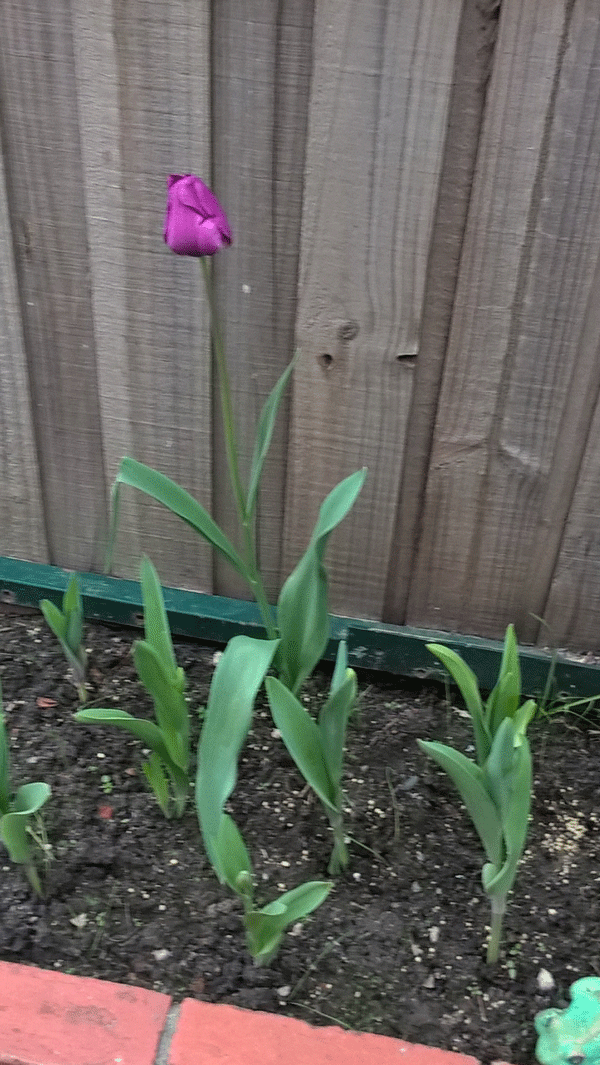
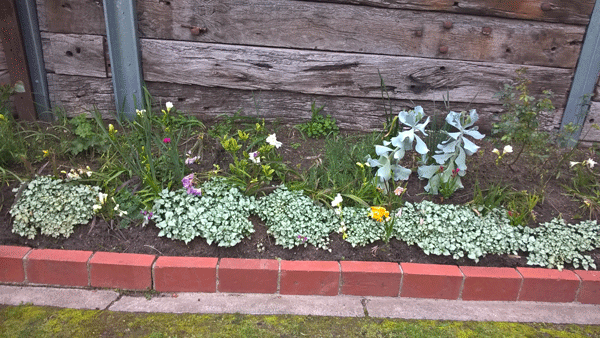
Our lovely garden, back when Helen was still weeding it.
Our garden is overgrown with weeds at the moment.
Helen, who used to do our weeding for us, retired some months ago. She was eighty-one years old.
She started weeding because she wanted to earn a little extra money. She was worried her rent would increase. Not only that, she lived in an upstairs flat, so she didn’t have a garden of her own, and she enjoyed working.
She came once a week, sun, hail or shine. She was fantastic.
By the end of the day she was exhausted, and then she had to get home. It got too much for her, so she finally said she couldn’t do it any more.
Sherylyn was talking to her the other day.
A downstairs flat in the block she lives in had become vacant. Her landlord offered it to her for the same rent she has now. Not only that, he said he wouldn’t increase her rent while she lived in the unit. And that’s not all. He’s pulled up some of the concrete for her out the back, so she can have her own garden.
Helen, may your garden be as beautiful as you made ours.
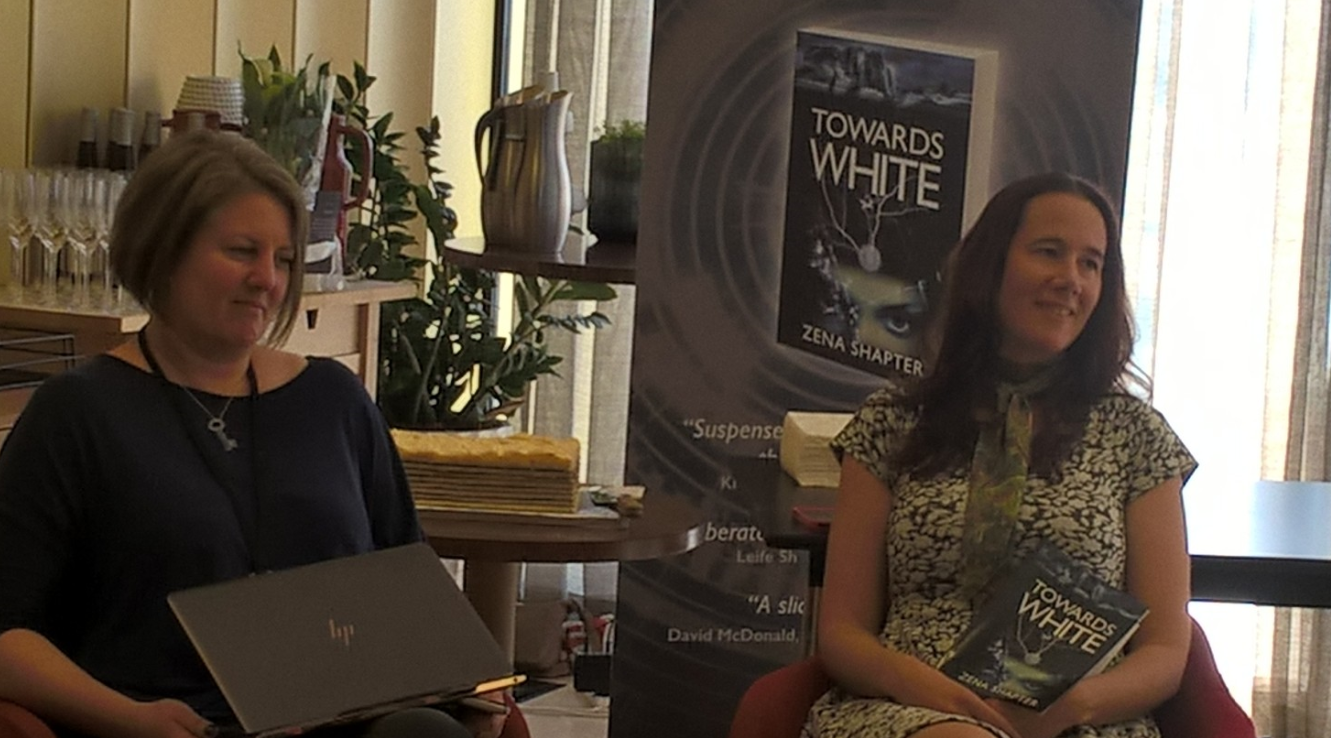
Zena Shapter (right) launching Towards White at Conflux on Saturday afternoon. Zena’s hosting a panel we’re on later today (Sunday), along with Laura E. Goodin. Come along and see us all.
This weekend we’re at Conflux, in Canberra. I have to say, the weather today is beautiful.
Canberra is only about 400km from where we grew up, so this is almost home territory for us.