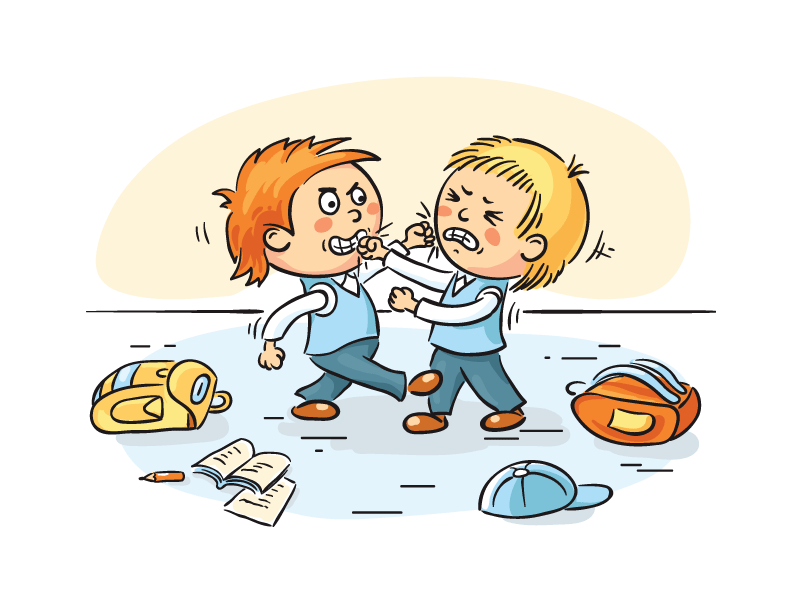
Right now the Australian government ministers are behaving like kids in a classroom, where the teacher has left the room, and been gone for a while. Calling each other names, doing stupid things, bullying, offending our nearest neighbor.
We’re waiting on an envelope in the mail to vote whether or not we want to allow same sex marriage, but even if we all vote yes (I’m voting yes), that doesn’t necessarily mean the government will allow it. It just means that that the government will introduce a bill to allow them to debate whether or not to allow same sex marriage. It also, I think, allows members of parliament to vote as per their own conscience, not along party lines.
Confused? So am I.
We haven’t even got problems, compared to other countries.
I don’t have to mention the United States, where it seems that the craziness has escaped the confines of the White House and infected the populace. We’re hurting for you.
It seems like whole of the democratic world has been infected by … I don’t know what you’d call it. The pendulum, having swung one way, is swinging madly the other way. It feels a lot like Galloping Gertie right now, ready for that final swing.
The new Anne Leckie
On a more positive note, Anne Leckie’s newsletter dropped into my email the other day. Provenance is out in just over a month.
I like the way Anne does her newsletters. Only when she really has news. And she put the first three chapters in the newsletter. Yes! (Lots of exclamation marks here.) We might try this ourselves.
Naturally, I read the excerpt immediately.
There are characters you take to immediately, and I love Captain Uisine. He’s not the protagonist, so I hope he’s in the book more than just two chapters.
Afterwards, I went straight to Amazon’s pre-order page. I’m looking forward to late September.
I went up to Sydney last week for a work conference. (Excellent conference, by the way, and the closing keynote speaker, Mike Monteiro, gave an wonderful, thought-provoking speech about ethics and design, using the current US political state, along with examples from businesses. He deserved the standing ovation we gave him.)
Breakfast this morning. Criniti’s, Darling Harbour
I convinced Sherylyn to come up for the weekend, afterwards. Sydney turned on lovely weather for us.
We do find it difficult to write on these breaks, however. (Although we did get some accounting done, believe it or not.)
View from our hotel window
So here are some pictures of Sydney. Mostly around Darling Harbour, because the first thing we do when we get to Sydney is find a ferry.
Boats on Darling HarbourAnother food place. This one at the hotel. It’s a hard life.
First round of sorting. More similar to our current site than we expected.
I try to leave work at work when I leave the office for the day, but how can I not use this technique from work (card sorting), when we’re redesigning our web site?
As you can see from the sorted topics in the image, above, it’s not a total redesign, just some tweaks to make things easier to find.
Incidentally, if you have any ideas or suggestions as to what should go on the site, let us know.
Leveling up in computer games is a process whereby a character gains enough points or experience to unlock a whole new level in the game.
Writers level up too. The first time they finish a book, the first time they learn to take critiques properly, when they learn that writing is not just writing, it’s rewriting.
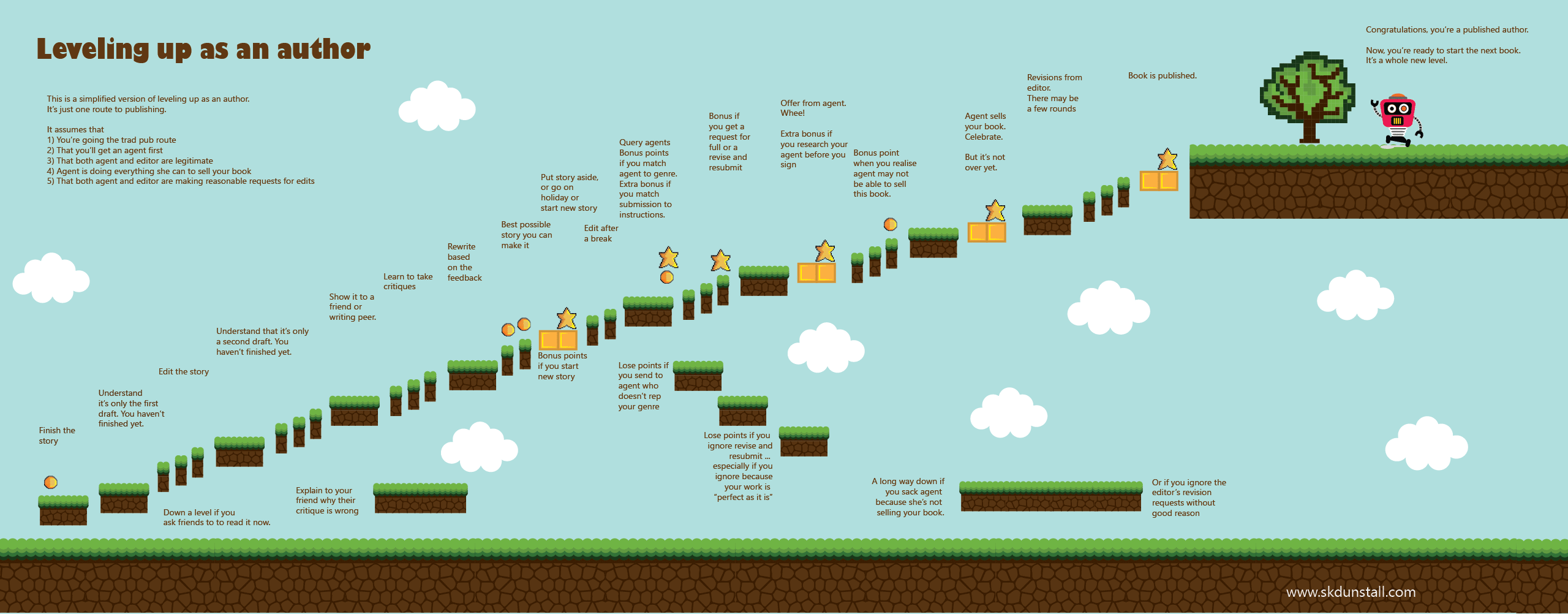
Here’s a fun diagram of a writer leveling up. We’ve made some assumptions.
The writer is going the trad pub route, and they get an agent first, who then sells their book to an editor
Both editor and agent are legitimate and doing their best to sell/make the book as good as it can be. That is, the writer isn’t caught up by scammers.
A lot of these things loop. You can keep going around and around in circles, but we’re only doing it the once.
I wanted a picture of utopia to balance this blog. Interestingly, my stock images supplier had lots of pictures with the word ‘heaven’, but little else. Except pictures of Roman ruins kept cropping up as well. I googled, but couldn’t find any reason for it.
I started a book today.
It was well written, and had a characters I cared about, right from the start. World building was superb. And yet … I couldn’t keep going with it.
Too many bad things happened to the point-of-view character in the first two chapters. Nasty, horrible things. Beatings, starved, torture, being branded on the face with a hot iron. Worse, the world he lived in was the sort of place where that could happen to anyone except the truly rich (and sometimes even to them). Where the people in power treated those outside their circle as lesser beings, and did really nasty things to them.
I stopped at the start of chapter three.
I couldn’t read any further.
It’s starting to feel as if I live in that world already. I don’t want to read about it too.
I think it’s human nature to want to read positive stories when the world around us seems quite depressing. I certainly do, anyway.
I picked up another book, more light-hearted, and read that instead.
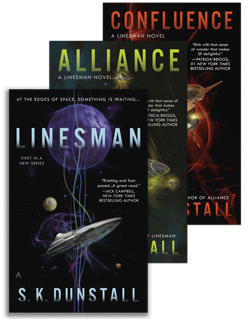
As mentioned in last week’s post, to celebrate we’re giving away a set of all three books. Linesman, published 30 June 2015. Alliance, published 23 February 2016. And Confluence, published 29 November 2016.
It’s a Goodreads giveaway, so enter over on the Goodreads site.
This is the Queen’s Birthday holiday long weekend here in Melbourne, the second official week of winter and it’s cold. It’s also the start of the snow season. Lots of people head to the mountains. Brrr.
Some snippets first.
Coming soon—a Goodreads giveaway
30 June 2015 was the release date for Linesman. It’s hard to believe the first book came out two years ago already. We’re planning a Goodreads giveaway for the anniversary.
We’ll announce it on the blog closer to the date.
Book news
Our editor came back with feedback and requested changes on the new novel yesterday. Changes required by the end of July.
We have work to do.
Some questions from one of our readers that we would like to discuss.
Bruce, one of our readers, asked some questions about Linesman. We liked the questions, thought they would make a good blog. So, here are Bruce’s questions and our answers.
***Spoiler alert***
There is may be spoilers if you haven’t read the books, so you might want to stop reading now.
Bruce asks:
Who taught Lambert his strong sense of right and wrong? The alcoholic beggar at the store only said he’d get caught. Rigel cheats.
Cann kid gang: Will Wen Cann, the kid who was kind to Ean, resurface? They’re beating the bushes for Linesman.
Will Rossi or Hernandez ever headline a story, solve a crisis, or make a discovery? What are Rossi’s experiments?
Tinatin and the shuttles?
Who taught Lambert his strong sense of right and wrong?
Firstly, Ean has always had a strong sense of what’s right and what’s wrong when dealing with the lines.
He has always known—and been confident of—his own ability to work with the lines. Any inferiority he has comes from working with other people, not with the lines.
From an early age, he was focussed on becoming a linesman.
He had a name for the music now. Linesman. And once he asked, it wasn’t hard to find out more about lines and linesmen. He was determined to become one. (Linesman, p153)
Old Kairo tells Ean being a linesman wasn’t for the likes of them. The guilds didn’t take criminals, and they didn’t take slum kids. In Linesman, we mention that Kairo was a Lancastrian soldier once, dismissed from the military for being overweight. There is an implied history behind Kairo that we don’t go into in this story. Kairo may steal, but it is possible, probable even, that he helped Ean, that he taught Ean other traits, like the value of a human life.
Ean is, also, basically a decent person.
Cann kid gang: Will Wen Cann, the kid who was kind to Ean, resurface? They’re beating the bushes for linesmen?
This was the question we really wanted to answer, because it shows how much a story changes from what you plan to what is actually written.
When we start writing a story we have the beginning, and we know, roughly, how it ends. Occasionally we have one or two plot other things that we know will happen.
Wen Cann was one of these plot points.
He was to be one of the new trainee linesmen. He had a different name, different background and, of course, no prison sentence. Ean recognises his music, knows it’s Wen, and struggles with the knowledge. When they realise there might be a traitor amongst the trainees, he confronts Wen, who gives a plausible story as to why he’s there. Ean doesn’t report him. Normally, he’d talk it over with Radko, but she’s not there, and the traitor keeps betraying them.
If you’ve read Confluence you know how that turned out.
Of course this didn’t happen. As you know, he wasn’t in the book and instead we had Han.
Maybe he’ll turn up in another book, maybe not. But if he does, he’s unlikely to have a major part like the one he was going to play in Confluence. Or, he may have a totally different storyline altogether.
Will Rossi or Hernandez ever headline a story, solve a crisis, or make a discovery? What are Rossi’s experiments?
Ah, Rossi. He’s not the most pleasant of characters. Probably not pleasant enough to headline a story, but he’s certainly a great second point-of-view.
If Acquard’s War ever sees publication, Rossi is a secondary character there, and (we think) you get to feel more sympathetic toward him. You certainly understand him more. Hopefully without him changing his character.
Rossi’s line experiments? We can only point to Acquard again. Yes, you find out a bit more about what he’s doing with the lines there. But only a little, for it is Acquard’s story, not Jordan Rossi’s.
What about Hernandez?
At the moment we don’t have a story planned for her. If we did write one, it would likely be a novella, rather than a full-blown novel. But, never say never. (Hernandez gets a small part in Acquard’s War, too. :-))
Tinatin and the shuttles?
All we know about Tinatin and the shuttles at the moment is that eventually the whole ship will become involved. People and lines.
It’s in the back of our minds, something we think will happen in the books where we meet the aliens. But, it might be a single mention, and you find they’re already using the shuttles, or it might be subplot, or something else entirely (like Tinatin getting one of the aliens to show her how they work).
We hope you enjoyed the answers. If anyone else has questions or something they would like us to discuss on our blog, please let us know. If it doesn’t give out too many spoilers, and is not something we have answered before, we would be happy to consider it.
“People of Earth, your attention please … As you will no doubt be aware, the plans for development of the outlying regions of the Galaxy require the building of a hyperspatial express route through your star system, and regrettably your planet is one of those scheduled for demolition … There’s no point acting all surprised about it. All the planning charts and demolition orders have been on display in your local planning department in Alpha Centauri for fifty of your Earth years … What do you mean you’ve never been to Alpha Centauri? … it’s only four light years away … if you can’t be bothered to take an interest in local affairs that’s your own lookout.”
Douglas Adams, The Hitchhikers Guide to the Galaxy.
Local politics in space opera
Writing local politics in a space opera is a bit like the scene from The Hitchhikers Guide to the Galaxy, where the Vogon in charge of the destruction of Earth tells humans that Alpha Centauri is only four light years away.
No matter that to humans that distance is an impenetrable barrier, for people from other worlds, it’s not. What happens on Earth is so insignificant as to mean nothing. The aliens go down as far as the local planning office, and that’s where they stop.
If you’ve read the Hitchhiker’s Guide, you’ll know that the story starts with a similar planning event, but on a smaller scale. Arthur Dent is protesting the loss of his own house to make way for an overpass. This event wouldn’t register to the Vogons. It’s a local event, too miniscule to matter.
There are close on 200 countries on Earth. Each of these has their own government. Oftentimes, these are broken down further into states, provinces, precincts and the like. But we also have an overarching body, the United Nations, who have representatives from most nations of the world.
If aliens arrived today and demanded to speak with a representative who could speak for all of Earth, who would we choose to represent us?
We have two choices. If the alien stayed orbiting Earth, we’d probably send in someone from the United Nations. If the alien landed in a specific country, then the rulers of that country might claim to speak for all humans. At a guess, they’d land in one of the most populous countries, so the rulers of China or India would be speaking for the human race.
It is highly unlikely the aliens would deal with more than one group.
So going back to writing politics in science fiction. When you’re dealing with multiple worlds, you don’t want to complicate the story with the small stuff. Even if a world, logically, has a number of governments, you tend to compress it together into one ruling body.
Which is why, in Linesman, Yaolin is ruled by a single council and Lancia is ruled by a single emperor.
Yes, but there are such things as democracies. Shouldn’t Lancia be a democracy?
The current ruling body of Earth (or what would be perceived as our ruling body by people on other worlds), the United Nations, is strongly pro-democracy. To many people—myself included—a well-run democracy is probably the best outcome for the political running of any country.
Even so, it’s not necessarily the logical endpoint for a governing body.
You have to work at democracies. If you don’t, they decay. Little by little the process gets distorted as people in the government attempt to retain power or benefits for themselves. The people in charge subdue any oppression. They bring in laws that prevent people from dissenting. They create states of emergency that allow them to subdue information and dissent. They stop having elections. Then finally, the leader of this no-longer democracy appoints a successor. His son, or his daughter. Or some other close relative.
Alternatively, you might have a coup. The army comes in. A general takes over, stays in charge. And finally, appoints a successor. Guess who.
What about a people’s revolution? We’ve seen a few of those in the past hundred years. The revolutionaries put the lead revolutionary in charge. What happens then? Who does he elect as his successor?
Sound familiar? Of course it does. It happens over and over again. We’ve seen it happen ourselves. We’re seeing it all over the world now.
People, once handed power like that, tend to pass that power on to their own family unless there are restrictions in place to prevent it. Like democracy.
What’s the definition of power handed over from parent to child?
A monarchy.
That’s why Lancia is a monarchy.
Of course, the funny thing about monarchies is they tend to morph into democracies over time.
The predominant feeling among the line sevens right now was a baritone eddy of hope. It hadn’t been there before, and it sounded a lot like Fergus.
Linesman
Back in Linesman, we never really gave much thought to the sound of line seven. We knew what it did (even back then), but the sound? There was that one throwaway line about it being a baritone and not much else.
When you’re writing a trilogy you don’t always consider how what you write in book one will impact what you write in future books.
Sometimes, serendipitously, something you write sparks an idea that becomes ‘the’ idea for a new story.
Terry Rossio, writer on Pirates of the Caribbean, once said, “Who knew the throwaway line, ‘Clearly, you’ve never been to Singapore’ would turn into movie three?” [Paraphrased here, because I can’t find the original quote.]
And sometimes you write throwaway lines like ‘a baritone eddy of hope … sounded a lot like Fergus’ and realise later that you never really thought of Fergus Burns as a baritone. You’ve always thought of him as a tenor.
You can’t change something that’s written. It took all of book two and part of book three to get into the mindset. Fergus is a baritone. Fergus is a baritone. His voice is deeper than you think it is.
We’re getting there.
Elvis Presley was a baritone. So were David Bowie and Johnny Cash.
Right now, we’re imagining his voice as a cross between Elvis Presley and Teddy Tahu Rhodes.
 If you’re not part of the solution …