Categories
Writing process

One future concept I hope comes soon is self-driving cars

One concept for self-driving cars.
A concept for self-driving cars. Note, this is totally impractical for older people. The seats are too low. Old people need seats they can sit on, without having to drop into, and they want to be able to twist, and not have to lift their feet too high. I liked the computer idea, thought that on her shopping trips Mum might like to check Facebook (she was a big Facebook user), but after shopping she was always tired, so a seat that reclined would probably be better. She could snooze all the way home.

A group of us were sitting around this morning, discussing our parents getting old, some of the problems that caused, and how we can alleviate them.

Loneliness is one problem.

Many of our parents had lost a partner, lost many of their close friends. Or their friends have moved away. For us, a friend moving, say, two suburbs away isn’t much, but when you have limited mobility it becomes a major problem.

Many older people lack mobility. They can’t walk as far, or as fast, due to problems with hips or knees or their back. Many of them can’t drive any more due to vision problems.

Lack of mobility makes you housebound. It becomes harder to go out and do things, which makes it harder to talk to people, which in turn ends up making you lonelier. It becomes a vicious circle.

This is not just old people, by the way. It impacts everyone. It just happens that we were discussing old people, our experiences, and some of the problems.

A lot of the things we could do to make lives better for our elderly parents took place during working hours. Exercise classes, craft sessions, friends getting together. Which we couldn’t get to, because we were working.

We talked about how not being able to give our parents their freedom made us feel helpless.

Giving up your job, your life, to look after a parent is sometimes the only thing you can do. But most of the time, that’s not optimal. There’s the money aspect, of course, but there’s also the dignity, the freedom for the older person. They don’t want to be reliant on you. (Or our parents didn’t, anyway.) They want their own life, but they want it to be happy and fulfilled.

They certainly don’t want to have to rely on someone else.

It’s one reason I can’t wait for self-driving cars.

Seven years before Mum died she lived in a small country town which had a post-office/shop and that was it. Even the local pub, which used to be open Friday and Saturday nights, had closed down. She drove 100 kilometres for groceries, and she was losing her sight. So we moved her across the state (a move of 400km) to be closer to her family.

If we’d had self-driving cars, she could have stayed in her own home longer.

Mum left most of her friends behind when she moved, and while her new town had family, with her limited visibility it was still hard to go out and do things on her own. She had to wait until one of her children was available to take her shopping. There were exercise sessions she was encouraged to go to, but she had to take a taxi to get there. She couldn’t go to places like craft classes, because most of them were in working hours.

She was tied to our schedule, not her own.

If we’d had self-driving cars she could have gone where she wanted to, when she wanted to. It would have given her back mobility, which would have given her back her freedom.

That’s no small thing.

(Mum moved into an aged care facility six months before she died. She loved it. There were people around to talk to. They ran classes. They had concerts, and excursions. She could do things again.)

Categories
Writing process

There’s always one error left

Book news first

We have one more interview online for Stars Uncharted, if you’re interested. It’s over at PaulSemel.com.  In the interview we talk about who we’d like to play Nika and Josune if they ever made a movie out of Stars Uncharted, and we talk about how the show Firefly didn’t influence the writing of the book. No, we go way back further than that, to Star Trek, Doctor Who and Blake’s Seven.

Now, back to the main post

I did a presentation at work the other day, myself and two others. It was a good presentation. At the end we did a demo.  After the demo we answered questions for around fifteen minutes. 

Up on screen, the final page was left up while we talked. And all I could see was the typo I should have fixed.

“What we dont’ …”

All in big, dark letters because it was a sub-heading.

The first thing I did when I got back to my desk was fix it.

The fact is, when you’re writing, you make a lot of typos. Errors you don’t pick up, even when you read a piece of writing again and again. One of the advantages of co-writing is that another person is reading your work all the time.  They pick up things you don’t see.

I know that when I’m writing, I’ll often change a sentence, but not go back and delete words that made sense in the context of the original text, but don’t any more. And the funny thing is, even when I reread the sentence, I don’t pick up all the errors.

No matter how often you read your own work, you miss things.

Right at the end of a story we like to read our novels aloud. This is after more than twenty rounds of edits on the book. Even so, it’s amazing how much we change in that last round.

And we still miss things.  There are the typos which mostly get picked up by the editor and the copy editor, thank goodness.  (Although, there were five thousand copy editor corrections on Linesman. Admittedly half those were serial comma issues, and many of the rest were Australian/US spelling, but that still left a lot of basic typos.)

Less often, there are basic logic errors.  For example, as one of our readers pointed out in Stars Uncharted (Thanks, Ian) that a measurement is tiny.

Alejandro’s meddling had taught her early that she had to build in safeties. Especially after they had started using the exchanger and she’d come back to her own body once to find that while he’d been in her body he’d redesigned it to add twenty millimetres to her bust and to remove the same from her waist.

Yes, well. Twenty millimetres.  That’s 0.8 of an inch.  Just a bit over three quarters of an inch. Not quite what we had had in mind.

We originally had it two inches. (For those of you who have read the book, Alejandro would have tried a small amount first, to see how far he could go, which is why we chose two inches.) Everything else in the book was in SI units (metric), so we changed it.  Except, two inches is 51 millimetres, not twenty. We should have made it fifty.

Ouch.

Categories
Book news Writing process

We survived pub day

Amazing nature

Let no one tell you that the internet is a waste of time.  You learn things on the internet. The other day on Twitter @rainbow1973 posted an image of a rainbow eucalyptus tree.

Rainbow eucalyptus?  Australia is the land of the eucalypt, but I had never heard of them.

It turns out that they’re not native to Australia. Here’s me thinking all eucalypts originated here.  I was wrong.

Rainbow eucalyptus, also known as Mindanao gum or the rainbow gum (I wonder where they got that name) grow in warm, tropical climates and can be found in places like New Guinea, Indonesia and the Philippines.  They’re the only eucalyptus that grows natively in the northern hemisphere. The image above is of a tree in Hawaii.

Stars Uncharted is finally out

Publication day has come and gone. It seemed to go well, and we had wonderful marketing for it. Things are quieting down now. We hope those of you who bought the book enjoy it. This has been the most nerve-wracking release since Linesman, in a way, because it’s not a Linesman book.

As promised, we said we’d put interviews up for you. Here are the first few.

Over at SyFy Wire we talk about writing together, world building, and media that influenced us when writing Stars Uncharted.

On Jean Book Nerd we talk about inspirations for developing Nika and Josune, and some influences/turning points in our lives.

One thing I did notice, my IT background crossed over and I didn’t even realise.  Before ‘publication’ day I kept calling it release day, and I have trained Sherylyn to say ‘release’ as well.  I have learned.  Next time I’ll do better.

Categories
Writing process

Release day – Stars Uncharted

Stars Uncharted is now officially available.

Our thanks to the team who helped us create it. Our beta readers, our agent, our editor, the artists and designers, the copy-editors, marketing, all the assistants and everyone else along the way who was part of it. Thank you. We didn’t do this alone.

Enjoy.

Categories
On writing Writing process

Deleted scenes

Sometimes, the scenes we delete are simply that, scenes. Other times we rub out a whole character.

We don’t know about other writers, but when we write novels, we delete as much as we write. Sometimes we delete more.

The problem is, some of these deleted scenes are great. We like them, anyway.

Some of them aren’t so great, either. Back when we first started writing Linesman we deleted a lot of Rossi scenes. Looking at those scenes now, they had to go. They were boring, and didn’t add to the story at all.

But there are other scenes we delete because the story turns in a direction different to that in which it was going.  Or you write yourself into a hole, realise something can’t happen. Or you write a scene that happened way too early for the book.  Those sorts of things.

We do keep deleted scenes. We have massive OneNote file with pages and pages of deleted scenes in there.

We like some of these scenes. Sometimes we were sorry we couldn’t do anything with them.

Earlier this year we started a newsletter.  Newsletters are good for letting readers know what we’re doing without them having to look for that information, but what’s the point in a newsletter if it doesn’t give you something you can’t get elsewhere?

We considered writing short stories about the characters in our books, but neither of us are great short story writers. And having to write four a year.  Nope.

If we can write any short stories we might still put them into the newsletter.  Meantime, what a perfect place to put up our deleted scenes.

They’re not great, because most of them are little more than a first draft, but they are a look into our writing life. Particularly if we can continue to show the deleted scenes of characters we really like. You never know, they might turn up in a later book in a different guise.

Categories
Progress report Writing process

A ragtag band of explorers …

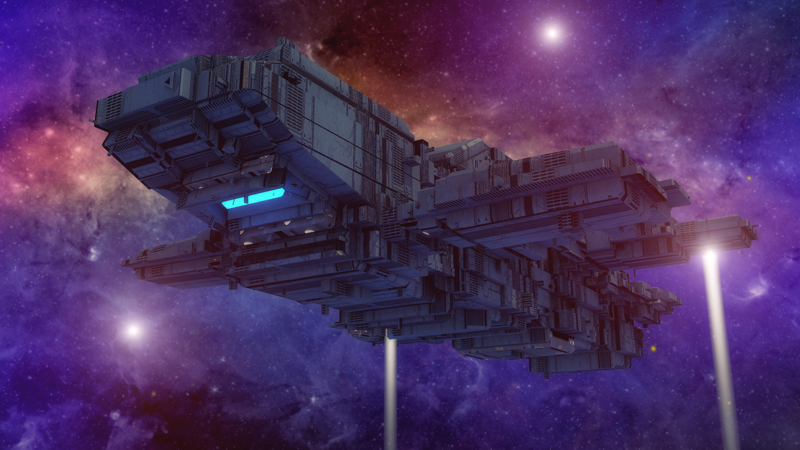
My kind of spaceship. Not too many windows to space. Windows make a ship more vulnerable, and a lot more expensive to heat.
This is the sort of ship a ragtag band of explorers like Hammond Roystan and his crew might use. Image: Miguel Aguirre

Status today:  Ow.

I’ve had a lazy week, reading lots of books.  I’m a fast reader, I tend to open a book and read through to the end, stopping only for work, dinner and bed.  Maybe bed, if the book’s too good I’ll read through the night to finish. Bad me.  (The only day I ever took off work for reading happened because I stayed up till 6:00am reading Robin Hobb’s Fool’s Fate. I thought I’d snatch an hour’s sleep. Ahem.  By the time I woke up it was way, way past getting-to-work time.)

Anyway, I read three books yesterday, straight through, stopping only for lunch and dinner.  (I’m not going to name them, because the first book was so good I went and bought the second two, and by the end of book two I was going, ‘Huh’, and book three I just skimmed. In my skimming I thought I missed something important because the end I felt as the author had left a major plot-hole. I spent a couple of hours rereading book three, trying to work out if they had, or if in my skimming I couldn’t find where they covered it.  I still couldn’t find it.)

I sat in the same place all day. I’m getting old. My body can’t take that sort of punishment any more. Today I am sore.


There’s one month to go for the release of Stars Uncharted.  Release date is Tuesday, 14 August.

It’s funny how when you write a book you think it’s so unique, but it turns out that it’s not.

We’ve learned that a ‘ragtag’ crew is a thing. There are lots of books about people who join up as a team (a little bit of the found family we talked about last week), but I wasn’t aware that there was a word to describe them. It doesn’t feel that common in Australia—maybe it is, maybe we never noticed it—but since it was used in the blurb on Stars Uncharted we’ve noticed it everywhere.

Categories
Writing process

What are some things you like in stories?

A couple of days ago, on Twitter, Isabel Yap (@visyap) started a thread that asked,

“What are some things you like in stories (not tropes, necessarily), that you are always down for?”

I read all the comments, agree with a lot of them, and came up with my own list of things I particularly enjoy.

Deep platonic friendships

Friends who are there for each other. People enjoy each other’s company, can be honest to each other, tell them their thoughts and hopes and dreams. And of course, in the stories we like to read and write, can also trust that their friend will save them if they get into trouble, and knows that they will do likewise if their friend gets into trouble.

Found families

My family life was practically idyllic, so far as I can tell. Loved Mum and Dad, still get on well with my siblings.  I have no idea why I love found families so much, but I do. This is where a group of disparate people—usually lonely, often without family of their own—come together in a family group.  In fact, right now we’re toying with a story just like that.  An alien, a human down on his luck, and a kid whose own father was violent, so he ran away from home.

People have mentioned Stars Uncharted is a found family, too.

Happy endings

When I finish a book I like to finish feeling satisfied. That usually means a happy ending.

Bad guys who aren’t pure evil

I hate it when the bad guys are purely evil, with no redeeming features at all. The thugs are just thugs, the evil company is evil all the way through, and so on.

It’s easy to make people and organisations purely bad. The enemy in Stars Uncharted is a lot more simplistic than the enemies in the Linesman books.

Banter

Love the quick back and forth repartee between characters. It makes a story fun, shows that they’re friends (usually), and demonstrates character.  When we were younger, Ivan Southall’s Simon Black series was our favorite duo who talked back to each other.  (They’re kids’ SF books, love them still, but they haven’t aged well, except the first one, which wasn’t science fictional at all, but about World War II.)

I have, however, read books—which shall remain unnamed—where the banter didn’t work, so it’s not as easy to write as it looks.

Strong sentiment, lots of emotion

Laugh out loud moments, moments that make you cry, no matter whether you’re in public or not, even those lovely little bits of romance that thrill (not the sex, just the pieces where you go, ‘ooh’ and go back and reread all the time).

Happy endings

The world is depressing enough sometimes, particularly if you listen to the news, nowadays.  Of course there are good bits, but it’s nice to know when you escape to a book that you’re going to feel good at the end of it.

Strong women

I don’t need kick-ass women all the time, but I really don’t want women who have no control over their own lives.

Then again, I don’t like books where men have no control over their own lives, either, and I’ve read a few of them lately. There’s one author I love, but I refuse to read any more of her books because she’s done that to her main character (male) in two series now.

No, characters have to have some control over what they do and how they live their lives.

Science fiction and fantasy with gender and race equality

Which leads on to the next thing, which drives me crazy, particularly in fantasy. Books where the author has built an amazing world, plus an awesome magic system, and then they base a woman’s role on a quasi-medieval western Europe role, and a non-white person’s role on the same.  Women are chattels, owned by their husbands or fathers, colored people are slaves, or semi-human.

You’ve built a whole world, and you stop right there. It doesn’t have to be that way.

Non-perfect characters

Given that we wrote about Ean, who is a classic ‘special person’, you can see that we have no objection to a story about a chosen one, or a (technical or strategic) genius, or any of the—can I call them—tropes that are used in science fiction and fantasy. No, the real issue is when they’re perfect people with it.

They have to have some failings.  Because no one is perfect, and perfect people are difficult to like.

Stories with big ideas

Anne Leckie’s Ancillary Justice with a ship, the ancillaries and a single person all as one entity. Vernor Vinge—how to murder someone by leaving them to die in real time in Marooned in Real Time, or how not to pay call centre staff, in The Cookie Monster. Big ideas, science fiction that makes you think.

Fantasy, too. You can’t go past the bridge builders in Brandon Sanderson’s The Way of the Kings, or even the magic in Robin Hobb’s Soldier Son series. (Miserable books, those, but the last story ended on a high note. I reread the end quite a few times.)

Not-so-alpha males

I like to know how my male characters feel, and what they think, not just what they do. In many stories, that makes them less-than-alpha. So be it.  They’re the best.

And let’s face it, in real life, a true alpha male is not generally a really nice person. They tend to be arrogant, take-charge, think they know everything and refuse to listen to anyone else.

Strong family relationships

I know I said earlier that I like found families, but I do like books where people who are part of a blood family actually get on with each other, and love each other, and have contact with each other. So many characters in fantasy and science fiction seem to have no families at all.

Children’s books are often the same. Parents and siblings are totally out of the picture. Yet for some reason, when we get to young adult, the family is around all the time, causing the main character grief. (And isn’t it nice when you find a young-adult novel where the hero or heroine has a good relationship with both parents?)

Fun in a story

I love stories with a dash of humor. They don’t have to be laugh-out-loud funny, just make me smile.


So that’s my list. What’s yours?


(p.s. Today’s blog is a total mix of US and UK spelling, not even one or the other. Sorry. I just went with what worked for me, today.)

Categories
Writing process

How do you write ‘good’ characters versus ‘bad’ characters?

One thing writers try to do is ‘show’ a character by his or her actions. That is, rather than say,

Bob Jenkins was a bad man.

You show it by

Bob Jenkins pulled into the petrol station one midnight, just after Granny Stevens had closed up, and demanded she unlock one of the bowsers so he could fill up. Granny refused, so he punched her in the face, knocked her to the ground, and drove off. Granny spent three months in hospital, recovering.

It’s not so common now, but simple way authors were taught to show a protagonist’s character was to show how he treated animals.

Does he kick the dog, or does he pat it?  Does he, like Jack Holloway in John Scalzi’s Fuzzy Nation, allow his dog to detonate explosives. (This works better than it sounds here, Jack’s relationship with his dog saves him, in my opinion.)  Or does he, like Riggs in Lethal Weapon, rescue a dog that’s being tortured by some low-lifes?

That last may or may not be true, but I’m sure I’ve seen the start of Lethal Weapon where some people are sitting around a fire in a drum, and they’re torturing a dog. Riggs is uber crazy, out of his mind with grief and depression, probably blind drunk, and he goes in and tears these people apart.  (Not literally, but he roughs them up.)  It sets the scene for the whole movie.  People I’ve spoken to can’t remember the scene, so I don’t know if I imagined it or not.  But to me, it’s part of the Lethal Weapon canon, and it shows Riggs’ character perfectly. He’ll go in to prevent injustice, but he’s badass with it.

Like I say, they don’t use animals as much to show character now, although it’s still around.

Another common technique was to show how the character treated children.

Nowadays, good guys can be a lot more ambiguous, but they have to have morals. Morals that we agree with.

Even if they’re half-way bad, our ‘good guy’ has a good reason for doing something.  Something that we as a reader think is a good thing.  For example, our protagonist may be determined to destroy a pharmaceutical company, and does unpleasant things to achieve it, but it always turns out that the company he (or she) is trying to destroy is worse. For example, they covered up the test results of a drug they sell, and even though they know the drug causes people to die screaming in agony they still sell it, because it makes them money.  Enough money to buy and sell governments.

I love bad guys who aren’t truly bad, just doing what they feel is right, and that’s different to what the protagonist wants.  They’re the best type of ‘bad’ characters to read about.

Even so, my gut feel is that with the world in the turmoil it is today, many writers will start making their antagonists a little more obviously bad in the future.  It’s a way of coping.

Categories
Writing process

Two weeks to deadline

With two weeks to go before we send Stars book two to our editor, I’m sitting back and relaxing while Sherylyn works on final cleaning up of the story.

In fact, I’ve started editing another story that Sherylyn had worked on mid-last year while I was working on an earlier draft of Stars book two.  It’s fun, and fresh, because after you’ve been working on the same book for the last year it’s always nice to start on something new.

Oh, and I’m catching up on some reading.

Then, out of the blue, Sherylyn says, “I don’t think we’ve given [name redacted] enough reason to do what she does [also redacted, for spoiler reasons].

Noooo!

She’s right, of course. But two weeks.  And this is basically the inciting incident for the whole story.

I go into denial first.  Of course. I mean, who wants to change a major plot point two weeks away from submission? Then we talk it out. I come around. We talk some more. How might we fix it?

Okay, we can do that, and that, and that.  Three small changes to the story will fix it.

Phew.

It’s funny how often you don’t need to make big changes to a story to make a big impact. Just a tweak, here and there.

Disaster averted.

I go back to working on the other book.

Until the next bombshell. 🙂

Categories
Writing process

Eurovision 2018

This is the tag line for Catherynne M. Valente’s new novel, Space Opera. This is from the front cover.


Catherynne M. Valente has introduced a lot of people to the Eurovision this year with her new novel, Space Opera, which is effectively Eurovision in Space.

By the time you read this the Eurovision Song Contest 2018 will probably be over.  The final will be held Sunday morning, Australian time.

Here in Australia we see the contest on Sunday night.  Sherylyn and I try to avoid spoilers throughout the day, then sit down at night and score each entry. We seldom pick the winner. In fact, the ones we like often score very low.

Normally I go through the songs and pick out the power ballads. I’m a sucker for power ballads. This year there weren’t many. The closest I could find was Azerbaijan.

I rather liked the Azerbaijan entry (singer, Aisel). It’s one of those songs you like better every time you hear it.


Unfortunately, they didn’t make it past the first semi-final. A pity.

The other song I really like is Estonia’s entry (singer Elina Nechayeva). I don’t think it has a chance of winning, but listen to Elina’s voice.

Plus, she deserves extra points for that dress.