The question was posed in a local writers’ magazine.
A friend has just published her first book and has invited me to the book launch. I don’t read in her genre. Do I have to buy the book?
The answer, from an author who had published a number of books, and is respected in the industry, was:
Of course you should buy the book. You’re there to support your friend.
I understand this is what is expected, but I disagree. Totally.
Given the above answer, I expect that friend will make an excuse and not go to the book launch at all.
What makes a successful book launch?
Buzz. What makes a buzz? People.
If I was the questioner’s author friend, I’d just be happy my friend came along to support me. A common writer’s nightmare is the book launch or book signing or book talk where no-one turns up. (Signing in the Waldenbooks, anyone?) The best support your friends can give you is to come.
Not to buy your books.
A lot of my friends don’t read science fiction or fantasy. I don’t expect them to buy our books. If I was doing a book launch I’d be just as happy if they came along. If I’m launching or signing in a bookstore and they felt obligated to buy a book they should buy one they want to read. I’m happy, I get the crowds. The bookstore’s happy, they get a sale. The two combined means it’s more likely they’ll invite me back.
There are some friends whose books I’ll buy when they get published because I want to support them. But I don’t think one should ever go to a book launch feeling obligated to buy the author’s book.
Word and Scrivener are not the same. They are both writing tools that will help you craft novels. They produce a similar end result. A novel.
Scrivener is a content generation tool for writers. Word is a word processor.
Scrivener started out as a Mac program, Word as a Windows program, so users used to divide along the lines Windows users used Word while Mac users used Scrivener (or a Mac word processor). Nowadays, both programs work for both types of operating systems, so it’s more a case of preference.
Many of the things you do in one program can be done in the other, even if not the same way.
Scrivener was designed for novel writing, while Word is a general purpose word processor. You can write letters or reports on it just as easily as you can write novels. So I imagine that many novelists would find Scrivener useful and easy to use. Especially if you’re a plotter. Almost certainly if you already use index cards or similar to plan out your stories.
Me, I use Word. I’m a Word guru from way back, a Microsoft user all the way. I’m also a pantser—or as Brandon Sanderson calls it, a gardener (he borrowed the term from George R. R. Martin). I’m happy to let my words flow. I go back and rewrite along the way, and move big chunks of text around while I do it. I like having the whole book in one document.
My co-author, Sherylyn, uses both. Scrivener when she’s planning out a story, or writing non-linearly, Word when she’s just letting the story flow.
Neither program is necessarily better than the other. Both have good and bad points. It’s what works for you and the way you write.
Why, oh why does that snappy one-liner we worked so hard to come up with always sound so lame when someone asks, “So, what’s your book about?”
You’ve spent countless hours trying to come up with something that works, and all that comes out of your mouth is an almost inarticulate, “Well, it’s a space opera about a guy who repairs spaceships and gets caught up in the discovery of an alien spaceship that two warring factions in the galaxy both believe can help them to win a war.”
Which is technically correct and absolutely nothing like the book at all.
You can see the poor listener’s eyes glaze over. “Oh,” they’ll say, and the conversation stops dead.
That’s the most common reaction, but we’ve had others. A close second is, “So what’s a space opera?”
I’ve got the answer to that one down pat. “Think Star Wars. Space, spaceships, fighting, politics, a little bit of humour.”
The poor listener’s eyes glaze over. “Oh,” they say, and the conversation stops dead.
It’s amazing the amount of in-words we use, that we don’t even realise we’re using. I take ‘space-opera’ for granted. It always pulls me up short when I realise most people don’t have the foggiest idea what I mean.
Then there’s the standard double-take. “You don’t look like you write science fiction.”
What does a science fiction writer look like?
One of my favourites though, was from an editor who works for one of our local science fiction/fantasy imprints for one of the big five publishers who Sherylyn was talking to one day. “It’s a space opera. Think Lois McMaster Bujold.” We lifted the Bujold reference straight from our agent. We’d never have come up with it ourselves, even though we can see why she mentions it.
“Who?” asked the editor, and the conversation stopped dead.
There’s a standard novel manuscript format and it goes something like this:
A4 or letter paper
Times New Roman 12 pt
2.5 cm or 1 inch margins
Double spacing
Indent the first line of each paragraph 1 cm or half an inch
No extra space between paragraphs
Author, title and page number in the top right-hand corner of each page
Begin new chapters on a new page.
Letter/1 inch/half inch are for countries that use imperial units, A4/2.5cm/1cm for those that use metric.
Most writers set this up every time they start a new story in Word. But you don’t have to. If you use a template you will turn out consistently formatted novels every time without having to do any manual setup.
Where to get templates
Microsoft has some standard manuscript formatting templates already set up. Or you can create your own. Today, I’ll show you how to find Microsoft’s preformatted templates. Next time I’ll show you how to create your own from scratch.
Preformatted templates using Office 2013
I’m using Office 2013. If you’re using an earlier version of Word, you can do a similar thing, the actual steps may not be quite the same.
Open Word
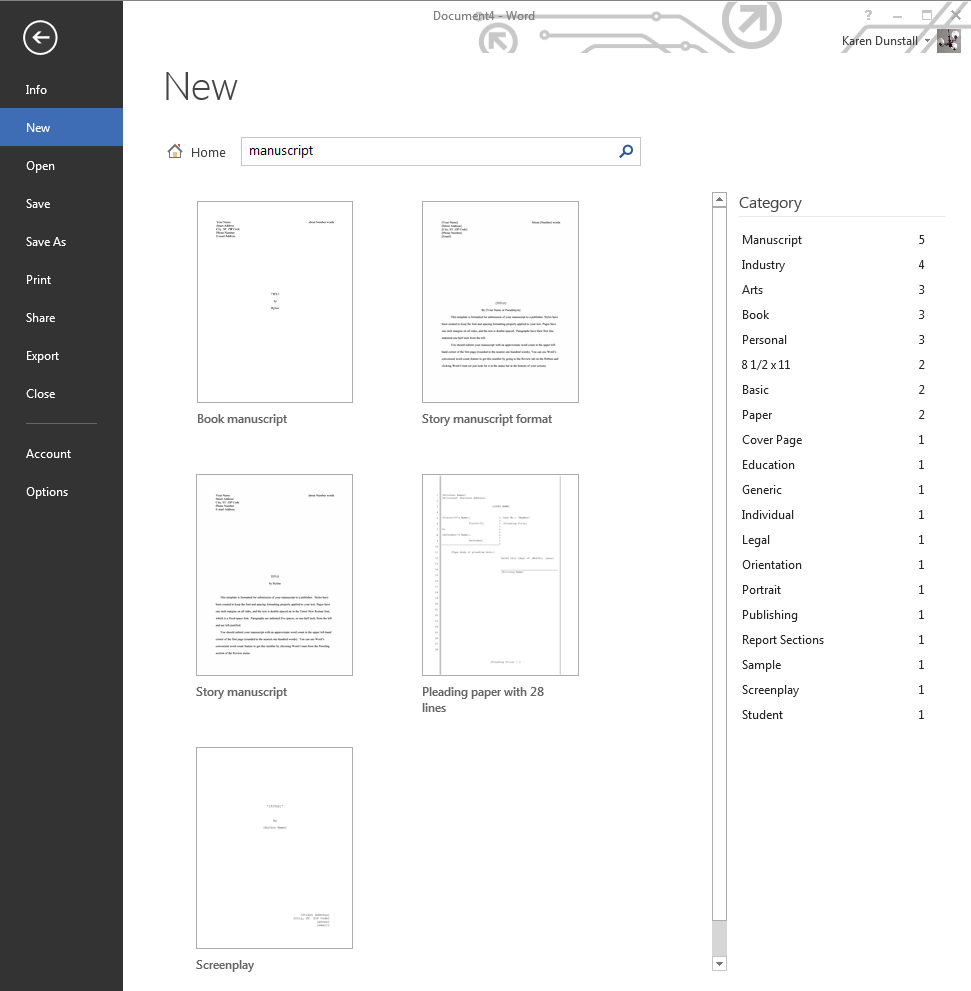
This opens on the template page
Type manuscript into the search field and start searching (press <Enter> or click on the magnifying glass)
This brings up five potential templates you can use. The three that look most promising are:
Book manuscript
Story manuscript format
Story manuscript
Results from a template search using ‘manuscript’ as the search term
Let’s look at each of them in turn.
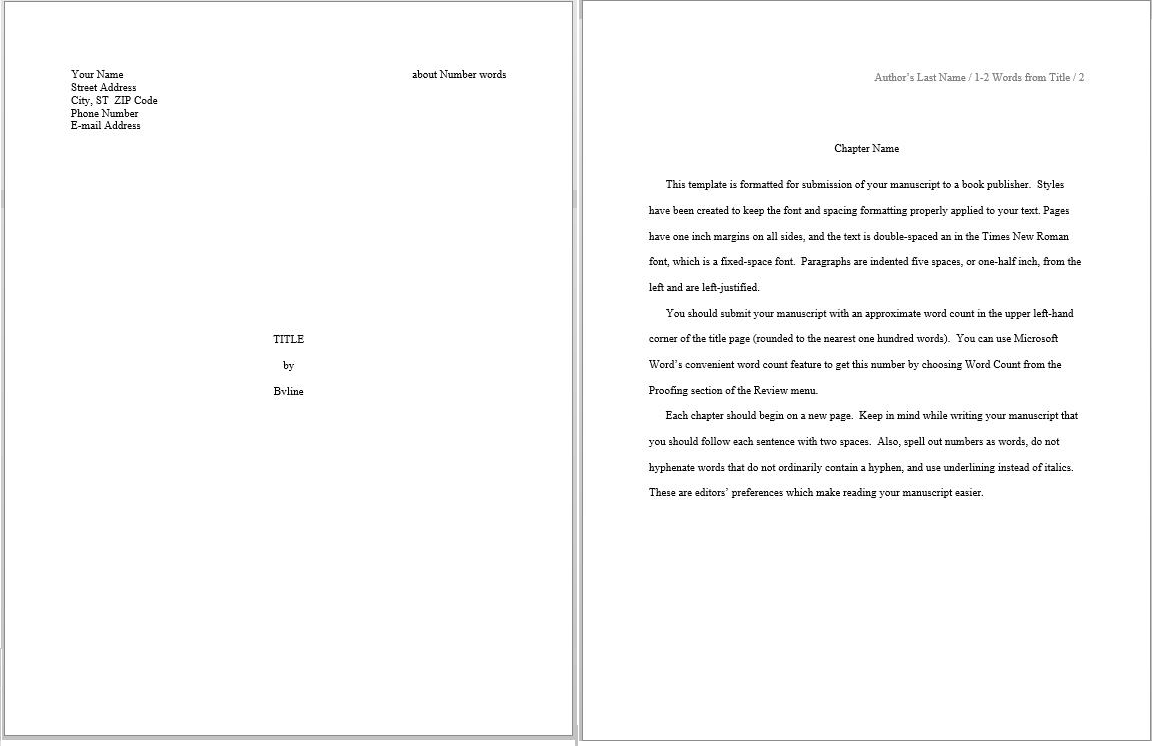
Book manuscript
Book manuscript template. This is the only template that includes a front page
Book manuscript looks good. Inspecting it I can see that:
It’s letter size. Good for the US market, and I can easily change this to A4 if I’m in a metric country
It has all the author information you need on the front page
The header contains the story name, author name and page numbers
Text is 12 point Times New Roman
Margins, strangely enough, pick up my metric 2.5cm. Again, that’s easy to change
Text is double spaced
Chapter name is styled and defined as a heading type
So far, I’m liking it. Now I’ll put on my Word guru hat and look more closely.
What don’t I like about it?
There’s no line indent for the start of each paragraph. That means you have to tab in at the start of each paragraph. You shouldn’t have to do that.
Chapter name is not in the Style Gallery, so how does the poor inexperienced writer know how to use it
Things I’m ‘meh’ about but that only impact me (in other words, personal preference)
It overrode my default dictionary
It uses content controls for the first page, in the header and in the chapter title but they don’t seem to do anything. (Think of content controls as fields you can fill in, like a form.)
Outside of that, it’s definitely something you could use if you wanted to be up and running fast.
Story manuscript
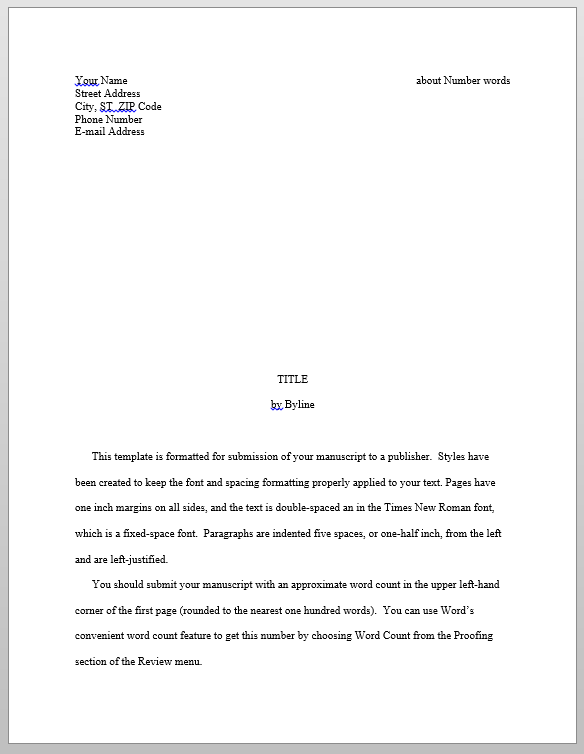
Let’s look at the story manuscript template next. This one doesn’t have a front page. I’d consider this more of a short story manuscript.
Story manuscript. Behind-the-scenes, this setup is similar to the Book Manuscript template.
It looks similar to book manuscript template except that it doesn’t have a chapter title style. I’d guess that it was created by the same person, or that one was based off the other.
It has the same issues as book manuscript template. The biggest of these is needing to tab at the start of every paragraph.
Story manuscript format
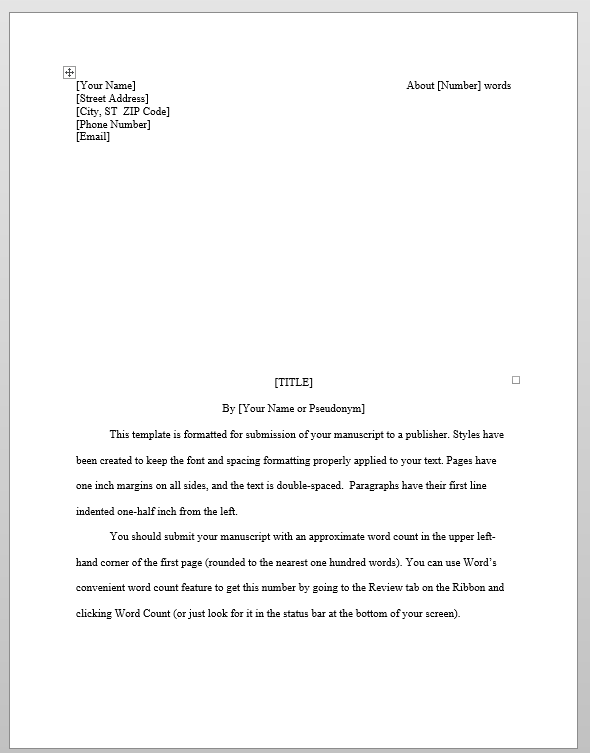
At first glance story manuscript format looks almost the same as the story manuscript template. It’s not.
Again, it’s more suited to a short story than to a novel because I think that for a novel a title page is good. The styles are very basic.
Story manuscript format template. Looks similar, but it’s not.
I like:
Finally, yes, indented first paragraph, so you don’t have to tab to start each paragraph. You cannot imagine how much time this will save you
The styling is basic, but it works. (Note however, that if you’re writing a novel, when you add your title page you’ll have a couple of problems with basic styling. I’ll get to that in another blog)
Meh about:
The name and address at the top of the first page are in a table
Plus it overwrote my default dictionary again.
The verdict
If I had to recommend a template, I’d use the story manuscript format. For one reason, and one reason alone. Indented first line.
There are things you can do to customise the templates, but that’s for another blog.
I’m sitting on the train, on my way to work, editing one of our own stories, when I get to a sad part. I start to blink, and then sniff. My eyes are watering, my nose is running and I don’t have a tissue to hand. Then, as the train stops at the next station, out of the corner of my eye I see one of the guys from work. He gets into my carriage.
What do I do?
Normally I’d say hi and we’d sit and talk for the rest of the journey.
I pretend I don’t see him, engrossed as I am in whatever I’m ‘looking at’ on my computer. Which, by now is nowhere near the sad part. I don’t look up.
I find a tissue—at last—and wipe my eyes surreptitiously and blow my nose as I get off the train.
I lie. “Why, hello Michael. I didn’t realise you were in the same carriage,” and I blow my nose again. “My hayfever’s bad today,” I say, in an effort to explain the red eyes and runny nose
Later that night, when I finally get back to editing that part of the story, I don’t cry at all.
I don’t mind. Earlier, just for a moment, I had managed to invoke in a reader the emotions we were trying for when we wrote that piece.
For a 100,000 word novel the first draft usually comes in at around 80,000 words.
What happens in the first 50,000 words generally remains the first half of the book in the final version, even if it doesn’t happen the same way or in the same order. The last 30,000 words are the second half of the book. We race through this, leaving lots to fill in. But it ends up mostly as fill-in, not rearranging.
This first draft is missing lots of detail from the back end, but it’s also got no colour. It’s mostly a ‘this happened then that happened’ telling of events, with occasional flashes of in-depth colour and point-of-view. For example:
Siavash the demon looked around the long library filled with books, at the fire burning hot and green at one end of it, at his worktable with its neatly ordered crucibles and rare minerals.
The library had taken fourteen centuries to collect. In it he had records of the history of every major civilisation that had risen over that time. Most of them were gone now. Even other demons envied his library.
He looked at the neatly labelled bottles on his workbench. The rare minerals had taken almost as long to collect.
Siavash should have been content. Instead he paced the shelves, picking up scrolls and vellum at random, putting them down again unread. He set out the makings of a rare, intricate spell that would take two years to build, then swept the ingredients together into a heap and tossed them into the hearth.
This excerpt is from Wizard, an experimental project we’re writing in our spare time. (By spare time I mean writing downtime, when we’re stuck on our current story and need a break from it.) It’s pretty boring, isn’t it. It’s pure telling. Description only.
So we add some description, more storyline, and some thoughts. For example, this part of Wizard becomes:
The tiny rock fiend spat pieces of gravel out with his words—which was normal, because he was a rock fiend, after all—but he spat them all the way to Siavash, twice as far as he generally did.
Not to mention he would never dream of spraying Siavash with gravel under normal circumstances. Siavash endured the spray and tried to work out what the little creature was saying.
“No more eating rock.”
“Are you saying you refuse to eat any more rock for me?” The rock fiend had indentured to Siavash for 200 years. Only 45 of those years had passed.
“No more.”
“You’ve another 155 years of your contract to go.”
“I know.” The last was a wail, followed by something that sounded suspiciously like, “How will I feed my family?”
If he didn’t break his contract he’d be able to feed his family perfectly well for the next 155 years. If he did break his contract Siavash would see to it that no-one indentured the little fiend ever again. His family would starve.
“I fail to see—”
The fire blazed up green and hot from the end of the long room. “He’s trying to tell you, Demon-for-brains. He’s run out of rock to chew.”
I was looking for a short course. Something creative to break the monotony of the work, writing, sleep cycle. Work had quietened down; I could afford one night off for a few weeks.
One of the biggest providers of short courses in my hometown is the CAE which is, in its own words, ‘responsible for the provision of a range of basic and general education programs to adults’.
They have an excellent website. The courses are laid out by type or you can search for them.
I went through the courses.
I couldn’t find anything that interested me.
I don’t know why I clicked on the PDF version. I think it was an accident. After all, the link is on the same page.
I glanced through it.
I found a course I’d like to do. And another. And another.
It was exactly the same information I had been looking at before, just presented a different way. I could graze what was on offer. I found courses I didn’t even think to look up. Chocolate tour, anyone? Or maybe learn some coffee art?
Even the creative courses that had seemed so boring before were more interesting.
I’m not sure why the layout and media made such a difference, but it did.
One of the questions asked of Robin Hobb over at the recent reddit AMA was how important she felt her higher education was to her writing. (This is my interpretation of the question, because it wasn’t phrased quite that way.) The answer was, not very. Robin didn’t complete university.
As thousands of people around the world will testify, it hasn’t impacted her writing at all.
Many writers know early that they want to be writers. Thus when it comes to choosing tertiary education they instinctively go for what are perceived as the ‘writing’ courses like journalism and literature. Not everyone wants to be a journalist, so our would-be writer often chooses to study literature.
Sometimes it’s the worst thing they can do.
The only reason you should take literature as a major is because you like literature, not because you think it will make you a better writer.
If you want to be a writer you’re actually better off majoring in something else.
Why? Because writers need things to write about. They need passions and new experiences. Literature may help you appreciate great writing, but can it spark an idea for a fantasy about King Coel and the dying days of the Roman Empire? Maybe, but that particular spark is more likely to come to you as a history major. Can it spark an idea for using sodium channels in the body to build humans who can’t feel pain? Unlikely, but a science major might find that particular idea amongst their journal readings.
University is a time to expand your horizons. Use it, and your writing will be richer and more unique for it.
The tub and hot water Brianna had paid an extra copper for arrived promptly. Gods be praised. She couldn’t wait to be clean. She stripped quickly, dropping her filthy tunic on the floor in her eagerness to get to the water.
Afterwards, she lay back in the tub and washed her hair. It floated like a halo around her face, the blonde reddened by the dust of three weeks on the road that now coloured the water.
So what’s wrong with it? Apart from being a rather ordinary tale of a traveller in a fantasy novel, that is.
Have you ever bathed in a tub of water?
Tubs of the type an innkeeper might carry up to a room aren’t that large. They don’t even contain a lot of water. Sure, you can bathe in them, but the usual way you do it is as follows:
You soap yourself down first
Then you get into the tub
You can’t sit with your legs out straight. You have to pull your knees up. All the way up to your chin if you’re one of those long-legged, muscular heroes that authors (like me) love to write about.
You wash the soap off.
Washing your hair?
Not by laying down in the tub, that’s for sure.
If you’re small, and the tub’s big enough, maybe you could scoop some water to pour over your head. It’s not going to be a good wash.
More likely you’ll do it out of the tub. Use the pitcher to scoop up some water, lean over the tub and pour the water over your head. You could dunk your head in the tub if you like, and let the hair float around you then.
But you’d have to be a contortionist to lay back in the tub and wash your hair at the same time.
Building worlds in science fiction and fantasy is immensely satisfying. Yet sometimes it’s the little things that we take for granted in our own time that trip us up. Those of us who write fantasy know nowadays that we can’t gallop our horse for days on end. We know how impractical stews are to cook on the trail.
Our characters, too, don’t normally think of everyday ablutions unless something is different. As an author you can’t draw attention to the things a character wouldn’t think about. For example:
Brianna soaped herself down quickly, and stepped into the tub. She was so tall and lanky her knees came up to her chin. Gods but she hated these tiny tubs.
gets the message across, but it doesn’t work for me. Not unless she bathes elsewhere most of the time and we’ve already established that.
Brianna stepped into the tub, wincing as she put her full weight on the injured leg. She stopped. She couldn’t bend her knee, and the tub was too small to lower herself into it one-legged.
She was damned if a twisted knee would stop her getting clean. She raised her voice. “Trantor.” Trantor was the strongest of her team, even if he wasn’t the largest.
The deep laughter outside the room stopped.
“Get in here.” She grabbed at the side of the tub as her leg threatened to give way. “I need some help.”
Works better, and it has the added advantage of moving the story forward too.