We went for a walk around our neighbourhood last night to see the Christmas lights.
If anything epitomises change, this is it. The students are moving out, families are moving in. And with the families come the family-like things that we hadn’t even realised people around here didn’t do much—until they started doing them.
Young children in the street. People walking their dogs. Decorating the house at Christmas time.
Change has crept up on us.
So has Christmas, and the end of another year.
We’ve been busy, both at work and with writing. Some specific highlights for us were the release of Alliance and Confluence, selling our first foreign rights (Japanese), and the new book.
We’ve both got the week off, and we’re looking forward to relaxing. Reading a book or two, writing some more, seeing some movies.
Here’s wishing all of you a happy holiday and best wishes for the festive season.
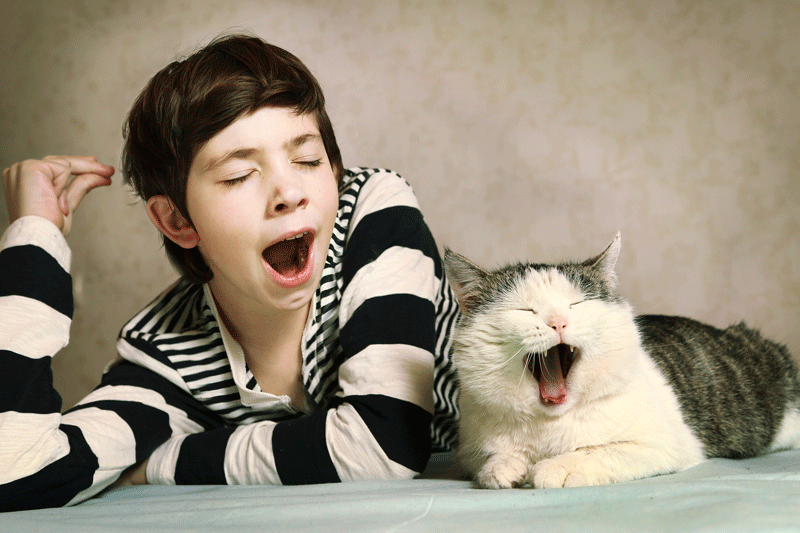
We are exhausted. Can’t stop yawning. It’s been a weird week, with so much non-book stuff happening. It was surreal to launch the book in the same week.
Confluence has been out nearly a week now.
Thank you, all of you, you said some great things about the book.
Lots of you have asked about the next book. We will blog about this later, but we do touch on it in an interview with DJ on MyLifeMyBooksMyEscape which does touch briefly on what we’re doing next.
A huge proportion of high fantasy stories written by western writers are set in worlds based on a medieval European setting. Or not so much real medieval Europe, but the fantasy world the medievalist Tolkien designed.
Tolkien’s world was a made up one.
Many writers base their worlds on his. They don’t change much. Except for the magic, and ‘their’ story, most of them remain true to Tolkien’s setting. Including his now almost-a-hundred-year-old views of a woman’s place in society, and how sex, politics and gender should be treated.
We don’t need that to make a good high fantasy.
What do we need?
A world which has little or no technology, and the subsequent lifestyle requirements from that, like transport, and how people fight
Clothing from another era
The magic, or McGuffin, demons or dragons or whatever makes your story special.
What else do you need to make high fantasy work? Other than a good story and characters to love?
Politics?
Democracies, republics, monarchies, aristocracies, theocracies, dictatorships have been around for millennia. I can’t say I’ve come across many governments in fantasy that you can’t break back to one of the known types of governing bodies.
Gender inequality, skewed toward a patriarchal system, where the girl never inherits, and her husband or her father protects her?
Of course not, but that’s often part of a high-fantasy novel.
Sexual ‘standards’ where there are two genders and men get together with women and and anything else is a deviation?
Again, you don’t need this for a fantasy, but likewise it’s also often standard.
What about treatment of other races, where people of other cultures or color were treated as sub-human, or property? Do you need this for your fantasy to be successful? Most likely not.
Writers might put a bit of a modern-day slant on these things, in the same way Regency romance writers put a modern-day slant on how their women behave. Because for most of us, the way other races, genders, and women, were treated in older times is not okay. But they still write basically the same world Tolkien did.
I, for one, love books that take the gender/sex/race components and mix them around a bit.
Sometimes I feel I’m living in my own science fiction story, but I don’t realise it.
Computers, credit cards, mobile phones, microwave ovens, genetically modified wheat and other plants, 3-D printers, military drones (military anything, really), tablet PCs. The list goes on.
While it’s true some of these were invented before I was born, they only became common in my lifetime.
We haven’t got self-driving cars yet, but here’s hoping we get to them before I get too old to drive. Believe me, I’ll be first in line.
But for someone born in the year 2000 however, their science fiction will be different.
They grew up with computers, so that’s not science fiction to them. Mobile phones, the internet. They’re part of life, in the same way electricity and washing machines are to me.
For them it will be self-driving cars (I hope), commercial trips to the moon (maybe), genetic modification of people (maybe) and a whole slew of other things that I haven’t even thought of yet but some science fiction writer probably has.
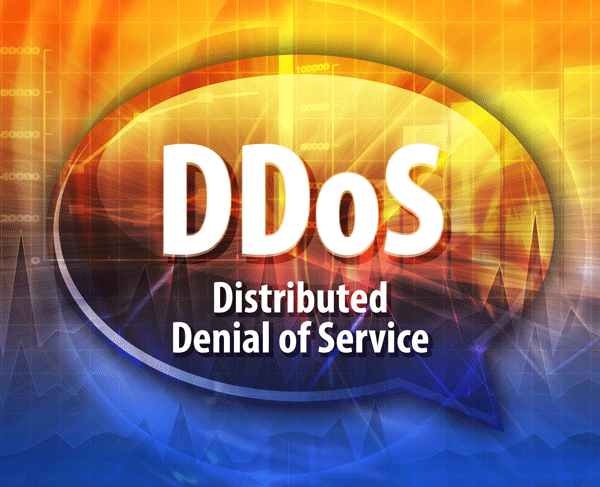
Friday’s internet denial of service attack feels like something out of science fiction. Maybe an apocalyptic novel, or a near future thriller that threatens an apocalypse.
I work in IT. I also run a blog. Which means I know about denial of service attacks. In fact, most Australians do now, for our last census (#CensusFail) was spectacularly disrupted by a denial of service issue.
While we weren’t hit anywhere near as severely as the US last night, it does make you think about how much we rely on the ability to be online all the time. And when we do get an outage, how much it impacts us.
It’s a different world to pre-1980, back before the internet as we know it didn’t exist. Back then Friday’s events would definitely have been science fiction.
Last week we gave you a quiz: What alien am I? This week we give you answers.
Alien One
My people (a whole ship of them) are stranded on a distant planet (Earth) and we want to go home. We have membranous bodies that can’t survive long in the new planet’s atmosphere. We survive by finding hosts to inhabit. Over the millions of years we have been on this world our people have split into two factions. Now we’re at war, and using our human hosts to fight the war for us.
Unfortunately, my last host was betrayed by one of my people who went over to the enemy. I had to find a new host in a hurry.
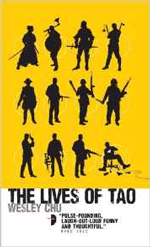
Tao, from the Lives of Tao, by Wesley Chu. Tao is a Quasing, an alien race that can’t live outside of another body (on Earth, anyway). One might call them parasites, although the Quasing themselves might refer to themselves as symbionts.
Alien Two
We begin life as female, become male once our egg-laying years are over and change to something else again at the end of our life. I am currently male. I look like an otter crossed with a gecko, but I walk like a six-legged caterpillar.
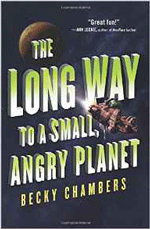
Dr Chef, a Grum, from The Long Way to a Small and Angry Planet by Becky Chambers.
Chambers’ book has been described as Firefly crossed with Guardians of the Galaxy. This is probably not the time to confess that I only saw Firefly about six months ago, when Netflix came to Australia.
Alien Three
I like meat—human, my own race—I’ll eat anything. Although, of course, marines do not eat other marines.
My race has prehensile toes so I don’t like boots.
I can hack into any military system. I am loyal to my staff/gunnery sergeant.
The alien in question, Ressk, one of the Krai from Tanya Huff’s Confederation of Valor series. I love Staff (later Gunny) Sergeant Torin Kerr. If I ever have to suggest military science fiction to someone who has never read it before, this is the series I recommend. It’s lighter than some, which makes it a good introduction to the sub-genre.
Alien Four
I am the captain of an alien fleet. I am being shot at by humans. I surrender.
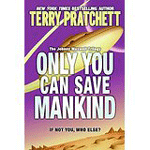
The one, the only, the late, great, Terry Pratchett. Specifically, the ScreeWee captain from Only You Can Save Mankind.
It’s a little dated now–anything with computers dates fast, and back in the nineties, when this book was written, computers were in their infancy. But the Johnny Maxwell books are some of my favourite Terry Pratchett books.
Alien Five
I look like a big pink erector set. My favorite pastime is fining the humans on my planet. I use the money from the fines to buy umbrellas, field glasses and slot machines.
I got the description for this one out of the book, but if you look at the cover, our alien isn’t pink, and he doesn’t look like a crane (which is what I imagine an erector set is, because it’s not a word we use here in Australia).
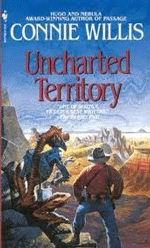
Bult, the alien from Connie Willis’s Uncharted Territory. This is one of Willis’s lighter books. Think Crosstalk, or some of her novellas and short stories like All Seated on the Ground, or Inside Job.
Winter is coming for half the world. For us, Summer is coming.
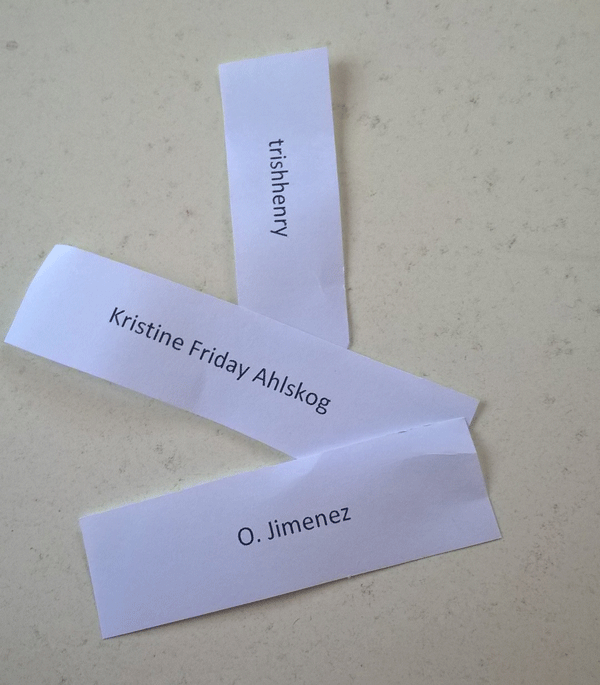
I’m sitting here at our local McDonald’s, blearily trying to calculate whether the onset of daylight saving last night means we have to leave our Confluence giveaway open an hour longer than we said we would. (I know, but the caffeine hasn’t kicked in yet, and I did stay up late reading Connie Willis’ Crosstalk, which wouldn’t have been too bad except I put the clock forward just before I got into bed and suddenly it was 1:30.)
But I am writing.
I haven’t written much over the last few days, so it’s nice to feel the words coming so easily.
Writing can be like that. Ilona Andrews describes it well with her writer’s circle of woe.
Right now we’re both at the ‘Just get to the end, just get to the end’ stage.
Most writers I know go through stages of something similar.
“I love this idea. I love the characters. I’m enjoying this.”
“This book is terrible.”
“Maybe it’s not so bad.”
The trick is to not stop writing. No matter what. Not until a draft is done. Even if you have to find somewhere else to write for a while.
Hence my trip to McDonald’s. We’ve got to get this big first draft finished.
Once that’s done, the next step is to put it away for a while and work on something else. But that’s a while away yet, and another blog.
In other news. Giveaway winner coming soon.
And we’ll put the first chapter up online (as soon as I get home from McDonald’s) for those who want to read it.
Electric lights. Something only half the house has at the moment. Look on the bright side. It’s just finished winter here. It’s dark when we go to work, dark when we get home. If those rooms are dusty, we can’t see it.
How many power points do you need for a computer?
Let’s see. There’s the one for the computer itself. One for each of the two screens. A printer. The backup hard drive. That’s five already.
There are two computers in the office. That’s ten power points. Plus the point for the laptop charger, one for the phone charger, and the one for the iPad. (Actually, we plug the iPads into a point in the dining room, for there are no spare points in the office.) Then there’s the router, and the stereo. The list goes on.
This is the second office we’ve had. We added extra power points a couple of years ago we switched the then-study with the dining room.
Our house was built post-World War II. The switches aren’t that old, but a lot of the wiring is. The fuse box is full of empty fuses that even the electrician has no idea what they do. Not to mention, the fuse box itself is no longer legal.
We know the lighting and power needs work. We’ve known that for a while. We’ve had a lot of electrical problems.
So last week, when half the lights in the house went out, and the electrician spent all day trying to find the fault and couldn’t, we weren’t surprised at the verdict.
“You’ll need to rewire the house. And put a new fuse box in.”
“Sure,” we said.
The head electrician came around to inspect the electricals and give us a quote.
Let me tell you, people, if you’re going to get an estimate for rewiring, make sure the power points are accessible (and it’s a good idea if your house is cleanish). The electrician goes into every room.
I got a bit embarrassed about all the power points in the study and the former study. “Twelve power points along that wall. Six along that wall. ” And in the other room. “Ten on that wall, ten on the opposite. Do you want them all put back?”
“Yes,” I said, because we’re actually thinking of shifting back to the old study. It has better light (or until last week it did, now it has none), and it looks out onto the garden, which makes a nice ambience for working.
I’m sure he thought I was crazy.
“And while you’re here, is there anything you’d like added?”
“Well, the kitchen light’s terrible, and we wouldn’t mind a heat/fan/light in the bathroom, and …”
“I’ll send you a quote,” the electrician says.
The quote arrived yesterday.
Ouch. That’s all I can say.
But I’m looking forward to having working lights again. And there’s an added bonus. If we buy new lights they’ll put them in for us as they do the rewiring.
While Sherylyn is conferencing, I’m living the hard life. Writing a book, of course.
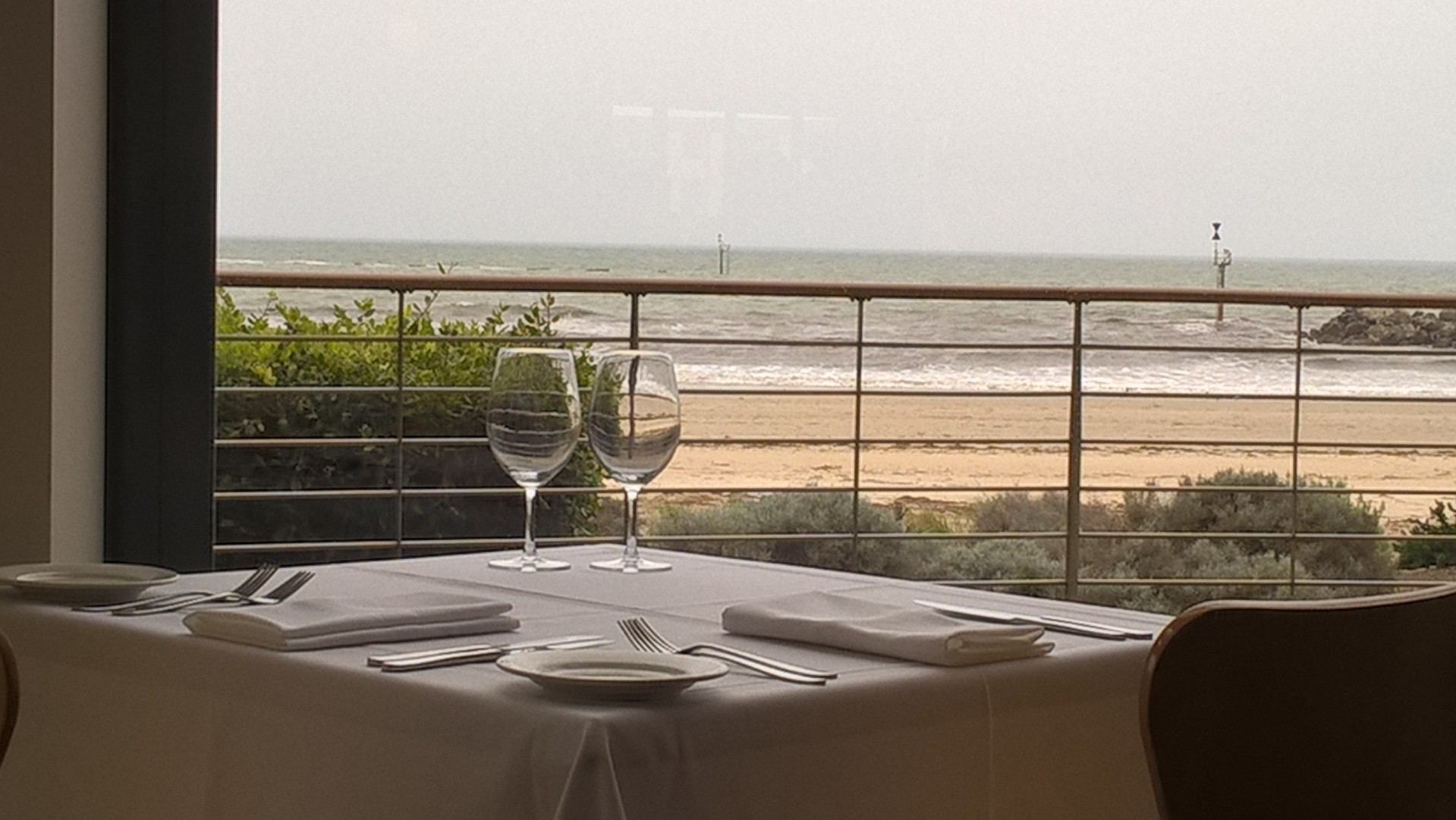
We’re here in sunny Glenelg today. [At least, it’s sunnier now than it was when we arrived on Thursday, believe me.]
Sherylyn’s at the RWA conference, I’m here writing. It’s relaxing, and peaceful (for me, anyway). Especially since I have the next week off and I’m looking forward to relaxing, and seeing more family.
Glenelg is a beautiful place. Very touristy. I’d liken it to St Kilda in Melbourne, or Manly in Sydney. Or even parts of the Gold Coast, only nowhere near as warm. In summer, I imagine, it will be wall-to-wall people, but right now it’s pleasant. It’s got a buzz, it’s busy, but it’s not overcrowded.