Answers to last week’s mystery fantasy quiz.
Stop right here if you haven’t tried to answer the questions yourself, and go to last week’s post first.
Ready?
About us writing our books
Answers to last week’s mystery fantasy quiz.
Stop right here if you haven’t tried to answer the questions yourself, and go to last week’s post first.
Ready?

Australians don’t tip.
Sure we’ll leave the coins at a restaurant after a meal, but that’s as far as we go.
That’s why, whenever you get to a country where tipping is required, you’ll find the first thing the Australians do is talk about tipping. Trying to get a feel of how much to tip, what to tip for, and so on.
We get used to it, but still find it awkward.
I was reminded of this on our recent trip to south-east Asia, because we tipped everywhere, and oftentimes it seemed it wasn’t so much a tip, as actual payment for service. (I know that’s technically what a tip is, but to me it’s a tip when you are also making another base payment for that service. For example, when you have a meal, you pay for the meal. Then you tip as well.)
It got me thinking about what a tip was, and how different fantasy novels would be if there was no tipping.
Maybe no different at all?
First, we have to decide what is a tip and what is payment for services rendered.
Asking a stranger for information
Petra stopped a man dressed in well-made, but faded, clothing. A scholar, she guessed, but not in a popular line of study, for otherwise his sponsors would have provided enough to keep him better clothed.
“Excuse me, but could you tell me the way to the Cascades?”
“The Cascades.” His deep voice didn’t match his skinny frame or the freckles on his face. He moved, and she saw the purple stains on the inside of his cloak. A chemist. Definitely not a career someone looking for fame would choose. “Lady, just follow everyone else. They’re only going one way.”
Petra glanced at the crowd in front of her. There were six streets off the square. So far as she could see, people were going all ways.
She looked back at the scholar, raised a brow.
He pointed. Past the square, half-way up the hill on the other side of town. She could see tiny figures moving over there. All going uphill.
“Thanks.” Her feet were sore. Her legs ached just thinking about the distance.
About now, in a regular fantasy novel, Petra would toss the informant a coin as thanks for his information.
But … in a regular fantasy novel you probably wouldn’t pick this particular guy to get information from, either. You’d be more likely to choose a beggar, or an innkeeper. Someone who expects to be paid for the information they give.
Paying for bathwater
This one’s easy. Not everyone tips the innkeeper when they bring the hot water and the tub. Many times you pay beforehand. Fee-for-service.
On reflection, maybe not much would change. Because often what people do in fantasy is fee-for-service, rather than a tip.
Except perhaps, protagonists might get less information.

Every life experience is grist for the writing mill, writers are told. Write what you know.
Right now, we’re in Kampuchea (Cambodia). We’ve visited a number of places in the Angkor heritage area—Angkor Wat (temple), Banteay Srei (temple), Angkor Thom (village), Ta Prohm (temple).
So I decided to take some of our experiences of the last few days and use it as a writing exercise.
Not all of it, for otherwise this would turn into a homage on the engineer(s) who designed Angkor Wat—so heavy its foundations can’t support it, except for that fact they built a massive moat around it (190m wide and it forms a rectangle 1.5 km x 1.3 km) and the water mixes with the earth underneath so it acts like quicksand.
Mid-afternoon, Vianne made Stephan quicken his pace. “Gates close at sunset,” she reminded him. “Otherwise we’ll be stuck outside till morning.” With a hundred cutthroats eyeing their well-made linens, wondering just how fat the purses around their necks were. And another hundred touts trying to get them to stay at ‘their’ establishment. For a nominal cost, of course, and probably no longer any purse to pay with in the morning.
“It’s twenty years since I was last in a city that locks its gates.”
“You know your trouble, Stephan.”
“Peace has made me soft. I know.” But he quickened his pace. “If I go any faster even my sweat will be sweating.” He sighed, a long, heartfelt moment of anticipation. “I’ll be glad to get these boots off, at least. “
Vianne had changed to sandals two weeks ago. And long linens to cover her legs so they didn’t get burnt. She’d insisted on the linens for Stephan as well, but she’d let him keep his boots. There was only so much you could do for a southerner before they stopped listening.
A trickle of her own sweat obscured her vision. The sweat was rust-coloured. As was she, top to bottom. Her legs were red. Her feet were red. Her robe was red, and ready to stand up by itself.
She wiped the sweat away.
“And into some clean clothes,” Stephan said. “I’ve sweat so much I can’t even take a shit without fighting to get my pants back on.”
Vianne just wanted to wash her hair. Or shave it off. It was thick and heavy, and weighed her down.
They reached the gates with the last of the stragglers.
The guards—perhaps sensing strangers—crossed pikes in front of them. “You’re too late for tonight,” the darker woman on the left said. “Gate’s closed.”
Anyone care to take a guess at which bits were actual experience, and which bits were made up?
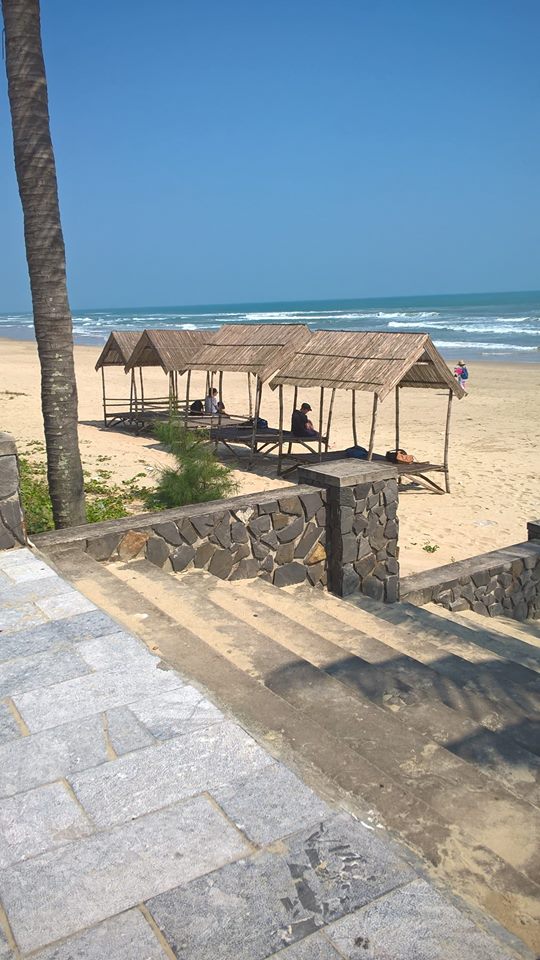
This holiday was supposed to be a combined writing/travel holiday. We planned to write the first draft of the second Uncharted Stars book (not yet confirmed as the book to be accepted, but we want to do a quick first draft to see how it goes).
Our tour—and we did book a tour, this being our first time in south-east Asia—supposedly had every two spare days out of five, and lots of spare time.
That hasn’t been the case. Today is the first day we’ve been able to sit down and write. Busy, busy, busy.
We’re having a great time, but definitely not writing much.
Still, I planned to write every day. So, I have. Even if it was only one sentence.

I wasn’t planning on writing about Vietnam (or anywhere on our travels). If you’re interested, Sherylyn will be posting on Facebook, but we’re here, and the other blog I planned is trite and ordinary. Or maybe I’m just in holiday mode, so you might get more holiday posts after all.
Anyway. Vietnam. Hanoi. The traffic!
The lady who met us at the airport was lovely. “Some advice,” she said. “Crossing the road. The traffic here in Hanoi can be daunting. Just copy what the locals do, cross when the locals cross. And if you start to cross, don’t hesitate. Just keep going.”
Believe me, if you need one piece of advice for Vietnam, that’s the advice you need. Even on the way into Hanoi proper people ran red lights, cut across in front of our driver and did all sorts of crazy things. We both agreed, we’re never going to drive in Vietnam.
After we booked in to hotel, we decided to go for a walk.
This was Saturday afternoon, mind. It was crazy, and as for the pedestrians, they just stepped out into the middle of it all. It was terrifying.
We ended up going around the block, because we were too scared to cross an actual road.
So this morning, we spent a couple of hours practising crossing roads.
It’s a big leap of faith, and still scary as anything, but we managed it.
Now we have to get up and do it all again tomorrow.
 Came home tonight to find we’ve been shortlisted for the Aurealis Awards for best sci-fi novel.
It’s such an unexpected honor to be nominated. We’re almost expecting them to come back and say, “Oops, mistake. Sorry.”
Unexpected, but not unwanted. We’re thrilled to be in such exalted company.
Look at the competition.
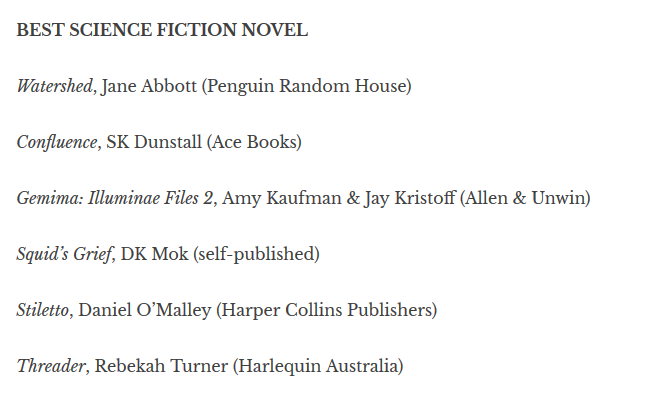
Congratulations to everyone else for their nominations. (And not just the sci-fi novel. There’s some great stuff here.)

Not much of a blog today. We’re both recovering from a drive north. The temperature up there was 42.3 C (108F), and we had no air conditioning in the car.
Hot is an understatement.
The drive back today was bliss, for the weather had changed.
Actually got a couple of story ideas out of it. Extreme weather conditions. We’ll let them germinate a while, see if any characters attach themselves to the story. If, in a few years time, you get a story from us about the weather, you’ll know this was where it started.
I’m off to have a snooze. It was too hot to sleep last night.

Over on Goodreads, a reader asked about Wendell’s age. We answered the question over there, if you want to read it but Wendell is actually a character we have a lot of backstory for. We thought you might be interested in some snippets.
The Cord Gambits were a series of two hundred and four war scenarios proposed by General Cord three hundred years prior to the start of the Linesman novels.
They were supposedly unbeatable, and were given as part of the final exams for students passing out of the Wallacian Fleet Academy. The idea being to show the newly-trained soldier that sometimes you couldn’t win.
The only person to ever come up with a solution for one of the scenarios was Piers Wendell. (He actually came up with solutions for two of them.)
Wendell was young when he made captain. Too young, some people said
A soldier isn’t normally considered for captaincy until his/her late forties, and usually not appointed as one until they were in their fifties. First, because captains need experience. You don’t want a raw soldier in charge of a ship. And second, ship captains stay with their ships, so once they take up that role, that’s as far as they go, career-wise.
Yet Wendell was thirty-two. (He’s thirty-nine now.) The youngest captain in any known fleet, ever. Why didn’t Wallacia wait?
Wendell was a brilliant strategist. He worked his way quickly up through the ranks. The Wallacian fleet didn’t want to lose him. Some saw him as a potential future leader of the fleet. But Wendell was getting bored, thinking about leaving the fleet altogether.
There was one sure way to keep him there. Give him his own ship, let him bond with it, and he’d remain in the fleet forever.
Wendell has steadily been working through the Cord Gambits ever since.
His crew bet him they could come up with a solution to one of the gambits as well. If they did, he’d have to dye his hair for a year.
It took months, lots of ‘what would the captain do now’, and precision teamwork, but they did it.
The crew chose the hair colour.
In Confluence, that twelve months was just up. Wendell was growing out the dye, but the crew had spent the last twelve months working on a new gambit and had just come up with a solution.

Nowadays, I enjoy songs like Dean Martin’s That’s Amore, and Johnny Cash’s Ring of Fire, yet as a kid, I didn’t like them.
Growing up, my parents loved the Dean Martin show. I didn’t. I was a puritanical little thing, with no sense of (adult) humour at all and to me Martin was a drunk, and he wasn’t even funny. (The drunkenness was an act; he drank apple juice stage.) Worst of all, he sang old-fashioned songs.
My parents also loved Johnny Cash. Not for me. He was so old.
I was into pop songs.
None of us—parents or me or anyone else in my family, I think—ever got into the Beatles. Our parents were too old for them, we were too young.
Yet all through the 70s, 80s, and even into the 90s, we were told “the Beatles are the greatest band ever”. Nowadays, ask anyone under about the age of 30 who the greatest bands is and you’ll more likely get U2 or Coldplay than you will the Beatles.
Back when my parents were younger, Dean Martin and Frank Sinatra featured on almost everyone’s list of greatest musicians. You don’t find them on many lists now, yet if people are reminded about them, they will admit they were good for their time.
I was thinking of this when I popped over to the Worlds without End and started reading James Wallace Harris blog, Falling Off the Classics of Science Fiction List. He was talking about books that had been removed from the Classics of Science Fiction list.
When books fall of the list, it doesn’t mean those books are unworthy of reading anymore, but that readers are forgetting them.
I have read most of the books on the Classics of Science Fiction list. I enjoyed (some of) them at the time, but few of them make my own personal classic list.
Really, what makes a classic a classic?
James Wallace Harris, on the Worlds without End blog again but this time in Why do you love the science fiction you love says:
Sometimes I feel there’s no such thing as a great book, at least not in a measurable sense. The books we think are great are merely the ones that reflect our strongest desires. They don’t need to be well written, brilliant, or literary. They just need to trigger emotions.
Yes, and so much yes. This.
When people start reading science fiction, they’re often told to go read the classics.
I think that’s the worst thing you can do to a budding science fiction reader. It’s like telling them, “You must listen to Dean Martin and the Beatles. They’re the only real singers,” when the reader’s taste runs to Lin Manuel Miranda or Taylor Swift.
Harris again (from Why do you love the science fiction you love):
I do love modern science fiction, and often think it better written and more sophisticated than my favorites here. And I do prefer the diversity of modern SF.
Me too.
Later, he says:
My favorite science fiction is 50 years or older… these are the stories burned in my memory. I read most of these stories before I turned 20. It might be our life-time favorites are the books we read in youth. First impressions are often the lasting impressions.
I’m the same. I love the modern stuff, but some of my favorite stories are old ones. And many of my favorites don’t make the classics list. These stories don’t always age well. They struck a chord at the time, but for someone reading them for the first time in this day and age, they won’t have the same impact.
So next time someone says, “I haven’t read science fiction before, where should I start?” don’t recommend the classics to them.
Recommend something modern. Something written in the last couple of years. Something you think they might like.
The time to read the classics is afterwards, when the new reader is enjoying the genre, and they’re interested in what came before.
90% of the books I read this year (that both of us read, I think), were eBooks.
Here are some that we read in 2016, and liked. Not all of the books are new, they’re just books we read. Some were re-reads.

All thirteen books.
A reader on our blog recommended these, so we thought we’d take a look. Thirteen books later … yes, not too bad.
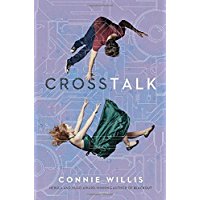 My favourite Connie Willis novel is To Say Nothing of the Dog. My favourite short stories of hers are those like All Seated on the Ground. Crosstalk is in the same vein. I enjoyed it a lot.
The first few chapters the writing is so fast paced I almost ran out of breath reading it, but it settled. A good, fun Connie Willis story which also says some pointed things about social media and society.
(Someone described Genevive Cogman’s Invisible Library as Jim C. Hines’ Libriomancer crossed with Willis’ To Say Nothing of the Dog. Guess what’s on my to-read list this coming year.)
Sherylyn read, and loved, both Anne Bishop’s Marked in Flesh and Robin Hobb’s Fool’s Quest. I haven’t read either, as work was super-busy during those months, and any spare time was for book deadlines. I’ve got them both saved up to read when I take leave in March, now.
Last year we rediscovered Tanya Huff’s Valor series as eBooks, and re-read them. We’ve always liked this series. Highly recommend it to anyone who’s looking for a light introduction to military fantasy.
Ditto C. J. Cherryh’s Hammerfall and Forge of Heaven.
Note how many of those books were by female authors. Most of them.
We don’t deliberately go out of our way to read books only by women. In fact, there are a couple of books I’m hanging out for. One of them is Curtis Chen’s Waypoint Kangaroo. Which has been out in hardcover for six months now. It’s A$35, which is more than I want to pay, given I can buy three, or more, eBooks for the same price.
In the US you can buy Waypoint Kangaroo as an eBook. Here in Australia we can’t yet. In the last twelve months it seems that rights have changed, or DRM has been tightened. Or maybe publishers are changing the rights they buy, and only buying North American rights for electronic books as well. I’m not sure what, but all I know is I used to be able to buy pretty much anything I wanted as an eBook off Amazon.com (as an Australian, with an Australian ID and address). Now I can’t.
John Scalzi’s Collapsing Empire (a book I want to read when it comes out) is another book I can only buy in hardcover, not as an eBook. Yet I can see from the Barnes and Noble site that there is an eBook version. Here in Australia we can’t buy B&N books.
The weird thing is, the books I can buy seem entirely skewed toward female writers. I can only assume that female writers sell World Rights to their books, while male writers sell North American rights. Or something.
I’m sure there’s a reason, but it’s frustrating to see all these books you want to read, but can’t get hold of except at very high prices, and only as paper. Especially when you know others can get them electronically.
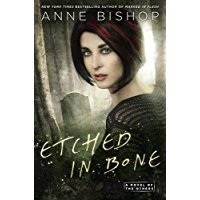 I’ve already mentioned Robin Hobb. Her third book will be out.
Sherylyn’s waiting for Anne Bishop‘s Etched in Bone. It’s on her must-read list.
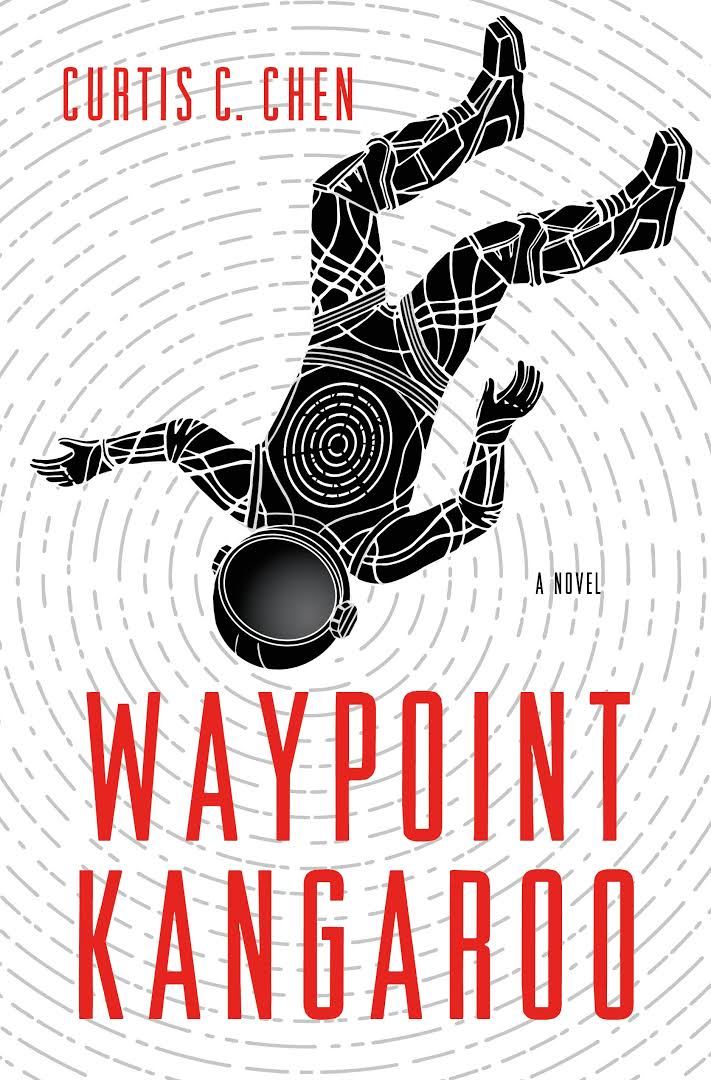 Waypoint Kangaroo, if I can ever get a copy. I have wanted to read this book ever since Chen posted his query on Janet Reid’s Query Shark. A long, long time ago.
 Revenger, by Alistair Reynolds. I like the idea of this one. Sounds like Forerunner* stuff, which obviously we love, given our own stories.
I also heard that the new Anne Leckie is due out this year. I haven’t seen any confirmation of that, but if it is, I’ll be in line.
Every year The Qwillery has a debut author challenge, where they challenge you to read a debut author a month. I find a lot of interesting books here, but I don’t tend to read them until a year or two after they’ve been out.
This year I’m going to improve on that. I’m going to read one debut author a month.
* Forerunner, with a nod to Andre Norton, who came up with the term that means rediscovering the advanced technology of ancient (often alien) civilisations.