This morning Sherylyn and I had a working breakfast. We do this roughly once every two months. We go down to a local café, where the seats
are comfortable, and we can linger over coffee.
Sometimes we talk about the current story we are writing, sometimes we
talk about future writing.
Today, we talked about future stories we want to write.
It turns out that we have seventeen story ideas in train.
That’s right. Seventeen.
Some of the stories are written to first draft or
beyond. None of them finished, mind, but
some close enough to consider one-more-draft-and-then-ready-to-send-to-our-agent
finished. Others are little more than
ideas that we want to work on.
So why aren’t we finishing the nearly-completed ones and
sending them to our agent? Two
things. Time and genre.
First, we need time to do that last draft before we send to
our agent. We both work full time, we’ve
a book we must deliver. We have no time to complete other stories.
Second, not all of these are science fiction.
Some of them are out-and-out fantasy. We even have one rural
fantasy, set in the hot, dry landscape of Australia’s Mallee region.
Some of them are mashups—science and fantasy. (Some readers might say that’s little
different to what we have now.)
There are several portal world stories—where the portal is a
teleport to another world in our universe, rather than a portal to an alternate
reality.
Plus lots of other fun ideas.
We don’t know if any of these stories are saleable. What we do know is that the ones that we have
already written/part written were fun to write.
That’s important, because above all, you should enjoy what
you write.
Sometimes the writing flows, sometimes it doesn’t, and while
I prefer writing on a desktop to a laptop, the first drafts of our novels have
been produced on laptops. That’s because
many of them have been written on our work commute.
The first basic requirement for me has always been, “Can
the laptop fit into my handbag?”
This is my third laptop since we started writing the
Linesman novels. The first was a little 10”
Acer Aspire netbook that even ten years ago only cost around $300. It was
a solid little workhorse that lasted four years. The second was a slightly larger laptop (11”)
that weighted four times as much.
That laptop put my back out, broke at least two bags, and
crystallised my second requirement. “How
heavy is it?” Carrying four kilograms of
PC every day wasn’t fun.
I bore it for six months, then bought the little Sony 11”
Vaio that I’ve had for the last five years.
That’s nearing the end of its life, now. The shift keys are broken. I have to press hard on other keys to make
them work. The touchpad isn’t sensitive
any more (thank goodness for touch screen functionality, which has saved my
writing lots of times), and it keeps selecting chunks of text (sometimes the
whole novel) with disastrous consequences if I don’t notice and typing.
Four to five years seems to be the average life of my
laptops. That’s pretty good, given the
amount of work they do.
It’s time to go shopping.
Charles Babbage built his analytic engine back in
1837. Konrad Zuse built the first programmable
computer, the Z1, in the 1930s. (He
built it in his parent’s living room, and if you’ve ever seen a picture of it,
it was a big machine. He must have had very
forbearing parents.) Every one of us
alive today was born in an age of computers.
There’s a massive difference between a computer bought in
the year 1998, and a computer bought in 2008.
Not so much between one bought in 2008 and 2018. I mean sure, there’s more memory and more
power, and some of them are a little lighter, and there are a few more apps, but
you know what I’m going to be using my new laptop for? Word processing. And that’s exactly the same thing I was using
it for ten years ago.
I’m even going to be using the same word processing
software. Microsoft Word.
Sure, we have things like mobile phones and tablets
nowadays, but try writing a story on them.
Until writers come up with a different way of writing stories—maybe by
dictation—we’re still going to need a keyboard and a screen. That limits the technology somewhat.
How did you go with last week’s quiz, where we asked you to identify the book, movie, television series, play or poem based on a few words
1. 42
Hitchiker’s Guide to the Galaxy a novel by Douglas Adams.
The number 42 was the answer
to the ultimate question of life, the universe and everything. A super computer,
Deep Thought, was created to come up with the answer, which it did, although it
took seven and a half million years to do it, and by then, no one knew what the
original question was.
2. A handbag
The Importance of Being Earnest a play by Oscar Wilde.
As children, we devoured books, especially second-hand books we’d get from the opportunity shops. Back in those days, there were a lot books about girls going to boarding school. The Merry books, by Clare Mallory, were our absolute favorites. In Merry Begins (I think), they put on a play—The Importance of Being Earnest—and that line, about the handbag, came up in the book. It wasn’t till years later that we actually saw the play.
3. As you wish
Princess Bride. The
book was written by William Goldman—which I confess I haven’t read—but I have
seen the movie so many times I can almost say the lines along with the
characters. There are so many quotable quotes.
“Inconceivable.” “Have fun
storming the castle.” “Only mostly dead.”
And, of course, the absolutely unforgettable, classic, “My name is Inigo
Montoya. You killed my father. Prepare to die.”
4. Beam me up
“Beam me up, Scotty,” is from Star Trek, the original
series. Can’t say any more than that.
5. Elementary
I believe that in Arthur Conan Doyle’s books, Sherlock Holmes never said “Elementary my dear Watson.” That came later, in the films. Although Holmes did say the word, “Elementary,” in The Crooked Man.
The word—the phrase, in fact—is, however, indelibly associated
with Sherlock Holmes. So much so that a
recent television series about a modern-day Holmes and Watson was called
Elementary, and no explanation of the title was needed.
6. Frankly, my dear
A little bit of a cheat on this one, because it usually
comes with the rest of the sentence. “Frankly
my dear, I don’t give a damn.”
Yes, it’s Rhett Butler in the 1939 movie Gone With the Wind. In Margaret Mitchell’s book the film was based on, I believe he said something more along the lines of “Frankly, I don’t give a damn.”
7. Friends, Romans, countrymen
Marc Antony’s speech from William’s Shakespeare’s Julius Caesar. As children we had this game where we’d go around saying, “Friends, Romans, countrymen, lend me your ears, and we’d all make a play of taking off our ears and handing them to the person who asked.
The things kids do.
Even if you don’t go to see Shakespeare’s plays, he’s beautiful to read—aloud or silently. He has this amazing way with words. Not to mention, there’s so much that quotable.
8. Here, kitty, kitty, kitty
Yes, Kate Daniels’ first book. Ilona Andrews’ Magic Bites, when Kate first meets Curran.
9. Houston, we have a problem
This quotation comes from the 1995 movie, Apollo 13, starring Tom Hanks, Kevin Bacon, Bill Paxton, Gary Sinise and Ed Harris.
It’s not quite a direct quotation from the real Apollo 13 mission, but they did say something similar.
10. I ate’nt dead
Esmeralda Weatherwax, from Terry Pratchett’s Discworld series. Esmerleda goes out borrowing other bodies and while she does, her own body remains in a comatose state. Hence she wears a sign “I ate’nt dead” to avoid embarrassing accidents. (Note, ate’nt is where Esmeralda puts the apostrophe.)
11. It’s just a flesh wound
Monty Python’s film, the Holy Grail. It’s said by the Black Knight, after he loses both arms.
12. More like guidelines, rather than rules
The actual words are “The code is more what you call guidelines, than actual rules.” It comes from the movie Pirates of the Caribbean. Captain Barbossa says this to Elizabeth, after she tries to invoke the pirate code.
13. My preciousss
I added the extra s’s myself. From The Lord of the Rings films. Gollum, of course.
14. No man is an island
This comes from a poem of the same name written by John Donne. There are two quotable quotes from the poem, the other being “for whom the bell tolls”, but that’s also the name of a novel published by Ernest Hemingway, so I used “no man is an island” instead.
15. Shaken, not stirred
Yes, Ian Fleming’s James Bond
loves his martinis shaken, not stirred.
16. The best laid plans
Another poem, where the common quote isn’t quite the same as the real thing, because the actual words are “The best laid schemes”.
This is from Robbie Burns poem, To a Mouse. Again, another poem I love to read aloud and silently. Great poem.
17. To infinity and beyond
Buzz Lightyear’s famous catchphrase from the Toy Story films.
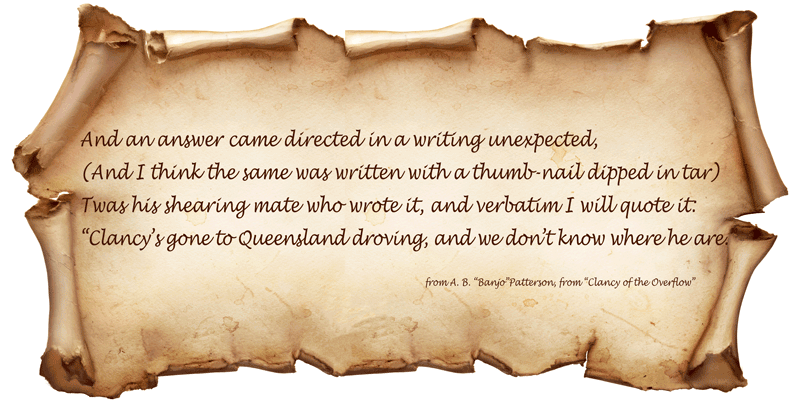
18. We don’t know where he are
A. B. (Banjo) Patterson is one of the giants in Australian literature. This from one of his best-known poems, Clancy of the Overflow.
19. What is best in life?
Conan the Barbarian. The quote
comes from the 1982 movie, not from the Robert E. Howard books. I believe the scriptwriter took the quote
from an earlier book about Genghis Khan, not written by Howard.
While I know the quote, the
closest I’ve ever been to Conan is a beta read I did of another author’s
book. He told me it was in the style of
Conan the Barbarian.
“I haven’t read Conan,” I
said, “But I’ll beta read if you want me to.”
I can’t remember how good the story was or wasn’t, because by the end I was so frustrated by the women in the book, who were all dumb objects, just along to further the main character’s story. If I recall my critique came back something along the lines of, “I found it difficult to warm to your protagonist. I also feel you are likely to alienate half your potential readership by your portrayal of women. Maybe you should give them more active roles.”
From what I’ve read since, the author sounds as if he got exactly what he was trying for. A Conan-type story. I have to say, my feedback was useless to him.
20. You can’t handle the truth
Jack Nicholson’s immortal line in the 1992 movie A Few Good Men.
Daniel Kaffee (Tom Cruise): “I want the truth.”
Colonel Jessup (Jack Nicholson): “You can’t handle the truth.”
Whoa. This year is
zooming by. This post comes to you an
hour earlier than normal, courtesy of daylight savings, which started last
night. We were just saying this morning
how lovely it was to wake to full daylight, too. (I’m not sure whether to be happy or
concerned that this year all the clocks in my house adjusted their time
automatically. Including my chill alarm clock,
because everything’s online.)
At work we’ve already started the mad scramble to
Christmas. Booking holidays, booking
end-of-year functions. Honestly, once
upon a time we’d just book the local pub a couple of days before our
end-of-year party and we’d all trundle down.
Nowadays, you book in October, or earlier, and places can still be
booked out.
In no time at all, it’ll be 2019.
But, in the meantime, let’s have some fun. There are some words and phrases that you can
instantly associate with a book, a television series, a movie, or even a play.
“I’ll be back,” for example, is forever associated with the Terminator movies. So here’s a list of—for us—well known words or phrases that we associate with a specific book, movie, television series, poem or play.
Good advertisements are entertaining and emotional. I’ve talked about Audible Australia, which
takes famous songs, and ‘audibilises them”. They’re simply entertainment.
Then there are the ads that truly inspire you and make you
feel better about the world, like the recent Shell ad I recently saw on twitter
about gravity lights. As as
advertisement, mind you, it worked. Because the first thing I did after I saw
the ad was google gravity lights.
I found a TedTalk on the gravity lights, and was so impressed I’m sharing it here.
Sometimes I wonder if Agile methodology was invented by 3-M and Sharpie, because Post-It notes and Sharpies are staples
I work in the computer industry (also known as IT industry,
where IT stands for Information Technology).
There are a number of basic methodologies for developing software in IT,
but the two big ones are Waterfall and
Agile.
Waterfall development, also known as traditional
development, is a method where you do each step—analysis, design, code, test—sequentially.
The problem with waterfall is that it’s
hard to change direction. You don’t know if the whole thing is going to work
until it’s done and out in the public.
Agile breaks the work down into smaller tasks. You work on one set of tasks, and then loop around to do the next. In general, this improves the quality, because you’re testing right from the start. It also allows you to change direction quickly if you find something isn’t working.
If we were to use these methodologies in writing, then the process by which a traditional publisher publishes a book would be Waterfall.
Publisher acquires a book
Schedules publication date
Author delivers the book
The editor edits it
Author revises
Cover copy is written
Cover is designed
Copy editor edits the book
Author reviews edits
ARC is produced
Book is printed
Printed copies are sent to bookstores
Publication day
The list above is not necessarily in order, and it’s only an approximation of all the work that is done.
Authors who are traditionally plotters would also work via the Waterfall method.
Story idea
Plot out the story
Write the story, one plot-point at a time
Edit the story
Send to editor
While authors who are pantsers work more to an Agile
methodology.
Story idea
Start writing
Edit what you’ve written
Write some more
Edit that, and so on until you’re done
Send completed story to editor
An agile purist would probably be horrified at my analogy,
because in reality it’s more like writing a serial, with reader feedback every
week.
Story idea
Write an episode
Revise
Publish
Listen to feedback from the readers
Write the next episode, taking into account the
reader feedback
This is not a picture of my new clock. This one is a lot more futuristic, but I swear the AI inside my clock loves soothing world music.
My alarm clock died. It was an old am/fm clock radio I’d had
for years. Probably at least ten. I mean, how often do you think to change your
clock radio? For a while I did the modern thing—used my phone as an alarm
instead—but it was tedious having to pick up the phone to see the time when I
was used to waking up and glancing at the clock. Anyway, nights were for
charging phones, not using it, and the charger was in the other room.
So I bought a new clock.
A new DAB radio, and I could connect through to my phone
onto if I wanted to, with lots of features. Want to have a weekday alarm and a
weekend alarm? Yes, please. (I know, some people would turn the weekend alarm
off, but I like waking to music.)
I followed the instructions. Set the time. Pre-set stations. Set the alarms.
It was so easy to set up.
It took time to work out what stations I wanted to hear. I
want a mix of old and new music, with a bit more emphasis on the new.
(Middle-of-the-road if such a term still exists.) News on the half-hour, weather. Not too much
talkback.
Talkback drives me crazy when I’m just waking up. And before my radio died it only got one
station for six months. A golden-oldies station that stopped at the Beatles era. About then, if I never heard a fifties song
again, I’d have been happy. Especially
when they all sounded so tinny on my old, dying radio.
I chose a weekday station and set the alarm. Again, it was easy.
Now for the weekend station.
What should I choose?
I scroll through my options.
Chill. What’s that? I check out the details. The
soothing sounds of world music.
I like world music.
Soothing sounds. I imagine the music
they play at meditation groups and when you go to the beautician. What about waking up to that? I can lie in bed and relax for half an hour
before I get up.
I listen to half a song. Not great, but okay.
I set my weekend alarm an hour later than weekdays. I don’t want to sleep in too late, but I want
some sleep in.
I’m all done, and it was so simple.
For the next week I enjoy waking up to an alarm I can hear,
an alarm that doesn’t play fifties music. Bliss.
Then comes the weekend.
I’m dragged awake by the most awful music. I listen to it for half an hour and pull
myself out of bed. I can’t listen any more.
Next day, it’s the same.
Two weeks of this and I know I have to change it. I scramble out of bed and find the first
station with a song I like. Bliss. I’m so happy I go back to sleep.
Next day the alarm comes on.
Guess what it’s playing?
Chill.
This time I go back to the setup guide that came with the
clock. I follow the instructions exactly as per the guide. I select my station, set the alarm. Next day, what comes up?
Chill.
I change the pre-programmed station, wipe Chill off the pre-programmed
stations. Reset the weekend alarm and
wait a week.
Come Saturday morning.
Chill.
It’s as if there’s some malevolent demon inside the clock and
really likes Chill music. But I am not
going to let this clock beat me. I’ll
keep trying.
A concept for self-driving cars. Note, this is totally impractical for older people. The seats are too low. Old people need seats they can sit on, without having to drop into, and they want to be able to twist, and not have to lift their feet too high. I liked the computer idea, thought that on her shopping trips Mum might like to check Facebook (she was a big Facebook user), but after shopping she was always tired, so a seat that reclined would probably be better. She could snooze all the way home.
A group of us were sitting around this morning, discussing our parents getting old, some of the problems that caused, and how we can alleviate them.
Loneliness is one problem.
Many of our parents had lost a partner, lost many of their close friends. Or their friends have moved away. For us, a friend moving, say, two suburbs away isn’t much, but when you have limited mobility it becomes a major problem.
Many older people lack mobility. They can’t walk as far, or as fast, due to problems with hips or knees or their back. Many of them can’t drive any more due to vision problems.
Lack of mobility makes you housebound. It becomes harder to go out and do things, which makes it harder to talk to people, which in turn ends up making you lonelier. It becomes a vicious circle.
This is not just old people, by the way. It impacts everyone. It just happens that we were discussing old people, our experiences, and some of the problems.
A lot of the things we could do to make lives better for our elderly parents took place during working hours. Exercise classes, craft sessions, friends getting together. Which we couldn’t get to, because we were working.
We talked about how not being able to give our parents their freedom made us feel helpless.
Giving up your job, your life, to look after a parent is sometimes the only thing you can do. But most of the time, that’s not optimal. There’s the money aspect, of course, but there’s also the dignity, the freedom for the older person. They don’t want to be reliant on you. (Or our parents didn’t, anyway.) They want their own life, but they want it to be happy and fulfilled.
They certainly don’t want to have to rely on someone else.
It’s one reason I can’t wait for self-driving cars.
Seven years before Mum died she lived in a small country town which had a post-office/shop and that was it. Even the local pub, which used to be open Friday and Saturday nights, had closed down. She drove 100 kilometres for groceries, and she was losing her sight. So we moved her across the state (a move of 400km) to be closer to her family.
If we’d had self-driving cars, she could have stayed in her own home longer.
Mum left most of her friends behind when she moved, and while her new town had family, with her limited visibility it was still hard to go out and do things on her own. She had to wait until one of her children was available to take her shopping. There were exercise sessions she was encouraged to go to, but she had to take a taxi to get there. She couldn’t go to places like craft classes, because most of them were in working hours.
She was tied to our schedule, not her own.
If we’d had self-driving cars she could have gone where she wanted to, when she wanted to. It would have given her back mobility, which would have given her back her freedom.
That’s no small thing.
(Mum moved into an aged care facility six months before she died. She loved it. There were people around to talk to. They ran classes. They had concerts, and excursions. She could do things again.)
Gregor Mendel’s painstaking work with pea flowers established the rules of heredity, which led on to further discoveries about genetics.
I’m slowly working my way through Alanna Mitchell’s The Spinning Magnet. It’s non-fiction, a book about the north and south magnetic poles switching and the impact that might have. The book caught my interest because we have an old story based around this idea that we’d love to revive. We shelved our original story because we thought advances in technology meant the switching wouldn’t have as much impact as we had originally believed.
We’re thinking of resurrecting the story because, according to Mitchell, something like this could still do a lot of damage to infrastructure and the environment.
Mitchell starts by giving the history of the discovery of electromagnetism.
What struck me, as I read, is how many people got parts of the theory right years before their part of the theory was accepted as fact, but were laughed at by their peers.
Alfred Wegener, for example, came up with the theory of continental drift back in 1915 and was criticised for it. It wasn’t until the 1950s that the theory became popular. (Continents drifting on a molten core is important to the concept of Earth as a massive electromagnet.)
But it’s not just electromagnetism where important findings are overlooked.
Nowadays, Gregor Mendel is known as the father of genetics, but while he was alive his paper on his garden of peas and his theories of inheritance were ignored while he was alive. Nowadays he’s known as the father of modern genetics.
You wonder how many other scientific discoveries are out there, even now, that are being derided or ignored. Or discoveries that people don’t publish because they didn’t want to be ridiculed.
Charles Darwin sat on his theory of the origin of the species by natural selection for years before publishing it. Not until a young, upstart scientist/writer by the name of Alfred Wallace sent him his (Wallace’s) own paper on his theory of natural selection which he’d developed from trips to the Amazon and the Malay Archipelago.
A year later, Darwin published his paper.
(To be fair, in between, he published a paper with Wallace, and he and Wallace apparently supported each other over the years.)
Alfred Wallace was well-known during his life, yet it’s only recently that he’s come back into favour. Most of us learned about Charles Darwin, we didn’t learn about his contemporary.
And what about poor old Mendel? I learned about Mendel and his peas in secondary school, and again at university. It’s only when we were researching genetics for Stars Uncharted that we discovered that if it hadn’t been for someone dredging up an old paper nearly fifty years after Mendel wrote his intial paper, we might never have known his about his painstaking research.
Maybe there’s something to be said, after all, for the academic ‘publish or perish’. At least academic papers are electronic nowadays. Put the right search terms in and someone up comes your work. Maybe they’ll quote it.
Or a science fiction writer might even find it and pick it up as an idea that might just work. You never know.
It wouldn’t be the first time a writer has picked up a crazy, seemingly far-out idea that was later proven to be factual.