Winter is coming for half the world. For us, Summer is coming.
I’m sitting here at our local McDonald’s, blearily trying to calculate whether the onset of daylight saving last night means we have to leave our Confluence giveaway open an hour longer than we said we would. (I know, but the caffeine hasn’t kicked in yet, and I did stay up late reading Connie Willis’ Crosstalk, which wouldn’t have been too bad except I put the clock forward just before I got into bed and suddenly it was 1:30.)
But I am writing.
I haven’t written much over the last few days, so it’s nice to feel the words coming so easily.
Writing can be like that. Ilona Andrews describes it well with her writer’s circle of woe.
Right now we’re both at the ‘Just get to the end, just get to the end’ stage.
Most writers I know go through stages of something similar.
“I love this idea. I love the characters. I’m enjoying this.”
“This book is terrible.”
“Maybe it’s not so bad.”
The trick is to not stop writing. No matter what. Not until a draft is done. Even if you have to find somewhere else to write for a while.
Hence my trip to McDonald’s. We’ve got to get this big first draft finished.
Once that’s done, the next step is to put it away for a while and work on something else. But that’s a while away yet, and another blog.
In other news. Giveaway winner coming soon.
And we’ll put the first chapter up online (as soon as I get home from McDonald’s) for those who want to read it.
Advance reader copies, or ARCs. Also known as galleys.
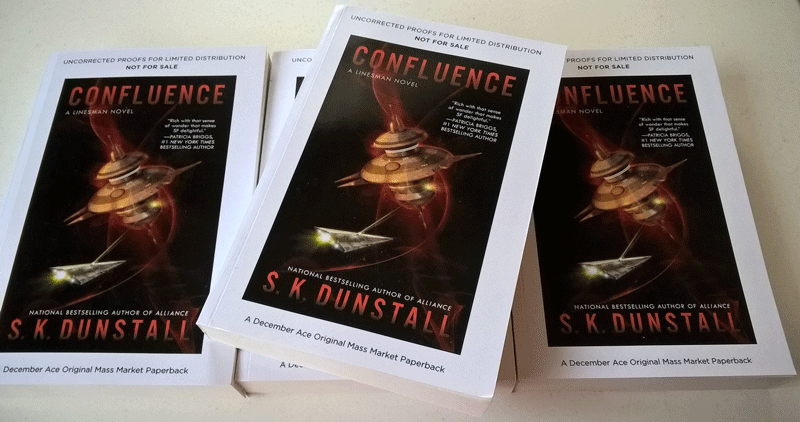
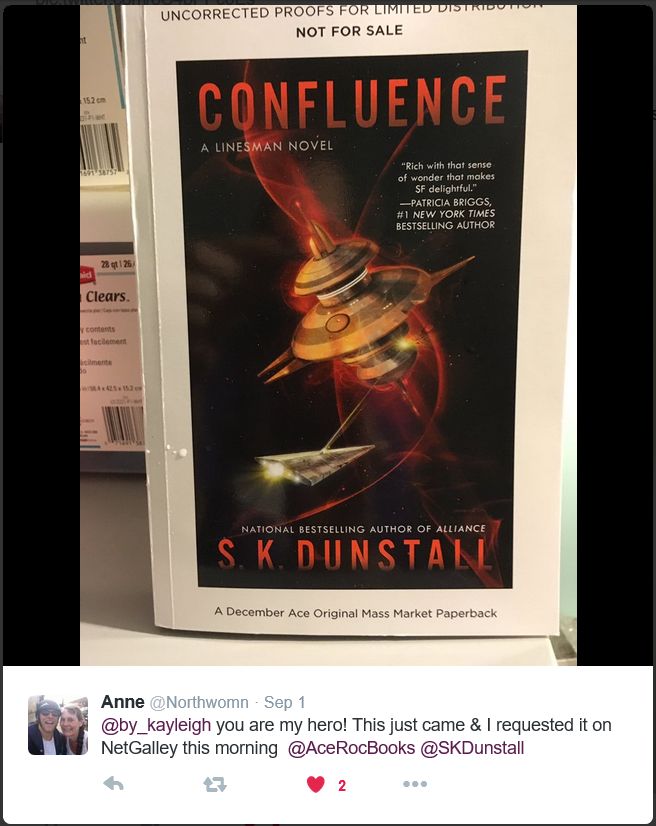
The advance reader copies of Confluence arrived on Thursday. These are books but without the final proof read. They have typos. Hopefully not too many.
(I opened the book to a random page and the first thing I saw was a comma that shouldn’t be there. I hope we caught that one in the final proof. )
Beautiful white books with coloured covers. We were expecting plain green covers, as that’s what we’d had for the other two books. Look at them. Aren’t they great?
We’re giving a book away.
If you want to win, comment on this blog post. (i.e. Leave a Reply.)
If you’re reading this through Goodreads or Amazon or Facebook or any other feed, please note that you must come to the blog site to comment. Click on this link to get here. (We’re asking you to come to the blog because last time it was hard to be sure that everyone’s comments got counted. Here they’re all in one place.)
Also, your comment must be on this blog post. Comments on other posts won’t count.
There are no location restrictions. We’ll send the book anywhere in the world.
Competition is open until next Sunday’s blog post (10am Australian Eastern Standard time on Sunday 2 October).
Once the competition closes, we’ll use the wholly scientific method of putting all names into a hat (or in our case it, the big aluminium mixing bowl) and we’ll draw a name out.
So if you want to read Confluence early, comment here.
Twenty four hours isn’t a logical time period in space. What would we use instead?
Yesterday was a beautiful spring day here in Melbourne, Australia. After a week of heavy rain leading to one of the wettest Septembers on record, the day was glorious. The sun was out, the clouds were white(ish) and there were flowers in every garden.
It’s spring. The weather is getting warmer, the days are getting longer. And it’s light outside when we leave for work. Not yet light when we leave work for home, but that will come. We’ll finally be able to see our garden—which we only see on the weekends in daylight right now. (Thank you, Helen, for making it look so immaculate.)
Like I say, the days are getting longer.
Longer days in summer happen because of the way the Earth tilts toward the sun. The day itself is the time it takes for the Earth to rotate on its axis. A year is the time it takes the Earth to orbit the sun.
Each planet has its own day and year. It may or may not tilt (although tilt is good if you want seasons).
In a spaceship, days, seasons and years are less relevant. When you’re travelling around the galaxy, you don’t care how long the local day or year is. When you move on, the next world will have a different day and year.
So how do you keep time in space?
Human beings have a diurnal rhythm of around twenty-four hours. That’s basically because we are used to Earth’s twenty-four rotation, with its period of light and dark. We tend to wake up in the day, and sleep at night.
In the book we’re currently writing, we use twenty-four hours. It’s an easy time period for readers to imagine. We imagine that ships would have a ‘day’ period of around fourteen hours where the lights were daylight brightness, and a night period of eight hours, where the lights are low.
But is it really a logical period to use?
Probably not.
Years won’t make any sense because each world will have its own year. You’re more likely to have a centralised date, based on multiples of some lesser time periods, and that will be the standard across the whole galaxy.
Think Star Trek star dates.
But what are the lesser multiples that will make up the years?
One thing is likely. Given the human numbering system, it will probably be some variation on a multiple of ten.
Probably the best date system I have ever come across is Vernor Vinge’s seconds, kiloseconds and megaseconds, from his Zones of Thought books. A second is a second. A kilosecond is a thousand seconds. Given there are 3,600 seconds in an hour, this comes out to roughly a quarter of an hour.
Thus a megasecond is 11 days, 13 hours, 46 minutes and 40 seconds, which is roughly of the order of a week. A kilosecond is 16 minutes, 40 seconds, or the length of a short break. A gigasecond 31.7 years, so typical human lifespans are 2 to 3 gigaseconds.
Electric lights. Something only half the house has at the moment. Look on the bright side. It’s just finished winter here. It’s dark when we go to work, dark when we get home. If those rooms are dusty, we can’t see it.
How many power points do you need for a computer?
Let’s see. There’s the one for the computer itself. One for each of the two screens. A printer. The backup hard drive. That’s five already.
There are two computers in the office. That’s ten power points. Plus the point for the laptop charger, one for the phone charger, and the one for the iPad. (Actually, we plug the iPads into a point in the dining room, for there are no spare points in the office.) Then there’s the router, and the stereo. The list goes on.
This is the second office we’ve had. We added extra power points a couple of years ago we switched the then-study with the dining room.
Our house was built post-World War II. The switches aren’t that old, but a lot of the wiring is. The fuse box is full of empty fuses that even the electrician has no idea what they do. Not to mention, the fuse box itself is no longer legal.
We know the lighting and power needs work. We’ve known that for a while. We’ve had a lot of electrical problems.
So last week, when half the lights in the house went out, and the electrician spent all day trying to find the fault and couldn’t, we weren’t surprised at the verdict.
“You’ll need to rewire the house. And put a new fuse box in.”
“Sure,” we said.
The head electrician came around to inspect the electricals and give us a quote.
Let me tell you, people, if you’re going to get an estimate for rewiring, make sure the power points are accessible (and it’s a good idea if your house is cleanish). The electrician goes into every room.
I got a bit embarrassed about all the power points in the study and the former study. “Twelve power points along that wall. Six along that wall. ” And in the other room. “Ten on that wall, ten on the opposite. Do you want them all put back?”
“Yes,” I said, because we’re actually thinking of shifting back to the old study. It has better light (or until last week it did, now it has none), and it looks out onto the garden, which makes a nice ambience for working.
I’m sure he thought I was crazy.
“And while you’re here, is there anything you’d like added?”
“Well, the kitchen light’s terrible, and we wouldn’t mind a heat/fan/light in the bathroom, and …”
“I’ll send you a quote,” the electrician says.
The quote arrived yesterday.
Ouch. That’s all I can say.
But I’m looking forward to having working lights again. And there’s an added bonus. If we buy new lights they’ll put them in for us as they do the rewiring.
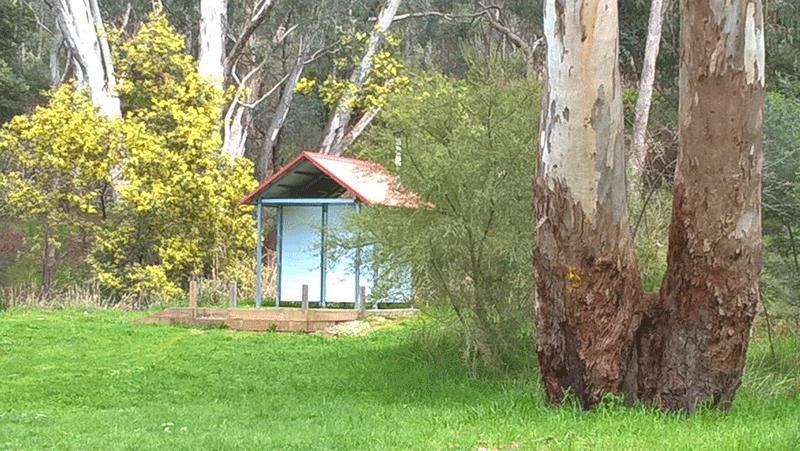
Continuing the toilet theme from the other week … the toilet block at the camping ground near Edi cutting, on the King river.
So we’re still on holiday, visiting our mother, who lives in North East Victoria. It’s lovely and green up there right now. (And pretty cold, too.) It’s beautiful.
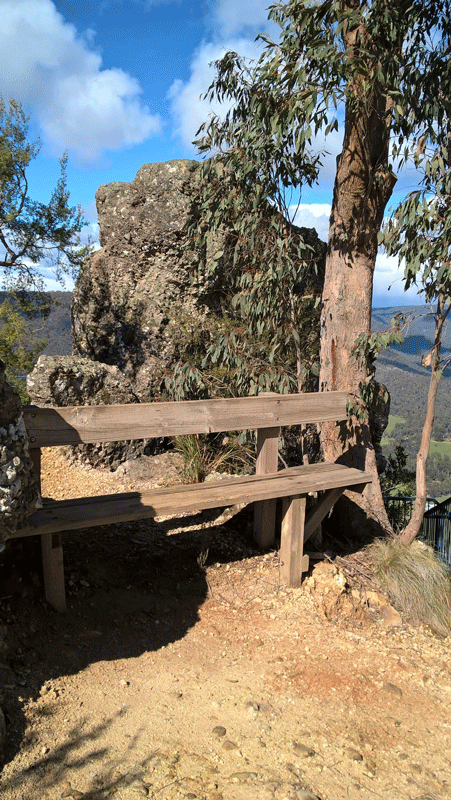
I think this was at Power’s lookout. Harry Power was a bushranger.
In four to six months all that green will be brown. If there’s any grass left it will be tinder-dry. Or there won’t be any grass at all, and it will look more like this.
Brown dirt.
A quick lesson in Australianisms.
1) Bushrangers are (were) the equivalent of highwaymen in the UK, or an outlaw in the US. Think Dick Turpin or Jesse James. I don’t know what it’s like in the US or UK but bushrangers were (are) often looked on as folk heroes. Despite the fact that they robbed, and on occasion, killed people.
2) And while we’re talking Australianisms, what about a language lesson?
How do you pronounce Carraragarmungee? (It’s a real place. A friend of ours went to school there. There isn’t much more than the school, but …)
Kah-rah-rah-gah-mun-gee. Sound out the syllables. Then, speed it up. Say it at least three times as fast as you did sounding it out.
While Sherylyn is conferencing, I’m living the hard life. Writing a book, of course.
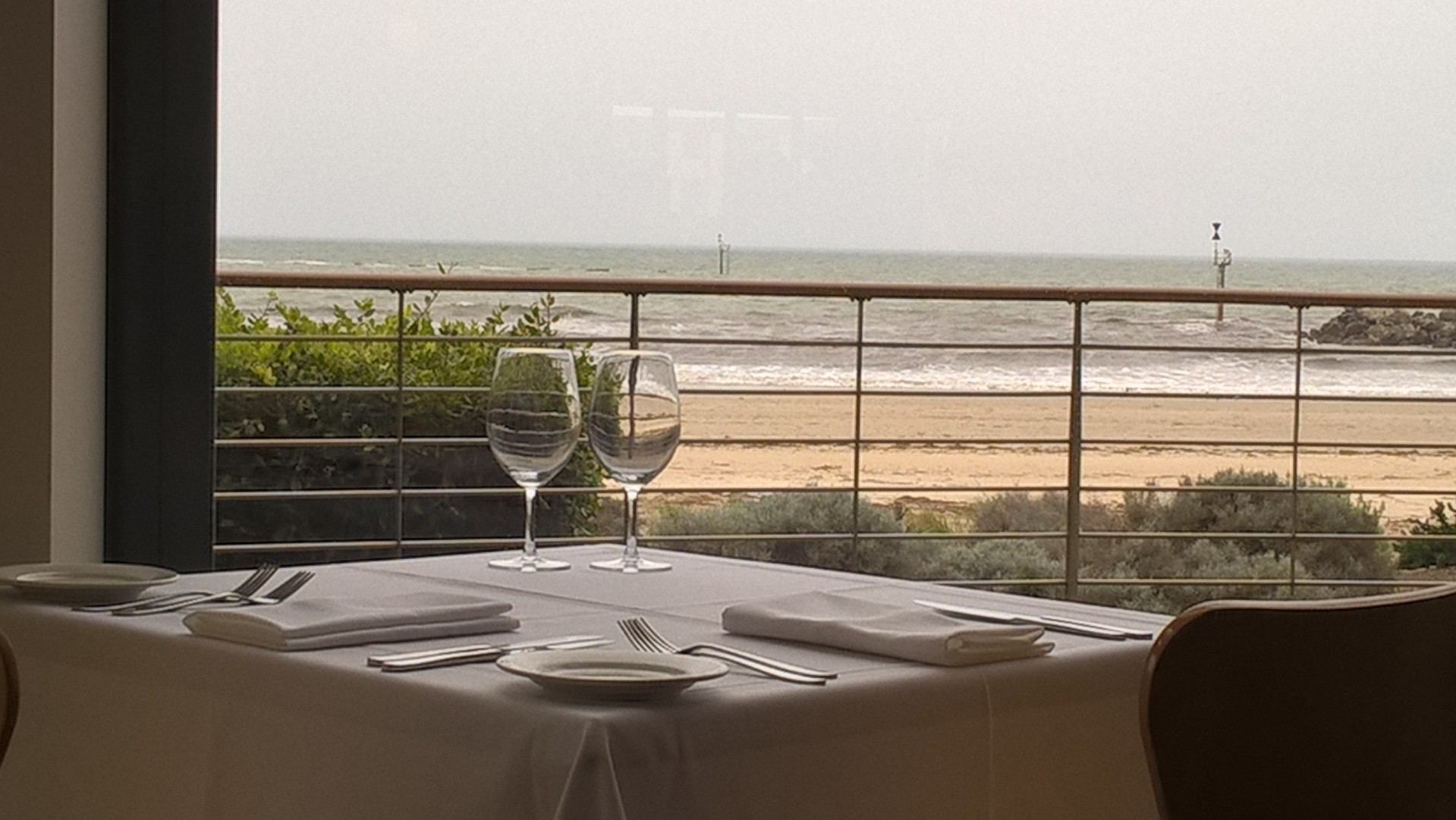
We’re here in sunny Glenelg today. [At least, it’s sunnier now than it was when we arrived on Thursday, believe me.]
Sherylyn’s at the RWA conference, I’m here writing. It’s relaxing, and peaceful (for me, anyway). Especially since I have the next week off and I’m looking forward to relaxing, and seeing more family.
Glenelg is a beautiful place. Very touristy. I’d liken it to St Kilda in Melbourne, or Manly in Sydney. Or even parts of the Gold Coast, only nowhere near as warm. In summer, I imagine, it will be wall-to-wall people, but right now it’s pleasant. It’s got a buzz, it’s busy, but it’s not overcrowded.
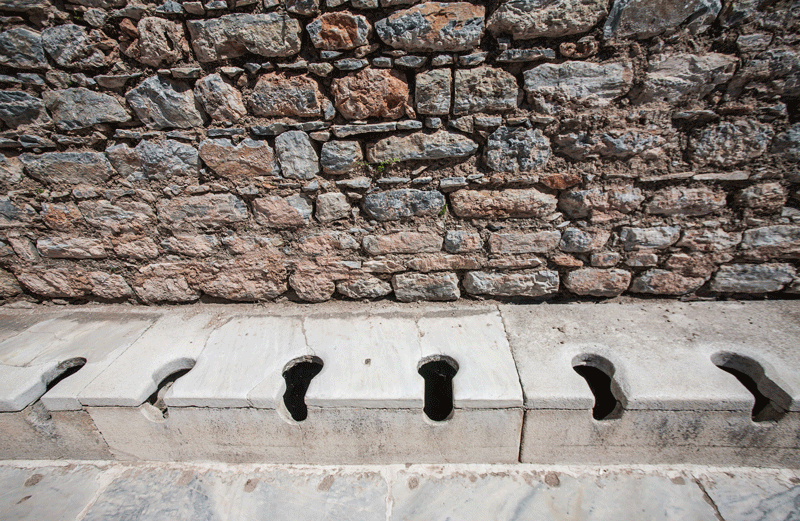
Roman public toilets, which apparently were a common place to do business and catch up. Although, according to one article I read, it wasn’t as great as it was made out to be.
Isn’t it funny how much ‘civilisation’ we lose, and continue to reinvent, time and time again.
Take plumbing and sanitation.
Stone age farmers in the Orkney Islands built drains under their houses and had toilets over the drains.
The Indus Valley civilisation in Asia (Afghanistan to Pakistan and northwest India) had a public water supply, covered sewers and an elaborate underground drainage system. Houses had their own private toilets.
Ancient Rome? They had running water, public baths, public toilets and sewers.
The Minoans of Ancient Crete used underground clay pipes for water supply and sanitation. They also had a version of a flush toilet.
Even the Mayans at Palenque had underground aqueducts and flush toilets. And they had household water filters, using limestone.
Pretty amazing, hey?
And then the middle ages happened. Wastewater collection seems to have consisted of open drains, that over time were covered. As for sanitation, that seemed to revert back to holes in the ground with a seat over them, or a seat over water, or pails that had to be emptied.
Until the modern flush toilet came along.
Now, it seems, we’re back to what they had in the past.
Karl Urban as Bones and Zachary Quinto as Spock in Star Trek Beyone.
We’re in the middle of writing our next book. (And by middle, I mean middle. We’ve hovered between 68,000 and 70,000 words for two weeks now. Working hard, but the rewrites. 🙂 )
It’s been quite relaxing. No deadlines yet.
We’ve had time to do other things, like go to the movies. There have been some good movies lately. Jason Bourne. And, of course, Star Trek.
I liked them all, but I have to single out Star Trek Beyond. It was good to see all the main cast getting screen time. Especially the interplay between Bones and Spock.


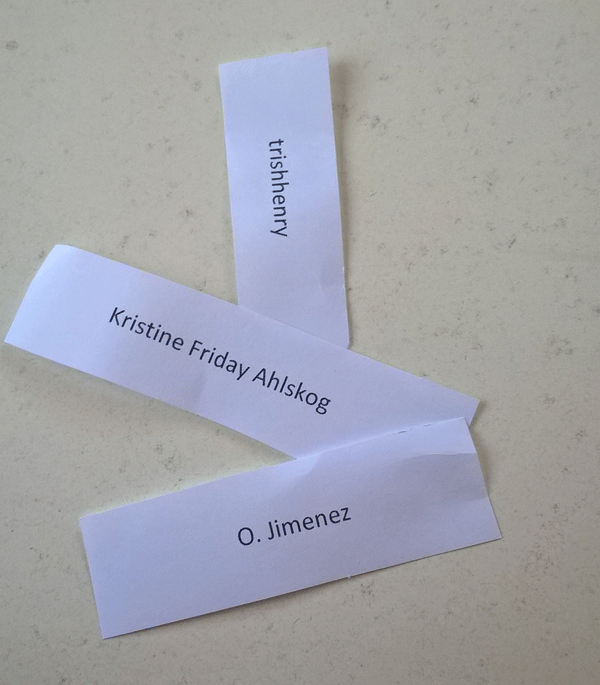 The winners!