If you’ve managed the word count, you’ll be 25,000 words by now. You’re halfway there. Keep it up and in another fifteen days you’ll have 50,00 words.
If you haven’t … don’t panic.
Sherylyn and I both enjoy NaNoWriMo, and we’d love to do it every year. Unfortunately, life often gets in the way. We’ve both been trying since 2009, but we’ve only managed to finish twice with more than 50,000 words.
Sometimes we don’t start. This year, for example, we’re too busy writing book three of LINESMAN to even consider it. Another year we both had major projects due at work.
Sometimes we start and work—or life—gets in the way.
It’s not a competition
Note that I said ‘finish’ and not ‘win’.
I don’t know when the idea of ‘winning’ NaNoWriMo came about, but I don’t really like the term. It’s not a competition. At least, not to me. It’s a marathon, and most people don’t enter a marathon to win, no matter how nice that would be. They enter it to run in it. To do it. To beat their own personal best.
It’s not a life or death situation
Don’t beat yourself up if you don’t can’t get the word count. The important thing is to keep writing. Don’t stop just because at your current writing rate you’ll only have 30,000 words at the end of the month.
Keep writing.
30,000 words is pretty awesome anyway, but it’s the habit of writing regularly that you want to cultivate.
Again, it’s like a marathon. Just keep working at it.
After GenreCon we took a few days extra leave and went down to the Gold Coast to chill out for a few days.
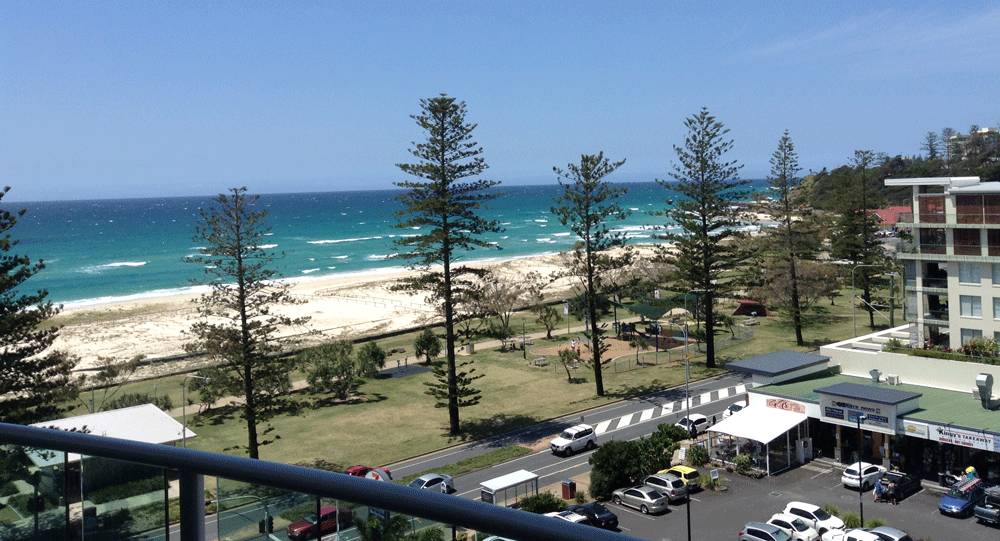
We went to Kirra, which is close to Coolangatta, and the one criteria for where we stayed was that it must be close to the beach.
There’s a lot to be said for taking a break like this. We spent most of our time sleeping, and relaxing, and looking at the view, and swimming in the apartment pool. And eating, of course. Far more than we should have or needed to. But it was relaxing.
The apartment itself had the most perfect view. It was easy to get up at five-thirty in the morning (Queensland doesn’t have daylight saving), write for two hours, shower, go out for some breakfast, come back, write some more, think about lunch or a swim, have an afternoon siesta, then go back to writing for a while before thinking about dinner on the terrace.
I have to say, by the time we were ready to come home I would have killed for an ergonomic chair, but there was something about looking out at that view that made it so much easier to get into a writing rhythm.
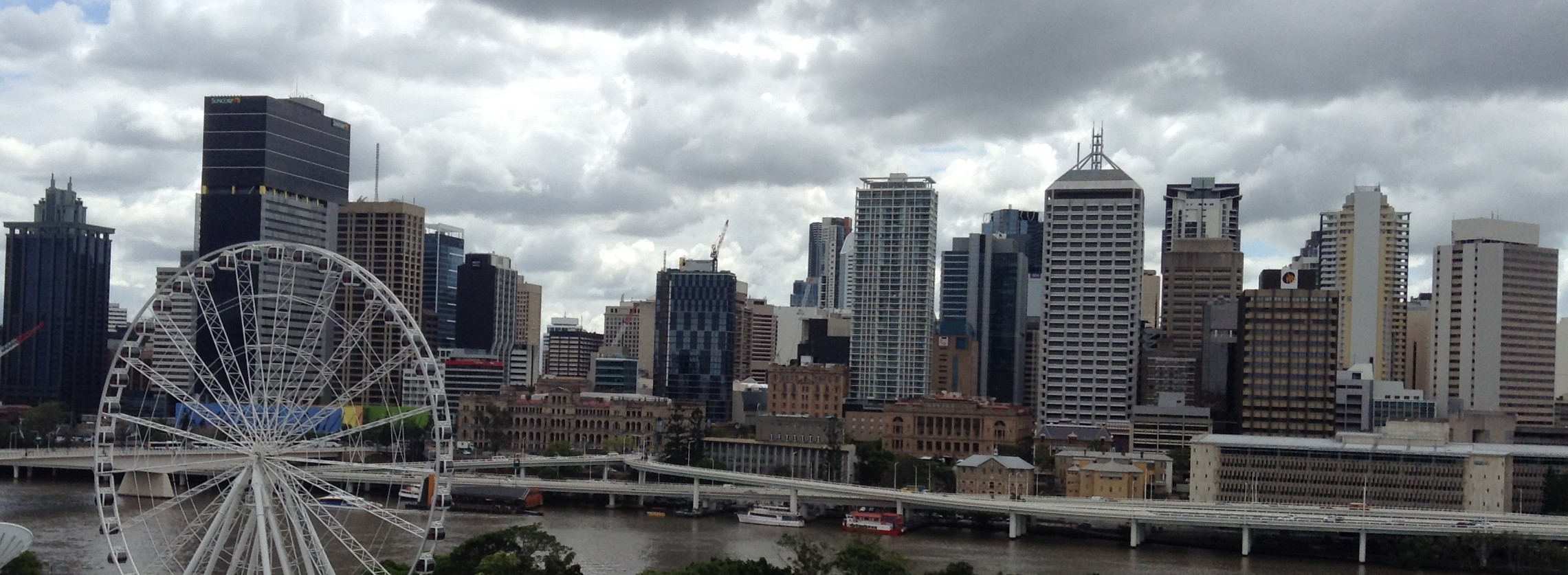
View from the hotel, by day. It looks spectacular at night, but my night photography just doesn’t hack it. Note the cloud cover. I’m very happy about that. We have to walk from the hotel to the State Library. Cloud cover is good.
We’re here in Brisbane for Genre-Con. Somewhat busy, attending sessions, so not a large blog today, but so far, every session has been truly good.
My favourite sessions so far:
Friday workshop: Write the fight right with Alan Baxter. Tremendously entertaining, as well as being informative.
What’s the golden rule in martial arts? Run away.
After this session we’re going back to look at some of the fight scenes in Linesman#3. Although, given the golden rule, we can’t have our hero run away, can we?
Saturday panel: Mining Myth and History. Kate Forsyth, Sulari Gentill and Christine Wells, chaired by Lisa Fletcher.
Three different points of view on writing historical fiction.
Sulari Gentill sounds like my kind of writer. I’ve got to look up the Rowland Sinclair mysteries.
Saturday night banquet: Mary Robinette Kowal.
An entertaining speaker, and loved the way she used rejection in the puppetry world and compared it to rejection in the writing world.
Loved the puppet show at the end.
To date, the standard of the panels has been excellent.
I said to Sherylyn the other day, “One thing I haven’t backed up in a while are our emails. I’ll do it on the weekend.”
Saturday morning, I turn on my computer and nothing works. Well, actually, everything works except that the computer isn’t coming on. The red light is flashing, the fan is whirring, but it’s not registering on the home network and nothing is coming up on the screen.
The computer is seven or eight years old, which is ancient for a computer. I’d planned on replacing it this year, anyway. Suddenly, that moved up on the list of importance.
Got the new computer. We backup regularly, so I didn’t lose many writing files, but I did lose my mails. Luckily we both keep our agent and editor emails, so Sherylyn can give me copies of those. We also both had copies of the email from a relative who’s also a writer (YA fantasy) which I was going to answer this weekend.
Not so bad.
The only thing I couldn’t get back was the tax invoices, which Sherylyn has been asking for all week.
And our tickets to GenreCon, which is on next weekend.
Tax invoices, hmmm.
For GenreCon—I’ll send an email the people at Queensland Writers’ Centre and ask for copies, but I imagine they will be very busy this week.
I hope they let us in without our tickets.
I enjoy GenreCon. I’ve blogged about it before. It’s great to get together with a group of other writers and talk writing (among other things). And they’re all genre writers, so you get a mix of romance, fantasy, science fiction, horror, mystery/crime, thriller and other writers.
You also get a mix of writers just starting out, people part-way along the road to being published, and published writers. It’s a good mix to talk to.
Not, I confess, that I’m good at talking to people. I’m a typical writer in that way. So if you see me at GenreCon and I’m a little awkward, just keep talking. If I see you at GenreCon and you’re the same, I’ll keep talking too. Because meeting other people who want to write, or are in writing industry, is what’s it’s all about.
We’re really getting into book three now. These are the main story points for the novel.
The words have been deliberately blurred, because, spoilers.
The orange ‘R’s’ mean rewrite this section totally, the blue dots mean okay, but needs some work, and the blue ticks, which you can’t see because they’re all at the top, mean this section is okay, just needs cleaning up.
We spend a lot of time with each other as co-writers, which means we share a lot of things, including bugs.
A rather nasty cold-like thing (too nasty to be an actual cold, or otherwise colds are becoming a lot more vicious) has downed both of us this week. We haven’t done much writing. Not even a blog, and to be honest it’s hard to dredge up much enthusiasm for a blog post, so today you get a recycled one. This is from back in 2006.
Because it’s so old, I need to give you some context on the novels we were writing back then.
Potion is a massive, sprawling epic fantasy. It’s the second novel we finished and rewrote enough to be respectable. It’s a trunk novel, but one day, if we ever get time, we’d love to rewrite it, just for fun. We have learned so much since then. It’s the type of fantasy you’d write twenty years ago. Fantasy has come a long way since.
Trivia fact for you. We did send this to our now-agent, Caitlin, and she asked to see the full manuscript. Nothing came of it, but it’s funny how things turn out.
Shared Memories is science fiction. Sherylyn calls it young adult, I call it adult with a young protagonist (but I think Sherylyn’s probably correct). Right now it’s a trunk novel as well, but it was a great idea. If we ever get the time we’ll revisit the idea.
Satisfaction is another fantasy. This one is still in the story folder. We remember this one particularly because when I described the original idea to Sherylyn it was an edgy, sexy adult novel, but the actual story we plan to write is the story Sherylyn saw after I described it to her. A whimsical coming of age tale. She took my idea, turned it around, and in half an hour we had a story we both wanted to write.
Also, we mention writing as a team. How we co-write has changed since this post. We still do some of what we mention in that link to another old post, but an article we did recently for Qwillery describes our current process better.
Do You See What I See?
It wasn’t until the fourth draft of Potion that Sherylyn and I realised we didn’t see the characters the same way.
Tegan, one of the point-of-view characters in Potion, has long dark curls that frame her face. We mention her eye colour—blue—when comparing her to someone else but that’s pretty much all the description you get of Tegan’s physical features.
We were talking one day and realised that Sherylyn’s Tegan had rich, chocolate brown hair with chestnut highlights. Her hair fell half-way between her shoulder and her waist, and the curls were quite, well, curly. My Tegan, however, had hair that fell past her waist. It was darker, and the curls were more waves than actual curls.
In another story, Shared Memories, the point-of-view character comes from a world called Nuan. Sherylyn pronounces it “Noo-one”, I pronounce it “Nah-wonn”.
Does it matter?
Not in the least?
The vision we share for a book depends less on the physical than on how the characters act and react. Yes, there are some physical things we know about each character—Tegan’s long dark curls, for example—but it’s more, “Tegan wouldn’t muck around like this. She would unleash a magical firebolt instead, and it would all be over in minutes”, than “That’s not how Tegan looks”.
We do, however, need to share a common vision for the story, and where it’s going. I mentioned in an earlier blog about writing as a team, that before we start writing we talk about the story, finessing it until we have a story we can both visualise and are prepared to work on. Satisfaction is the most extreme example of this to date, where my original idea was changed totally. Changed for me, that is. The final concept of Satisfaction, the one we’re going to write, is the picture Sherylyn saw in her mind in the first five minutes as I described it to her that first day.
That was unusual. Normally we meet somewhere in the middle.
Writing a book with a writing partner is a lot like reading a book you both love. What each of you gets out of a book when you read it is totally your own. But it doesn’t spoil the enjoyment of the story for either of you.
I buy a lot of books, but I also borrow books from the library.
If I want to read a book and it isn’t in my local library, I will request it. Most of the time—if the book is available in Australia—the library will purchase it for me.
This has lots of advantages.
I get to read the book. If I like the author, I then go on to purchase his or her books. Not just that one, but potentially future books.
Even better, because it’s in the library system, other people who might never have seen the book get a chance to read it as well.
But it has to be there for them to read.
Some things authors can do to make it easier to get their books into libraries
Today I tried to recommend a book for my library to purchase. I knew the book was out because the author had tweeted about it, and the details were on her website.
Unfortunately, it was hard to get details to put into the Spydus request form. It took some digging to find out. I was about to give up, when I finally thought to click on the first chapter excerpt. Luckily for me, the information was there.
If you’re an author, I strongly recommend you make this information available on your website. The easier it is to find, the more likely people like me will request it.
The information you require:
Name of the novel
If it’s part of a series, the name of the series and the number in the series
We said we’d do better than we did with LINESMAN, and we did, but not by much.
At least the issues aren’t quite the same.
We knew we had to change our Australian spelling to US spelling at the end, but did we? No.
Realise, rumour and defence became realize, rumor and defense. Words like travelled and councillor became traveled and councilor.
There were still a few of the dreaded serial commas. That is, a comma before the ‘and’ in a list (aka the ‘Oxford comma’). But we were better this time.
In fact, we need to work on commas in general. And on our capitalisation. (Or should that be capitalization?)
Trust me, you think you have a good grasp of grammar, but when you see a good copy editor go through your manuscript you realise (realize) that what you think is a lot different to what you know.
We have a goal to get down to minimal copy edits on a 100,000 word novel. Under a hundred edits would be nice.
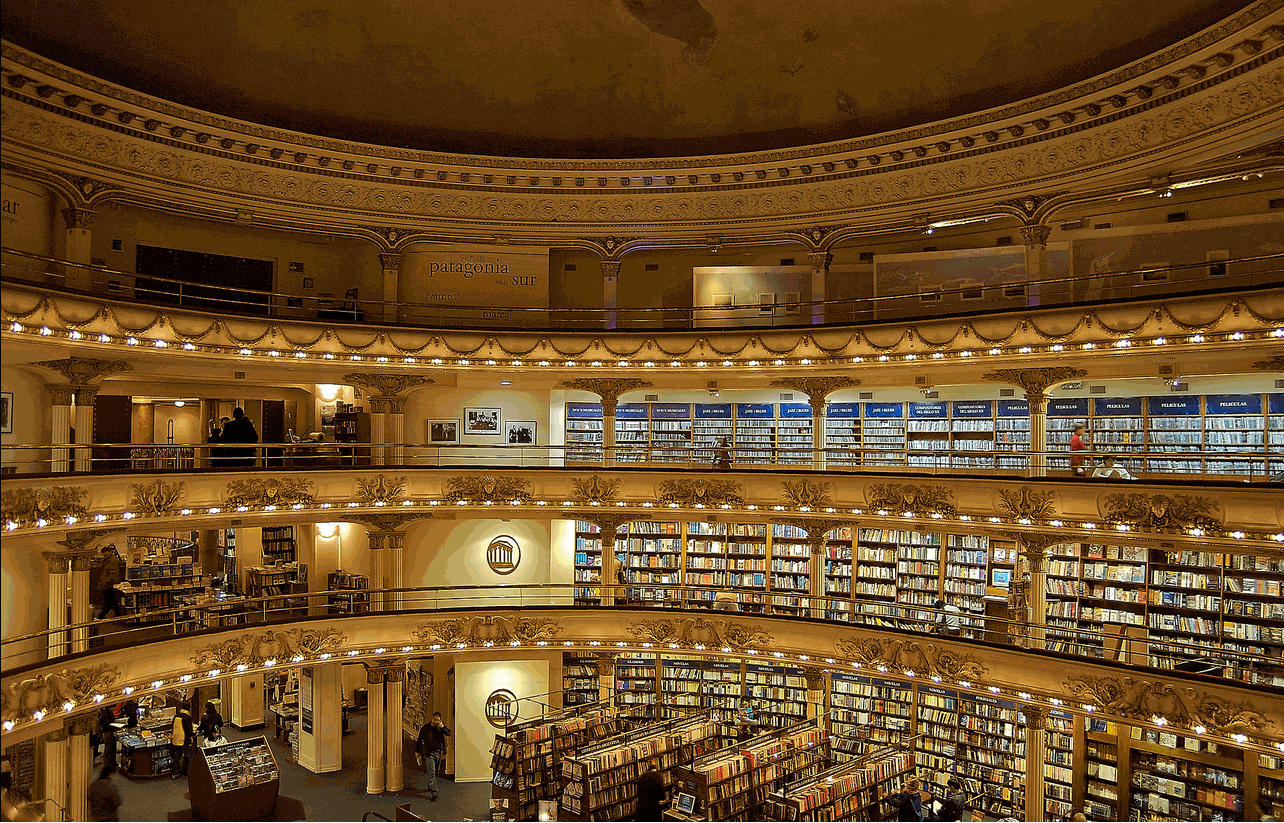
Now this is a bookstore. El Ateneo, Buenos Aires, Argentina. Image by longhorndave, orignal posted at Flickr.
Some recent tweets pointed me to two two articles from last year about designing bookstores (What makes a good bookshop? and Let’s reinvent the bookshop). I like some of the ideas, but not all of them, so I thought I would design my own.
It would be full of books
It seems obvious to say that a bookshop should have books, but to me one of the gauges of how well a bookshop is doing is how much non-book stock they are trying to sell. Before it went broke, Borders, for example, had started to get a lot of non-book stock in.
A bookshop is still a bookshop. It should sell books.
Ability to sell eBooks
eBooks are offered almost exclusively online, but I would love to see a bookshop offer the same. Ideally in different formats. A tap and load card that you could pay for at the counter or through an app on your phone/tablet.
You should also be able to order online (hard copy or electronic) and have a book mailed to you or be able to collect it from the store.
Information kiosks
While we’re on electronics, information kiosks where you can scan a book’s barcode to find out more about it. What other books the author has, volume number if it’s part of a series, how long it would take to order if it’s not in stock, even links to feedback sites like Good Reads.
Plus, an app on the user’s phone/tablet where they can do the same, only if they do it on their own device you could add links to the store to order if required.
Room to move
Aisles wide enough for people to browse but others to pass. Reading spots where a browser can stand out of the way.
Knowledgeable staff
One of the best things about a good bookstore—about any store really—is staff who know their product.
They know their books, but they’re also familiar with the standard electronic devices and can load an eBook for a customer (assuming the customer has an account).
Café
A pleasant space serving tea, coffee, cold drinks and sandwiches and cakes. It doesn’t have to be grand, but it does have to be clean. Ideally it would have lots of seats for singles. A lot of people go into bookstores alone.
You could take it even further and get a liquor license, which could also be useful for the book launches/book talks.
Maybe even a writer’s space, where writers can bring their laptops and work.
A dedicated area for book talks
Ideally it would have tiered seating (maybe bleacher style), and a little stage area at the bottom. It should definitely have good acoustics.
Lots of book talks to go with the area. Maybe even book launches as well.
A combined cafe/booktalk area might work, provided it is set up properly. I find, however, that in many bookstores with cafes where I go to hear authors, the noise of the refrigerators tends to drown out the author.
Resident authors
I’d like to see a space for resident authors. An author promoting a new release could sit in the store mornings for a week, say, and write. Obviously, their writing would be interrupted, but it would be good PR.
The store could also hire out the café to writing groups when the bookstore was closed. The authors would pay for this (in advance, because you’d have to cover costs), but the store would provide tea and coffee and biscuits.
POD
A print-on-demand (POD) facility, where the customer can get books printed. Again, this should be integrated into the store’s online store as well, so the user can submit their own work in to be printed and then come in to collect it.
Obvioiusly, there would be restrictions. The store wouldn’t print eBooks, for example.Plus, I’m okay with POD books being more expensive that other books in the store to prevent anyone thinking it smart to print their own copy.
There’s lots more, of course. But that’s a start.
p.s. The bookstore in the image is El Ateneo Grand Splendid, a bookstore in Buenos Aires. The building was originally a theatre. It looks amazing.
The photographer is Dave (longhorndave–sorry, Dave, I don’t know any more details) and permission for use is given under a creative commons license. The original image is from Flickr.
There’s also another article in the Guardian showing photographs of bookshops of the world.