Categories
Writing tools

Adventures with Microsoft (episode 294)

I failed the Apple quiz.

But then, I’m not really an Apple fan, although I do like the iPad as an eReader. I’m a Microsoft user from way back. Sometimes I think I’m the only person in the world who likes their products, but Word is still my favourite word processor by a long way.

I’ve been using Office 365 ever since it was introduced, and it took a while but I really got to like OneDrive.

OneDrive is Microsoft’s cloud service, where you can store files online and access them anywhere you have access to the internet. Think DropBox or Google Drive.

It’s fabulous when you’re writing together, because both authors can work on the same manuscript at the same time. It’s especially ideal when you’re fine-tuning the story in those last weeks before sending the finished product away, or when you get the edited version back and want to work through the edits together.

Plus, it stores an off-line copy of the document you are working on, and synchronises it when you’re back on line.

It had some weird habits, like sometimes reinserting deleted text, so you’d get sections with duplicates, and some other strange stuff, but in general, it worked well.

Best of all, both Sherylyn and I can link to the same OneDrive files no matter which computer we are using.
Along came Windows 10

Categories
Writing process

Conflux 2015

ConfluxWordleConflux 2015

Conflux, the science fiction convention held in Canberra, always has an interesting program. This year is no different.

Unfortunately, for us, it also usually coincides with the culmination of a large project for me, and in the busiest work period of the year for Sherylyn.

This year my project finishes on 30 September, two days before the Conflux weekend, which is the 2-5 of October. And then, the government of Victorian turned Friday the 2nd into a public holiday.*

Maybe we could manage it this year. Or even just one day. Particularly the Saturday, which has such neat things as:

Panel: SF and the Speed of Light

It’s the elephant in the room. We don’t know how to do it, but it’s essential technology for just about any story set in space. This panel looks at how sci fi handles FTL tech: the good, the bad and the downright ridiculous.

We’ve had a range of responses to the faster-than-light travel in Linesman. Everything from “the FTL travel is believable” to “I just can’t buy the lines as FTL”. I know, myself, if I don’t believe the the way FTL works, it does spoil a story for me.

Guest presentation: “Tax stuff for authors” by Robert Douglass

It’s a strange thing to get excited about, but it’s difficult to get tax information specific to authors. I don’t know what Robert plans to talk about but I think this is a vital topic for any author.

(And Robert, if you’re ever doing the same session in Melbourne, please drop us a line, because we’d love to come.)

In the end we decided not to go

It came down to cost versus time, and because we’d left it so late that one day at Conflux was going to cost us over a thousand dollars. Just for a day.

In the end we decided not to go.

If anyone does go and wants to tell us about it, we’d love to hear about it. (If you’re interested, we’ll even offer a guest post on our blog.)


* The public holiday is grand final eve, which is the day before the football final (big news here in Australia, but especially in the southern states of Victoria, South Australia and Western Australia). If you think it strange, don’t forget, we’re also the state that gives a public holiday for a horse race. If you think that strange, then you should really visit Melbourne during grand final week and stay on for the Spring racing carnival. It’s magic.

Categories
Talking about things

Jurassic World (Park): High Heels Edition

An image from 'Jurassic Park: High Heels Edition (Parody)' by XVP Comedy. Watch the full video below
An image from ‘Jurassic Park: High Heels Edition (Parody)’ by XVP Comedy. Watch the full video below

As crazy as it sounds, I have really enjoyed the discussion about Claire’s (Bryce Dallas Howard’s) heels in Jurassic Park.

Google ‘running in heels Jurassic world‘ if you haven’t heard about it yet.

Claire Dearing (Bryce Dallas Howard), the operations manager of the Jurassic franchise’s latest dino-themed pleasure park. While fleeing Indominus rex, an especially terrible species of terrible lizard, Claire runs across floors of slick stone and grounds of moist mud. She sprints and leaps and crouches. She drives an ambulance. She shoots a gun. She saves some lives. She takes some others. She grows as a person, and as A Woman. And she does it all in ridiculously spiked heels that you really, really hope are decked out with a good pair of DreamWalk Comfort Insoles.

This, of course, is absurd. And it is so obviously absurd that Claire’s perma-pumps are the source of a running joke within Jurassic World, manifested both through dialogue—Owen Grady (Chris Pratt) at one point explicitly mocks Claire’s entire flee-unfriendly outfit, which results in her removing clothing, but not swapping shoes …

The Perma-Pump: Jurassic World’s Silliest Character

It a gag that keeps going and going, and still gets lots of comments on various websites.

I can even see that a character who spends most of her time in the office like Claire does is likely to wear heels most of the time. I would have expected, given she does apparently go out into the park occasionally, that she would have had pair of flats in her bottom drawer (like those of us do who only have to tackle city streets), but—

Apparently, it was Howard’s choice to wear the shoes all the way through.

It’s refreshing that this has become such a point of discussion. Once upon a time no-one commented on the impracticality of women running for their lives in heels that are more likely to cripple them than to save them.

So refreshing, in fact, they even made a parody of it. Of Jurassic Park, really, but it’s the same silly fun.

Jurassic Park: High Heels Edition (Parody) by XVP Comedy

Categories
On writing

Other writers’ writing

I came across this blog post (from back in June). I hope K. Eason doesn’t object to my reproducing quite a large chunk of her post. This one’s for the Ann Leckie fans, and the Mad Max fans, and for all of us who name our electronic devices.

It was a dilemma

… what to call the new laptop. Furiosa, because FURIOSA … but I wasn’t sure I needed that kind of anger (and tendency toward violence) in a working machine. Also, the cybernetic limb made me a little nervous. I don’t want bits falling off.

… Then I remembered Ancillary Justice. So then it came down to Justice of Toren, or Breq, or OneEsk …

So OneEsk, it is. But I swear, if this machine starts singing, I’m outta here.

K. Eason Mythistori


K. Eason has two books, Enemy and Outlaw, coming out from 47North in 2016.

Categories
Writing process

Kudos to the Hugos

I watched the live stream of the Hugo Awards ceremony and was really pleased with everyone involved. You handled a potentially awkward situation with grace.

Well done.

Special kudos to David Gerrold and Tananarive Due. You did a great job.

None of my picks won. Oh well, next year.

My favourite quote for the night:

George R. R. Martin is no longer on Twitter. He killed off all 140 characters.

Categories
On writing

Are serial novels the next big thing?

Charles Dickens sold his stories one episode at a time. To quote Wikipedia:

His novels, most published in monthly or weekly instalments, pioneered the serial publication of narrative fiction, which became the dominant Victorian mode for novel publication.
Wikipedia entry for Charles Dickens

With the advent of eBooks, serialisation of novels seems to be entering another golden age.

John Scalzi’s The End of All Things, was recently released as four eBook novellas—one novella per week starting on 9 June and going through to 30 June.

A lot of people seem to think it’s the best thing to happen to books in a long time.

Is it?

Is it, as Maya Rodale asked on the Huffington Post last year, modern torture? Or the best way to read fiction?

Some people love serials. Others hate them.

I’m in two minds. I sometimes read them and enjoy them, but in general it’s not my favourite way to read books.

But then, I get frustrated if a full-length novel in a series ends on a cliffhanger.  And a series of novels is just a serial in its own way, except the stories are a lot longer.

I read short stories and novellas and enjoy them, but my favourite form of fiction is the full-length novel. I also like to read novels straight through. In one sitting if I can (I’m a fast reader); otherwise over a period of days. If a book takes me longer than a week to read, I’m probably not planning on finishing it.

I admit, I even subscribed to Ann Leckie’s newsletter so that I could read the first chapter of her novel in one gulp, rather than a sentence a day. And you know, just one chapter is frustrating when you’re waiting for the full book.

Waiting every week for the next instalment in a series … it would have to be something truly special to keep me coming back. I usually give up two or three stories in.

Once upon a time people watched weekly serials on television and tuned in to see what would happen next week. Many of us still do—look at Game of Thrones—but equally as many download and binge view.

I even have friends who refuse to read a book series (of full-length novels) until they know the series is done, for they don’t want to wait for the next book.

Modern publishers appear to be pushing out books in a series over shorter periods of time. Jeff Vandermeer’s Southern Reach trilogy, with three full novels over eight months is an extreme example, but many novels come out nine months apart.

I can’t work out if serialisation is just an extension of this, or not.

Categories
Books and movies

This weekend it’s movies and books

The edits for Alliance are away. This weekend it’s all about movies and books (and house cleaning) before we restart properly on book three.

I’ve just finished Charlaine Harris’s Day Shift, and thoroughly enjoyed it. Sherylyn’s reading Cress, by Marissa Meyer, and enjoying that. Robin Hobb’s new book, Fool’s Quest, is out. That’s on the list to read soon, and somewhere in here I hope to read John Scalzi’s Lock In and Vernor Vinge’s Children of the Sky.

Not only that, Anne Leckie has started posting excerpts of Ancillary Mercy on her blog site. One sentence a day.

We’ve a few movies to catch up on too.

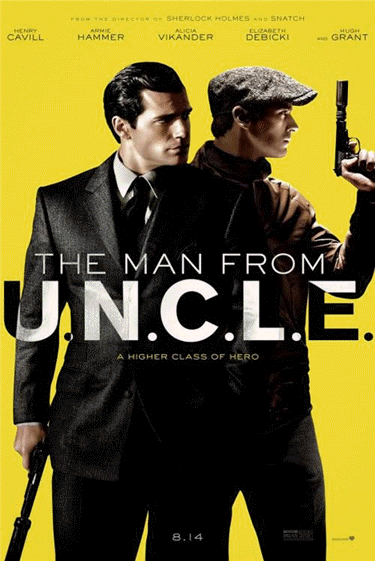
Hugh Grant as Alexander Waverly was rather good too.

Earlier today we saw The Man From U.N.C.L.E. It was a fun movie, very much in the style of the original television series and movies.

I think both Henry Cavill and Armie Hammer did excellent jobs. In fact, I liked Cavill better than Robert Vaughan in the role of Napoleon Solo.

But … growing up, David McCallum’s Illya Kuryakin was one of my favourite characters. I found it hard to reconcile Hammer’s version of Kuryakin with my version.

It’s a lot like how, for some people—me included—there is only one Mr Darcy and one Lizzie Bennet, and that’s Colin Firth and Jennifer Ehle from the 1995 BBC TV series. Firth and Ehle made those parts their own.

Darcy and Lizzie.
The incomparable Mr Darcy and Lizzie Bennet

For me, McCallum made Kuryakin’s part his own.

Thus throughout the movie there was this strange feeling of, ‘that’s not Illya’, he wouldn’t behave like that. Yet the silly thing is, I could see that Hammer did as good a job as Cavill did, and I liked his character better. (Then, I always did like Kuryakin better.)

I’d like to see Guy Ritchie make a second Man From U.N.C.L.E. By that time I should have reconciled myself to Hammer in the role. It would be interesting to see how much that changes my perception.

Categories
Progress report

Edits are nearly done on Alliance

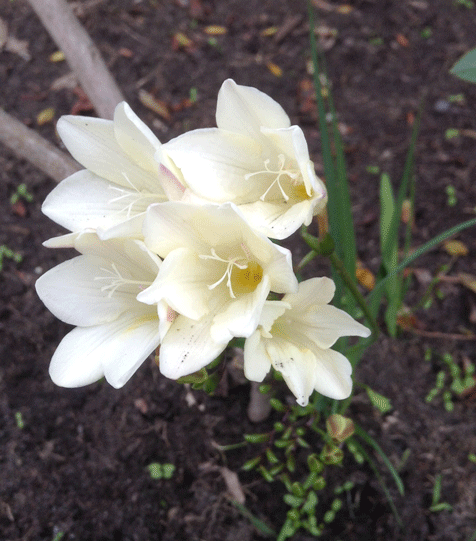
It's been freezing here in Melbourne, and we've been inside working on the book. But while we were writing ... look, our first freesia for the year.
It’s been freezing here in Melbourne, and we’ve been inside working on the book. But while we were writing … look, our first freesia for the year.

We’ve almost finished the first major edit of ALLIANCE following initial editorial feedback. Our deadline is Friday, 14 August.

Based on the first book, we’ll have at least another round of edits after that, possibly more, but for the moment we’re almost done with this draft.

This is one time we back up the changes frequently. Sometimes two and three times a day if we’ve worked a lot on the draft, because we’re at that stage where we’ve done the major rewrite, and now our changes are little more than tweaks. Cleaning up the text, fixing typos. If we lose those tweaks we’d never be able to reproduce them, we’d just have to redo the work.

As the deadline approaches my housekeeping gets more and more … rushed is a polite word. So come 14 August, I’m going to clean house.

After that, it’s back to book three.

Categories
Writing process

Library talk

On Wednesday night we did a talk at Balwyn library.  The talk was part of their “New and Emerging Author” series, where they support and introduce readers to debut authors.

It was a really great night.

We had a small group, which made it comfortable and non-intimidating and the audience was great with their comments and questions—both during the talk itself and afterwards over tea and cakes.

The moderator, librarian Fiona Malcolm, was excellent.  Everything you want a good moderator to be.  She read the book beforehand—she reads every book-talk author’s book—which was nice, because she doesn’t normally read science fiction.

Fiona asked questions, and we answered them.  Because she had read the book, she asked good questions—related to the book, related to co-writing, related to the writer’s journey to publication.

This was our first public appearance as authors and the good moderator, combined with the small but receptive audience, made for a non-stressful evening. It was a good introduction to being public about our book.

Thank you Fiona. Thank you Balwyn Library. And thank you to everyone who came along.

Categories
On writing

Great books are seldom written, they’re rewritten

If you don’t know the story behind the publication of Go Set a Watchman by now, you’ve probably been living without television or internet for the last few months.

Back in the late 1950s, Harper Lee tried to sell a novel, Go Set a Watchman. Publishers J. B. Lippincott bought it, and came into the hands of editor Tay Hohoff.

Ms. Hohoff was impressed. “[T]he spark of the true writer flashed in every line,” she would later recount in a corporate history of Lippincott.

But as Ms. Hohoff saw it, the manuscript was by no means fit for publication. It was, as she described it, “more a series of anecdotes than a fully conceived novel.” During the next couple of years, she led Ms. Lee from one draft to the next until the book finally achieved its finished form and was retitled “To Kill a Mockingbird.”

Jonathon Mahler, “The Invisible Hand Behind Harper Lee’s ‘To Kill a Mockingbird’“. New York Times 12 July 2015.

The rest is history. To Kill a Mockingbird had been Lee’s only published novel until the manuscript for Go Set a Watchman resurfaced recently. There was some controversy over the discovery of the manuscript, and whether or not Lee truly wanted it to be published, but published it was, and sold a million copies in its first week on sale.

Another controversy is over the quality of the book. As Joe Nocera says in “The Harper Lee ‘Go Set a Watchman’ Fraud”

Issue No. 2 is the question of whether “Go Set a Watchman” is, in fact, a “newly discovered” novel, worthy of the hoopla it has received, or whether it something less than that: a historical artifact or, more bluntly, a not-very-good first draft that eventually became, with a lot of hard work and smart editing, an American classic.

Joe Nocera, ” The Harper Lee ‘Go Set a Watchman’ Fraud“, New York Times, 24 July 2015

One thing everyone agrees on. Tay Hohoff had a lot to do with just how good ‘To Kill a Mockingbird’ was.

I think many people underestimate the work an editor does.

Most authors I know would say that the novel they initially turned in is not the one that gets published.

Sure, the days of the having two or three years to work on the edits is gone (for most of us, anyway), but a good editor will make suggestions as to how you can fix your work and make it better.

The editor doesn’t rewrite the book for you—that’s your job—but your book will be better once the editor has given their input.

To paraphrase one of the commenters on Nocera’s article,

… Lee’s two books are … the perfect example of the adage that great books are seldom written, they are re-written.

Bejay, commenting on The Harper Lee ‘Go Set a Watchman’ Fraud. 25 July 2015.