Categories
Books and movies

Thor: The Dark World. They should make more movies like this

By which you can guess that I enjoyed Thor 2. A lot.

I was a little worried because watching the trailers I got the impression Jane had been dumbed down, made more girly. But she hadn’t.

Thor/Loki? What can I say that others haven’t? Loki needs a hero to play off against and Thor is perfect.

The bad guy was a one-dimensional stereotype, but it didn’t spoil the fun. Imagine how awesome the movie would have been if they’d given us a better bad guy.

One minor quibble. If you dump a car in a neighbourhood like that, it’s not just going to be covered in graffiti and have it’s windows smashed in. It’s going to be up on chocks, all four tyres missing and the battery gone. No-one, just no-one, is going to get in it and simply drive away. (But I loved that they did, anyway.)

I’m off to buy the soundtrack to add to our ‘music to write by’ collection.

Categories
Writing process

Science fiction through modern media

Lately it seems I’ve come across more and more people who love science fiction, yet their total exposure to the genre is through film and television. They’ve watched every episode of Star Trek, seen more Star Wars movies than I have, they’ve seen Farscape, and Torchwood and Firefly. (Every single one of them adores Firefly.)

They have never read a science fiction novel that wasn’t a spinoff from a television series or a movie or a computer game.

These people love science fiction as much as I do, and most of them are far more fanatical. They go to conventions, they join forums to talk about their favourite shows/characters, and they meet up with fellow aficionados. Some of them are even writing novels. Good novels.

I just wish there was a way to steer them toward science fiction books. There are some stories out there they’d love.

I wouldn’t steer them toward the grand masters from the golden age of science fiction. They were good for their time, but that time isn’t now. I’d start them with what they’re enjoying at the moment. Light military science fiction. John Scalzi’s Old Man’s War, Tanya Huff’s Confederation series, maybe even Louis McMaster Bujold’s Vorkosigan books. Then I’d go on to some of the more modern day classics. Some early Connie Willis. Finally I’d move on to some of the more thought-provoking or deeper science stories. Vernor Vinge, Paolo Bacagalupi, Elizabeth Bear and others.

Except, no matter how much I coax, I can’t convince these fans to read them.

Fantasy doesn’t seem to have the same problem

People who are introduced to fantasy via the movies, however, often graduate to other books.

I wonder if this is because a lot of fantasy you get on television and film comes from books anyway. The three most obvious being Lord of the Rings, Harry Potter and A Song of Ice and Fire.

Many fantasy readers start off with the movies, graduate to the books and before you know it they’re waxing lyrical about Robert Jordan, Brandon Sanderson and Joe Abercrombie.

Don’t jump in at the deep end

Unlike fantasy, science fiction created new stories for the new media. There are a few standouts that came the other way, like BladeRunner, but I’m generalising here. And let’s be honest, Do Androids Dream of Electric Sheep (the story that spawned Bladerunner) is probably not the first story you would give someone to introduce them to science fiction as a novel. You need to ease into it gently.

Easing into it is important. Not everyone wants heavy science in their fiction, at least, not at first. If you ask the people who have been introduced to sci-fi through media-related material what they like about it, I’m sure that most of them would say the characters, the action and the humour.

They need stories with those same characteristics.

There are dozens of stories just like that in novels that these fans would love.

If only they would read them.

Categories
Writing process

NaNoWriMo

To all of you who plan on doing NaNoWriMo this year. Have fun, and may your words flow fast.

Categories
Talking about things

Sleeping in a cupboard

I love my cupboard. It is so cute and so just mine.

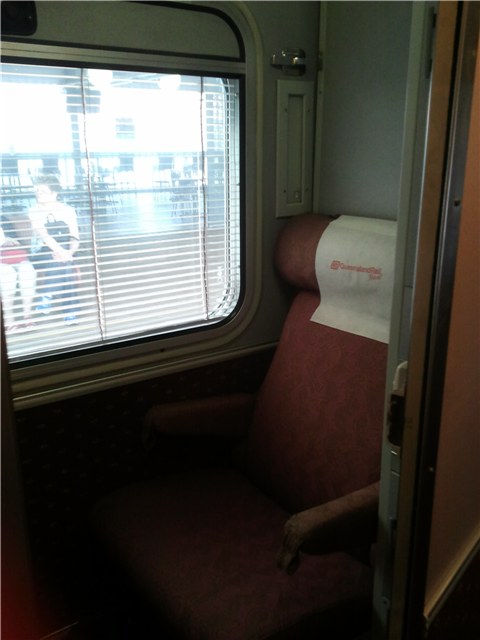
queensland rail single sleeper_1
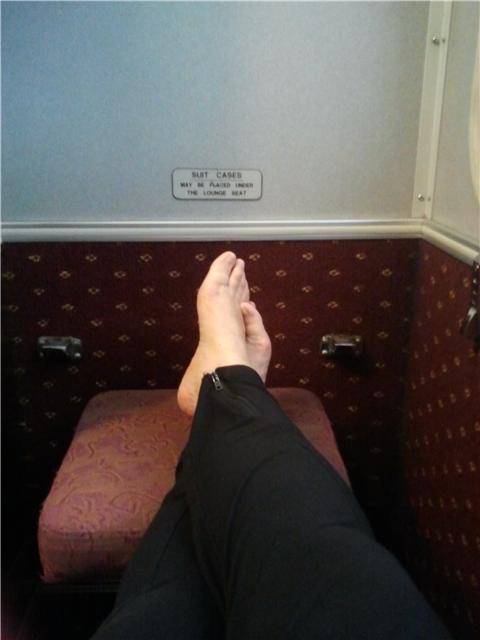
This is the size of a single sleeper on the Brisabane to Cairns Sunlander. As you can see, it’s squeezy.

After GenreCon we decided to catch the train from Brisbane to Cairns. 30 hours by train. Naturally, we needed a sleeper (but not Queenslander class, because we both wanted bottom bunks). The single sleepers were the same price as the doubles. The single is the size of a cupboard. And I am sleeping in this cupboard tonight.

Queensland Rail single sleeper_3

Queensland Rail single jump seat
I’m 160cm tall. These photos are taken with me sitting either end of the carriage. First in the little jump seat, second in the main seat.
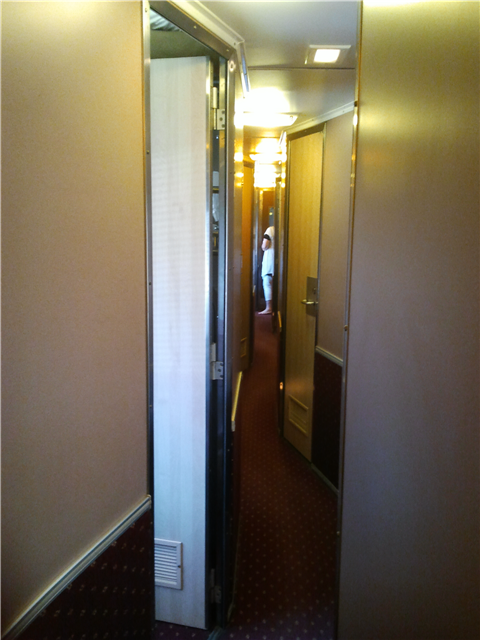
Queensland Rail single sleeper
Breathe in as you walk down the corridor. No room for overtaking or passing.


Categories
On writing

GenreCon 2013 – Take 2

This year, we headed to sunny Brisbane saying goodbye (temporarily) to the cold weather in Melbourne.

First things first.  Melbourne, why don’t you have an airtrain? Sydney does, Brisbane does. Instead we squashed onto a crowded bus and wove through crowded traffic out to Tullamarine airport. Arrive at Brisbane and enjoy a relaxed train ride into the city and a quick, two block walk to our hotel.

A shower, snack at the bar and off to register. Well, to find out where we were supposed to go for the GenreCon opening reception really, but registered at the same time. Nice and easy.

After the meet and greet, we meander back toward the hotel along the river. We know we should do the right thing and head to the bar—after all, GenreCon is about networking with likeminded people—but we needed time out. At Southbank, a night market is in full swing and the atmosphere is festival-like. The weather is warm and there is the most wonderful cool breeze straight off the water. Perfect for two weary Melburnians. Finally felt like I was away.

GenreCon 2013 moments in no particular order. And not necessarily all at the GenreCon event itself. If Chuck Wendig can do a top 25, I can do a top 10.

  1. Did you know John Scalzi looks better in a kimono that Chuck Wendig? (John, blame Chuck for that one.)
  2. The water pressure. It has been so long since I had a shower with decent water pressure it was worth mentioning. Thank you Rydges Southbank Brisbane
  3. That awful moment when drying my hair on a pristine white towel and realised that the hair dye was colouring the towel red. Very, very red. (Sorry Rydges)
  4. John Connolly, fantastic speaker. I didn’t want your talk to end. It must be the Irish in you. Almost, (only almost) wanted to go and read a Charlie Parker novel. Maybe I’ll try one of the young adult novels instead as they might not be so bloodthirsty. In the meantime, I keep repeating to myself ‘don’t hit send.
  5. Kathryn Fox, who made me cry with that little opening scene from ‘Up’. Another brilliant speaker.
  6. Meg Vann, Peter Ball and the Ninjas, who made the whole event happen. They did a fabulous job running and organising the whole thing. Thank you.
  7. Alex Adsett, who talked about contract and negotiations and was so very approachable.
  8. Sarah Fairhall for listening to Karen pitch and Rochelle Fernandez for putting up with me. Not sure I want to go through that experience again. It took me ages to recover. Strong coffee was the order of the day afterwards and I don’t like strong coffee. I still shake when I think about it. Whoever said pitching was easy. Caitlin, I don’t envy your job one iota.
  9. Kez, a fellow writer who we spent ages chatting with over the breakfast table post-con. I am really going to have to learn to play the drums. Kez writes erotica, a tad different to SF but it didn’t matter. Kez who told us that a drop of peppermint oil at the back of your tongue and holding your head up will help if you lose your voice when you speak in front of people. Will have to try it and see if it works).
  10. Brisbane weather. Has been fabulous. Couldn’t ask for a better introduction to Brisbane.

Karen’s take is here.

Categories
On writing

GenreCon 2013 – Take 1

GenreCon 2013 has come and gone. We both met lots of great people, talked until we were hoarse, and learned lots from the varied presenters.

As usual, we’re both blogging about it. This is my (Karen’s) take on the event. Sherylyn’s will follow in the next post.


John Connolly was superb. Entertaining, witty and targeted perfectly to his market of writers.  I would love to be able to speak like him.

Or failing that, Kathryn Fox.  She was excellent too.

The two stand-out sessions for me were the long ones that covered practical aspects dealing with writing.

The first was Damon Cavalchini’s Say It With Feeling. Damon gave practical tips and hints on how to prepare for and do readings. Useful tips on how to overcome your nerves, how long you should read for, and the impact that changing your tone and pitch has. Tips on dealing with nervous mannerisms like waving your arms about (do it, just be careful of the mic) or giggling. Tips for practising readings and using your voice. It was good, practical advice on a topic most of us never even think about until we have to do it.

The second was Alex Adsett’s Contracts and Copyrights. Again good, practical information from a woman who obviously knew what she was talking about. Alex covered the basics of copyright and permissions and then went on to cover publishing contract clauses and rights. What the various clauses mean, which are the show stoppers for her, and so on.  And she made it easy to understand, which you have to admit is hard to do when you’re talking legal documents.

Next up: Sherylyn’s take.

Categories
On writing

My writing crystal ball

After reading the recent tweets from #MSWL—Manuscript wish list hashtag—on Twitter I did my own non-scientific analysis of the results and came up the following list of potential future trends.

  • Historicals in different eras (MG, YA, NA, adult)
  • Male protagonist who’s not beautiful/perfect or who is deeply flawed
  • Lots of YA science fiction and fantasy
  • Lonely kids
  • Sassy contemporaries. If they’re YA, not too much angst
  • Retelling of fables, fairy tales
  • LGBQT and POC
  • Space opera
  • Epic fantasy
  • YA horror
  • Con/heists/mysteries/capers

If I had to pick a single trend I’d say it was historical fiction, particularly for eras that haven’t been written about before. Regency is out, Victorian, Renaissance and middle ages are in. The trend crosses over to science fiction and fantasy as well as mainstream historical.

There were a few requests for stories about lonely kids, some for non-perfect heroes, and others for sassy contemporaries without too much angst. Quite a lot for lesbian, gay, transsexual and bi-gender (LGBQT) and people of colour (POC).

I got the impression that people were looking for more uplifting stories than they have for a while.

There were lots of requests for YA horror, science fiction and fantasy. I think this is fantastic, as it means this next generation will grow up thinking of these genres as automatic ‘to reads’. Bring it on.

There was also a bigger demand for mysteries and capers than I have seen for a while.

What’s really good for us is that quite a few people are looking for space operas.

Now that’s a trend I like.

Categories
Writing tools

A final look at Office 365

It’s been six months since I bought Office 365. Time goes so fast. Only another six months to renewal, which was always the bad part about the whole deal, but I knew that when I started, so it’s not really the bad part, just the choice I made.

It’s a good time to look back on how I’ve found it. It’s been a busy six months, writing-wise.

Using Office

When I installed Office 365 I moved from Office 2007 to 2013. I had no problems with the transition.

I thought I would get used to the colours, but six months later I still open Outlook when I mean to open Word, and I still don’t like the all-white for everything. (I see that the iPad has gone very white as well. All I can say to both companies is, please don’t.) I would love an option to add more contrast. For users like me, who have two 24 inch screens, it is too much white.

The templates on the New Documents pages still drive me crazy. I would love to control which templates I see.

Outside of the above, I like the software.

Transferring licenses

Back in September I bought a new laptop and transferring the licenses was a breeze. A definite plus for Office 365.

Networking

Office itself is great, but when it comes to the cloud you can probably hear my screams from the other side of the world.

Categories
Talking about things

eBook things

The eBook market seems to be settling down, and with it eReading habits. I step back and take stock occasionally. Here’s where I’m at with eBooks right now.

I buy my eBooks from a number of suppliers, and I keep them in a number of different places as well. This may or may not be typical behaviour—most of my eBook reading friends tend to buy from one supplier, even if they buy their paper books from different places.

I can see lots of advantages to sticking to a single supplier and format but there a lots of disadvantages too.

Some eReading facts about me

  • I don’t have a dedicated eReader like a Nook or a Kindle
  • My favourite eReader is the iBook app on the iPad
  • Other eBook readers I use on a regular basis are Calibre, Kindle for iPad and Kindle for PC, and I use on a lesser basis some other proprietary readers
  • I like to keep all my books in the one place
  • I use Calibre to manage my books
  • I don’t have a preference for eBooks over paper books; price and immediacy (as in, do I want to read it right now) determine which format I buy in.

Some eBuying facts about me

  • I buy DRM-free if I can, because it’s easier to move between eReaders
  • I prefer to buy books in a non-proprietary format, again so I can easily move between eReaders
  • I try to buy from publishers whose business practises I support
  • I buy more books now I have an eReader
  • I’ve had some bad experiences with PayPal, so if that’s the only way I can pay for a book I’m not going to buy, not matter how much I might want it

And yes, those first three points mean that I only buy eBooks from Amazon when it’s the only place I can get them from, or when they’re so cheap I’ll take that in preference to a book I can read in another reader. What this means is that my Kindle books tend to be my junk novels. There are a lot of self-published books in there, for example.

I don’t buy books from the Apple store. Ever.

I also like to feel that once I’ve bought a book, it’s mine. The bookseller can’t take it back on a whim. Here’s looking at you, Amazon.

The last point limits where I buy books. A surprising number of smaller online publishers only take PayPal.

ePurchasing experience

Things suppliers/software do for me to make my ePurchasing experience easier

  • Read the first pages

This is the equivalent of picking up a book in the bookstore and starting to read. I love it.

  • Amazon one-click to purchase

I love it.Despite what I say about Amazon above, this makes be buy a lot of books. Spur-of-the-moment decisions. If I have to take out my credit card to make the purchase I’ll often think twice.

Maybe it’s a good thing.

  • Number of pages or number of words

Amazon again, but other publishers do it as well. Sometimes, buying a book off the internet seems like a lottery with regard to value for money. I have been caught out so often buying stories—at novel-type prices—only to find it’s little more than a glorified short story. Unfortunately too, many of my favourite mid-list writers are turning to self-publishing, and it seems that as soon as they do, they start producing shorter works. If a story is only nine pages long, I want to know that before I fork out $5 for it. I’m expecting at least half a novel for that price.

  • Send to device

Calibre has a great feature where you can send your books to iTunes. Kindle has a ‘send to Kindle’ option when you select a file. I use them both all the time. Anything that makes it easier to move between the various readers gets my vote.

Reflections

Looking back over old blogs, I’d say my eBuying and eReading habits were settling.

Categories
On writing

Remember, you became a writer because you enjoyed writing

The pressure to always write ‘serious’ stuff can lead to burn out. Sometimes you need to leaven it with some fun, otherwise you’ll find you just can’t write any more.

Paolo Bacigalupi writes some pretty heavy stories. They do what great science fiction always does, they make you think—really think—about the issues that he writes about. Like the ethics of genetic engineering.

I remember reading The Calorie Man back when it first came out, just after I’d visited family in the wheat belt of the Wimmera and for some reason that visit we’d been discussing Monsanto and buying GM modified wheat. I tell you, reading Bacigalupi’s story immediately afterward made an impression that stayed with me for years.

However, I digress, I’m not here to talk about Bacigalupi, I’m here to talk about a comment he made on John Scalzi’s The Big Idea, which is part of Scalzi’s Whatever blog.

If you read science fiction and fantasy, by the way, I hope you’re reading The Big Idea. It’s one of the best places I know to discover new/unfamiliar authors.

But, back to Bacigalupi, whose new book is Zombie Baseball Beatdown.

In The Big Idea Bacigalupi says:

To be honest, I didn’t write Zombie Baseball Beatdown just for the giggle … I actually did it because it if I didn’t, I probably wasn’t going to write another one of my ‘serious’ novels ever again …

For the last two years, I’d been miserable trying to write The Drowned Cities with that Greek chorus of critical voices in my head. I desperately wanted to play creatively in a space where I no longer had to worry about who liked what, or who approved of what, or whether anyone would want to buy what I wrote.

I just wanted to create…

The Big Idea: Paolo Bacigalupi*

I know exactly how he felt.

When Sherylyn and I write we tend to do one ‘serious’ novel and then one ‘light and frothy’, before returning to another heavier story.

You can’t call our serious novels anything like Bacigalupi’s, of course, but they’re still a lot more serious than our light-and-frothies, which tend to be romps. We have written, for example, a young-adult fantasy, a rim-world science fiction and a romantic science fiction in our metaphorical time down.

Then we got an agent, and while our agent has been fantastic and not put any pressure on us at all, we put pressure on ourselves. We jumped straight from one serious novel to the next.

And we struggled. Linesman II (Acquard) has taken us twice as long to write as a normal novel, and while it’s good in parts, it’s nowhere near finished yet. We’re on the second draft and there’s still lots to clean up. Clean-up that would normally have been done in the first pass.

Like all of our writing, once we’ve finished a major draft we put the story away for a couple of months. We do this not just so that we can come back to it with fresh eyes, but also because once you have finished writing a story you’re tired of it. Put it away for a bit and you come back to it less jaded. You see what you loved about it in the first place.

So we put Acquard away and what did we do next? We jumped straight into Linesman III (Fergus).

More fool us.

Fergus was coming hard too.

Then, I have no idea why, we started a side project. A story about a demon who eats a wizard and decides to take that wizard’s place. It’s definitely a light and frothy.

We’re having fun writing again.

And not surprisingly, Fergus is coming along well too.


*p.s. Bacigalupi still manages to pack some heavy themes into a kid’s book.