I finally caved in and bought an ultrabook laptop. My not-so-little netbook that I shopped so hard for weighed in at a whopping 4.1kg, which is a fair weight to carry around in your handbag.
My new PC weighs in at 0.87kg and yes, it fits into my handbag. I’m loving how light it is.
I have to admit, with Office 365, the installation of Microsoft Office was painless. Log in to the Microsoft site, click ‘install’ and wait for it all to happen. It was the most painless install I’ve done. And my shared data came across all set up ready to go.
One month to GenreCon 2013. We both had such a good time last year we’re going back. We even blogged about it (here and here).
The things that stay in my mind twelve months later aren’t the things we blogged about. What I remember now are the little things, like the young waiter serving drinks the night of the cocktail party who asked, “Are all these people published writers?”
“Some of them are,” we told him. “Some of us aren’t yet, but we want to be.”
Seriously, that young kid wouldn’t have taken much encouragement to become a writer himself. (Sherylyn planned to blog about incidents like this before we go this time, but she’s busy, busy, busy doing tax. Never get in the way of a lady doing her tax return, especially not when she’s helping me fill out mine as well.)
Like I say, we’re both going back. It was lots of fun, and we met lots of interesting people all interested in the same things we’re interested in. What more can you ask?
Science fiction writers try to predict the future. Take a trend, extrapolate it, and there’s your future. Yet there are some things you’d never think of, even though they’re so obvious once the trend has arrived.
Selfies are like that.
Whoever would have picked a trend where people took photographs of themselves and made them available on social media?
Not me.
I could probably have picked social media. Maybe not in exactly in the same format, but some kind of interaction and exchange of social information via virtual communities.
But selfies?
In retrospect, it’s logical. The proliferation of cameras on mobile phones, combined with easy access to upload them, combined with social media. It’s obvious, but only after it’s happened.
Sherylyn and I go through five and more major rewrites and dozens of minor ones for each novel.
Not so for blogs. Our blogs get three drafts. The initial draft, one re-write if we have the time, and then a final polish before we post. As you can imagine, they’re nowhere near as polished as our novels.
Once a blog is posted that’s how it tends to stay. We’ll fix typos or bad grammar but mostly what you see initially is what you get.
It’s rare, but we do occasionally rewrite articles, either because it they’re badly written or because the post doesn’t get across the meaning we wanted.
When we started A Novel Idea we planned to show how a story changed from first draft to final. Rather than rewrite last week’s post we decided to show what we would edit. And give the reasoning behind it.
Note. This article has been extensively edited. If you want to read the new version, please see An Exercise in Rewriting instead. Are you a ‘professional’ writer
Wow. Poor Lisa Morton. I bet she didn’t expect the outpouring of vitriol in response to her article ‘Ten questions to know if you’re a pro‘ on the Horror Writers’ Association Los Angeles site.
In her article Lisa gives a pop-quiz list of ten things that define whether you’re a professional writer or a hobbyist. Answer yes to at least eight of the ten questions and you’re a professional writer, rather than a hobbyist.
Most of the people arguing about her article seem to take umbrage at her definition of ‘professional writer’. They argue that you are only a professional writer if you have been paid for your work.
They object to her using the term in any other way.
They also object to questions like:
Is your home/work place messy because that time you’d put into cleaning it is better spent writing?
Do you routinely turn down evenings out with friends because you need to be home writing instead?
with answers like, “No, my place is not messy because I like a clean house,” and “So because I want to spend time with my friends I’m not a professional writer”.
Sometimes I look back at the things I write and laugh at myself.
We started this blog in 2006. In internet time, that’s half a life ago.
In 2006 the big social networking tool was MySpace. Facebook was the new kid on the block and Twitter had just been invented. Bloggers mostly used LiveJournal or blogger.com, because only the truly keen or the truly nerdy used WordPress, especially hosting your own site.
Unpublished authors weren’t expected to have websites, although industry advisers were starting to encourage this. Industry advisers were also starting to make the web their own in our in our little writing corner of the internet. In particular, literary agents were starting to blog, dispensing lots of useful information for unpublished writers.
One such agent site was the BookEnds, LLC blog. Like many other blogs set up around the same time, it is now defunct but it was a good site while it was going, full of useful hints and tips about writing query letters, getting published and so on.
Back in November 2007 Jessica Faust wrote about websites for unpublished writers. It was good advice back then, and I even blogged about it.
Part of Jessica’s post talked about putting samples of your writing up on your site. Here’s what I said when I blogged about it.
Jessica also suggests that posting a chapter of your novel is a good idea.
Some of the people who commented on her blog thought this was a good idea, others were a little wary. I confess to being one of the wary ones … I’m not sure about posting any of the work we are currently trying to sell.
“Huh,” is all I can say now, because seriously, one of the first places I go to nowadays on any author’s website (published or unpublished) is their sample pages. When a writer is published, those pages are my major book-buying decision tipper in many cases. If I like a yet-to-be-published writer’s samples well enough I will keep an eye on their site for when they finally are published.
I’ve been using Office 365 a while now. Here are my cool and not-so-cool features.
They’re mostly simple things. It’s weird how the simple things make a big difference. Some of these features may already have existed, I just didn’t know about them.
Cool Word—how long have I been writing this novel?
Word tells you how long you have been editing a document.
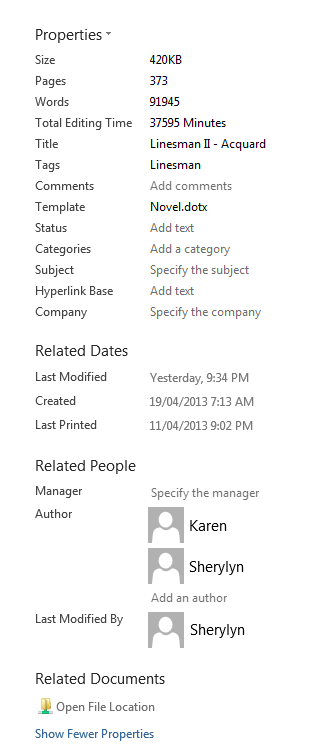
Click on the File tab and you get document information. One of the tags in the Properties area is ‘total editing time’.
So far we have spent 37,595 minutes writing our latest novel—626 hours or 26 days straight. That’s a big chunk out of our life.
Document properties
I don’t know how accurate it is for us. When I’m editing I often close the laptop without exiting from the document, but it’s an interesting indicator of how much time we do spend on a book.
Uncool Word—go to page doesn’t work the way it used to
In the old versions of Word you used to be able to click on the page number at the bottom of the screen and bring up the Go To Page box. Now I have to use <ctrl><g> (<ctrl><g> was always there, I just preferred to click).
Cool Word—simple markup
I like the simple markup option. It shows you a nice clean manuscript, but also indicates where revisions have been made.
Cool Word—pick up where you left off
When you open a document it gives you the option to resume where you last left it. Very nice when you’re in the middle of editing.
Cool Word—the ability to reply to comments
We often make comments as part of the editing process. It’s great to be able to reply to a comment.
Uncool Word—all those templates
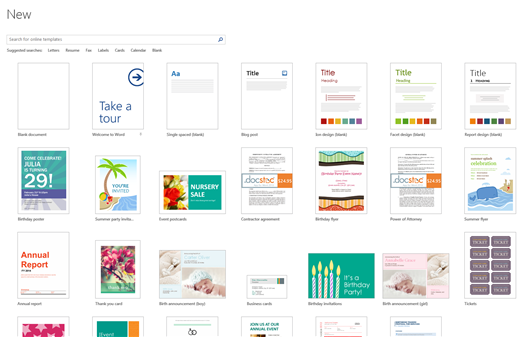
The way Microsoft displays the templates on the File > New page has changed. It now shows you a list of templates you can open. Most people will think this is a good thing.
Word templates
Me, I just want all that junk off my front screen. I’d love to be able to add my favourite templates here (normal, manuscript, blog) and get rid of the whole distracting mess of the rest. I don’t use other templates that often, and I’m happy to go look for them when I do.
While I’m on it, please, Microsoft, bring back the one-click for a new file based on Normal template. You haven’t had it for a few versions now, but I really miss it.
Uncool OneNote—sharing through the cloud
Again, one of those things that should really be an improvement, but Groove, I miss you.
I use a laptop and the desktop and write between, depending on whether I am at home or out. I add my continuity notes to OneNote. It used to be that I’d come home, plug the laptop into the network, open OneNote on the desktop and any updates I had made during the day were copied across to the desktop. Remember, too, that throughout the day I don’t have the internet on, because all I am using is the word processor.
To share OneNote in Office 365 I had to put the master file on the cloud drive. Now, I come home, plug the laptop into the home network, open OneNote on the laptop so it can copy its data up to the OneNote master, then open OneNote on the desktop so that it can update what has just been uploaded from the laptop.
It’s a lot more complex.
Uncool Outlook—lots of things
I think Microsoft needs to go back and redesign Outlook. All the good stuff that’s in Office 365 Outlook was already there in Office 2010. It wasn’t broken. They didn’t need to fix it.
I particularly hate the wasted space they force onto us by giving us the start of the mail beneath the mail heading. If I wanted a preview, I’d use the reading pane. It’s designed for people reading their email on tablets or phones. Microsoft, I have news for you. Some of us don’t.
I’d love an option to condense each mail down to its heading line.
They changed the icon from yellow to blue. Half the time I open Outlook when I think I am opening Word.
The bugs. One day I found I couldn’t open hyperlinks direct from Outlook mail. I had to go into the registry settings to fix it. (To be fair, I think Chrome has to take some of the blame for this one, but why was the issue limited to Outlook?)
In summary
There are some good things and some not-so-good with the new Office.
Most of my gripes have to do with the fact that Microsoft obviously designed this version of Office for tablets and phones. Unfortunately for me, I’m not using either. (A word processor, a spreadsheet , a presentation program and an email system. How many of these are naturally done on tablets or phones? The only one that naturally works on those systems is email, and to be honest I don’t know anyone who uses Outlook as their mail system on either of those. They use the native mail system provided with their device, or some form of webmail system.)
Otherwise, the functionality itself is sound. Microsoft puts out a good product, and so far, it’s still that.
If you write science fiction or fantasy, you end up doing a lot of world building.
If your world is part of a fantasy it may have some or all of magic, strange creatures, different plant-life, and so on. If your world is part of a science fiction then it may have some or all of new or amazing technology, strange creatures, different plant-life and space.
If you have space, then you probably have spaceships too.
If you know exactly how your space ships work and can describe the physics and technology behind them, then you are most likely writing hard science fiction. As for the rest of us, we have some idea of how our ships work but we couldn’t tell you much about the technology behind it.
But just because we don’t know every technical detail, it doesn’t mean we can forget about basic laws of physics.
Following are some of the things Sherylyn and I considered/discussed when designing our ships for Linesman.
Our ships never land on planets
They have shuttles to do that. Therefore, there are no strict aerodynamic limitations. Thus shape is not an issue.
Shuttles, however, will need aerodynamics of some sort. And they’ll need to be able to take the stresses of continual entry and re-entry to an atmosphere.
Ships will also need to be large enough to fit at least one shuttle, probably in a shuttle bay.
Our ships have artificial gravity
Given that many of our characters live on spaceships and move easily between ship, space stations (the size of cities) and planets, then our people have to physically be able to do this.
That means they can’t spend most of their time in zero gravity and only hit real gravity when they land on a planet. It would be too dangerous. Not to mention it would make our books a farce, because many of our characters are military people. They kick butt. Imagine a soldier coming onto station from months in zero gravity and taking on, and defeating, the soldiers on station.
Our ships can travel faster than light
In fact, they have a form of hyperspace. They jump through the ‘void’ from one point in space to another without having to physically move to get there. These jumps are virtually instantaneous.
This means that the ship speeds required are mostly for moving from the exit point of the jump to their destination. They don’t jump right to the edge of a planet, say. That’s too dangerous. They jump some way out and then use engines and inertia to bring them in close enough to use the shuttle.
Even so, our ships are plenty fast, and can take the stresses involved in truly fast speeds. We’re talking hours from Earth to the moon here, days from Earth to Mars.
Fuel
In our universe we assume that our ships are powered with some form of nuclear fission device, which by then is inexpensive and relatively safe (if you could ever call nuclear fission safe).
We also use hydrogen as a secondary fuel, although we never specify how it is used, or how it is stored.
Most of the fuel will be used in bursts. One initial burst to start the ship in a direction, smaller bursts to change direction or slow down.
Our ships are large
We think of our spaceships more as modern-day ships rather than like aircraft. A cargo ship has the capacity of a container ship, and works much the same, with a cabin area for the crew and the rest of the ship given over to big spaces for cargo. A passenger ship will be more like a modern-day cruise ship with bars and entertainment like a cruise ship has. Troop carriers will be like modern-day aircraft carriers.
So all up, our ships are designed for what they are meant to do—carry cargo, carry people—rather than for aerodynamics. Think a modern office block, a cargo ship or a hotel rather than an aircraft. Their limitations are function and the ability to provide artificial gravity.
I don’t know about you, but I get lots of email newsletters. Junk mail from Barnes and Noble and Amazon and some smaller booksellers I buy from, newsletters from the various writing groups I belong to, lots (and lots and lots) of junk mail from companies I purchase on-line items from.
I also subscribe to a number of author newsletters, where the author mails updates about their work to the reader. I like these, especially when they tell me close to publication date that they have a new book coming out. I’ll look for the book then.
Both the retail sellers and the authors go to some effort to make the emails look good. Adding pictures, formatting it so that it looks good, maybe even running to two columns.
I use Microsoft Outlook, and before I upgraded to Office 365 my Outlook got itself into a twist and started to resize the images. It’s a known issue, which you are supposed to be able to fix by resetting the resolution, but let me tell you, I reset everything I possibly could and nothing fixed it.
Except an upgrade to a new version of Office.
When I got emails with images in them, this was what I saw:
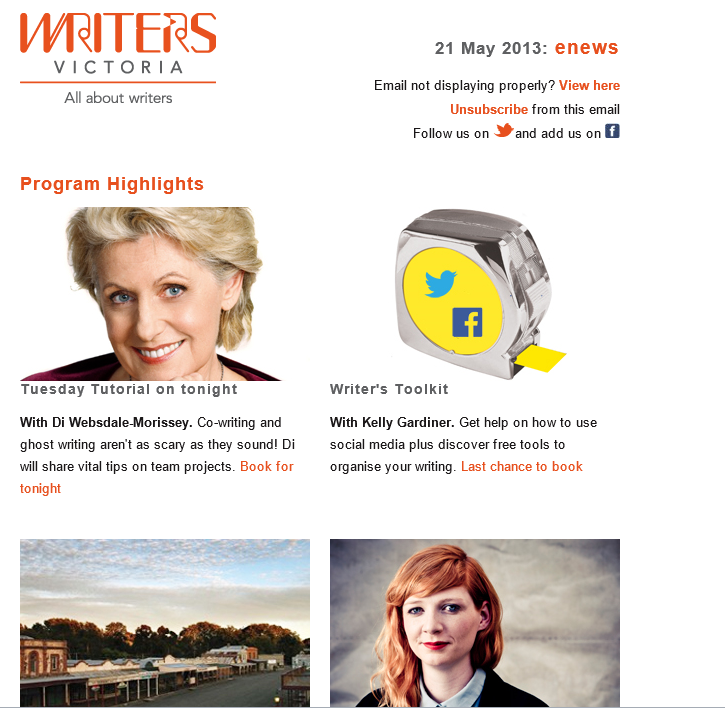
When what I was supposed to see was :
(Both these images were the full extent of what I saw when I opened the mail.)
The text was there, hidden beneath gigantic images that I had to scroll past to look at. After I scrolled sometimes I found the text was in one block and was readable, but other times I had to chase all over the screen to read it because of the way the mail was formatted.
If there was a link at the top of the message to view the newsletter on a webpage, then I clicked on the link.
Otherwise I simply deleted the email.
Sadly, the junk mail proponents always have an ‘if you can’t read this email click here to view in browser’ link. But I have yet to receive a single author newsletter that does.
Romance Writers of Australia (RWA) is, in my opinion, probably the most ‘professional’ of Australian writing groups. By professional here I mean profession-oriented, in a way that encourages and allows their authors to publish books and even make money from their writing.
Part of this has to be due to the genre. Romance novels account for around 50% of mass market books sold, so for authors it’s the biggest market around. Part of it seems to be that many romance writers are more practical, more business-oriented, than other writers. More career-focussed.
I’m a member of RWA. I joined on the recommendation of another writer I met at a speculative fiction workshop. She recommended them as, “Extremely professional, worth joining, and you can learn a lot.”
She was right, even for us, whose stories have romantic elements rather than being true romance.
Like other career-oriented writing organisations—Romance Writers of America (RWA), Science Fiction & Fantasy Writers of America (SFWA)*—RWA (and from now on when I say RWA I mean Romance Writers Australia) gives published writers extras. This includes access to special forum groups, a published author newsletter, special craft and career workshops and opportunities for promotion and to present paid workshops.
That’s not to say that RWA’s unpublished authors miss out. They get access to the monthly newsletter, to competitions that help them improve their writing, access to critique partners, e-groups and so on. Many of the competitions, particularly, are only available to unpublished authors.
At present, RWA defines “published” as …
the signing of a contract for any fictional narrative work of 40,000 words or more, excluding any self-published or vanity/subsidy published works.
Right now RWA is pondering the definition of ‘published’, because a lot of their members are self-publishing. Some of those who self-publish are selling quite a few books, but are still ineligible to be considered published members.