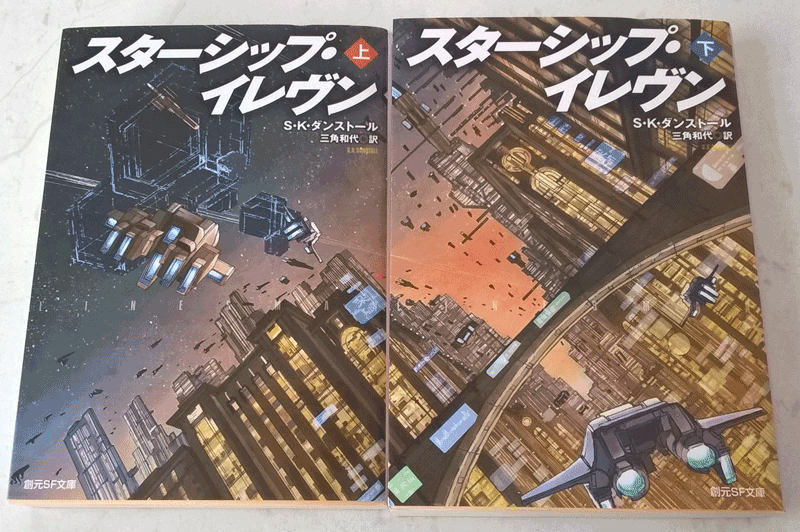
The Japanese versions of Linesman arrived in the mail the other day.
They’re so tiny and cute. Smaller than a paperback and half as thick.
Look at the covers. If you put them together, as we have above, they combine to make one long picture.
With the help of Google translate and a helpful reader (thanks Elizabeth) we’ve worked out that the book is called Starship Eleven in Japanese, and we think that one version is less complex than the other. (Blue dot is simpler, possibly)
The cover illustration is by K. Kanehira. The cover design is also credited, but sorry, awesome cover design person/people, we can’t read your name, and we don’t know how to get the name from the book to screen.
Likewise, we’re not too sure who the translator is. Google Translate gives us Triangular Kazuyo. Hmm. That might be right, but we think we’ll have to confirm this. More as we find out. If anyone knows, please let us know.
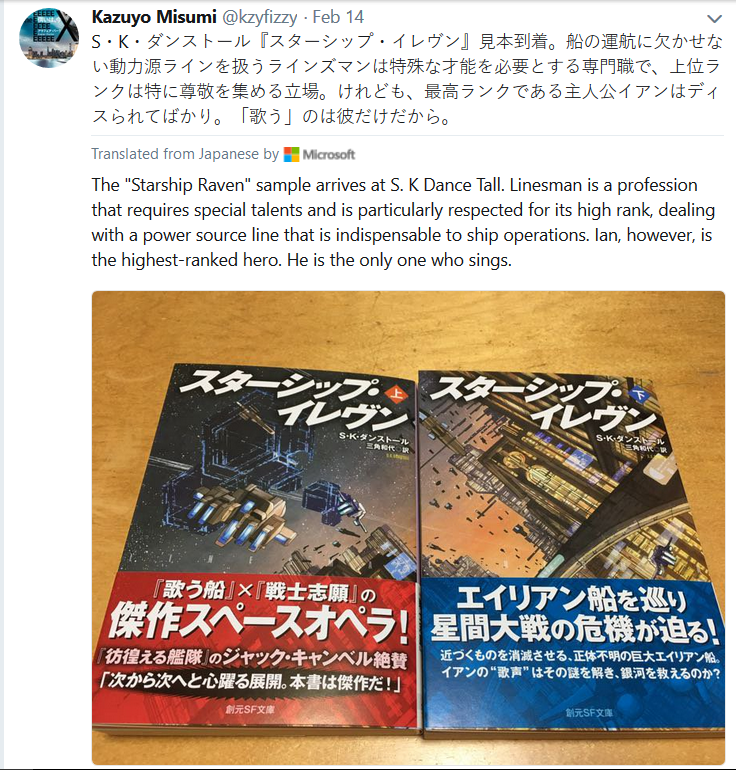
Update 25 April. S.E. Jones mentioned that the book is in two parts, and told us the name of the translator. (See comments, below.) Kayuzo Misumi. Here are twitter posts from @kzyfizzy on 14 February, which was when the book was released.
I do like the way our name translates phonetically into Dance Tall. It sounds so much better than it’s literal translation of the ‘brown stone’.
I pulled a muscle in my back this morning while cleaning the bath. I’d like to say it’s living proof that writers shouldn’t do housework, but unfortunately the reality is that this particular writer hasn’t been doing enough of anything active, housework included, to keep herself supple. Many writers are notoriously bad at keeping fit.
So while I wait for the Nurofen to kick in, let me tell you what’s been happening in our writing world lately.
We’re making good progress on the next batch of rewrites for Stars Book 2. It has a current, tentative title of Stars Beyond. We don’t know if that’s set in concrete. We’re at that stage in writing where every change we’re making is a positive change. “This will sound better if we do this,” or “If we move that section down past here the timeline will flow better.” Of course, some of those changes have flow-on effects, but that’s the way it is with rewrites.
We’re heading toward the deadline. We have to deliver the novel in six weeks.
Based on prior novels, there’ll probably a couple of obvious issues we discover really late. It’s amazing how you can go over a book ten, twenty times and still not see something so obvious until the last minute. Sometimes you can’t see it then, either, and your agent or your editor has to point it out to you.
Sigh.
In other news. The ARCs for Stars Uncharted have started going out to book bloggers and reviewers. The publisher has given some away on Goodreads. Keep an eye on the giveaways there if you want a copy, as we don’t always know about these when they happen so we don’t publicise them.
We’re busy putting the finishing touches to our April newsletter. This will include the first chapter of Stars Uncharted, so it’s going to be mammoth. Chapter one’s pretty long, so we’re trying to pare down the newsletter to a reasonable size. We’re getting there. Slowly.
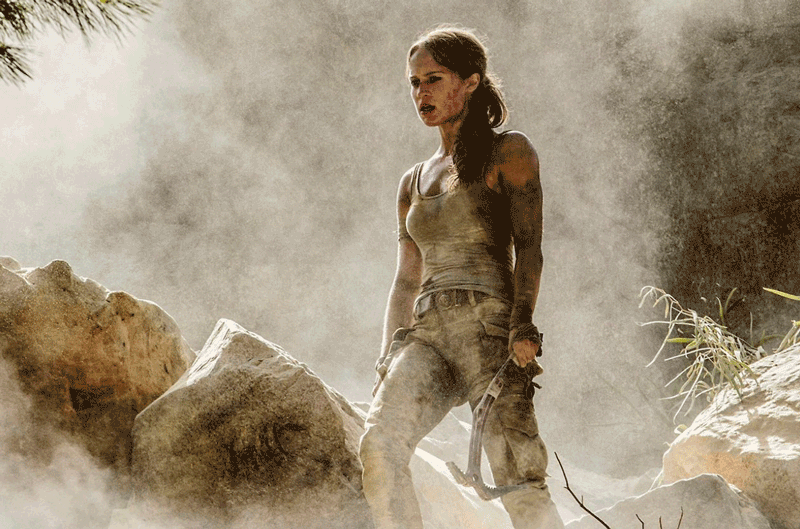
Image courtesy of the official Tomb Raider movie site. http://www.tombraidermovie.com
We went to see Tomb Raider on the weekend. I have to say, I liked it.
I didn’t love it the way I loved, say, Wonder Woman, but I thought the movie was quite strong and I enjoyed it. (I’m a supporting member of WorldCon this year and I already know which movie I’m going to vote for. Wonder Woman.)
The story line for Tomb Raider worked. It was solid, if a tad predictable. There were no massive plot holes where you thought what? How? Everything made sense. I particularly liked the ending, where they solve the puzzle not by supernatural means but by science.
I preferred this version way more than the 2001 version.
Probably the silliest bits were those that obviously came from the computer game. The floor falling apart around them while they tried to solve the puzzle, or sliding under the massive metal grates just in the nick of time. Don’t get me wrong, I love these things in computer games, but they don’t translate well to the screen. You really have to suspend disbelief to believe that someone will go to all that trouble to kill tomb robbers.
Alicia Vikander made an excellent Lara Croft. A believable one, too.
It was rather like settling down with an author you know, who reliably always turns out books you enjoy.
They left it open for a sequel. I’m looking forward to the next one.
I’ve been thinking the blog I wrote a couple of weeks ago, about how when you read a book at the wrong time it doesn’t appeal, but if you read it at another time, you love it.
I was a voracious reader, but I was never one of those people who as a teenager found a book that changed my life. I have friends who did, but my childhood reading was a blur. It was a mix of the old books we had around the house—Enid Blyton, the Bobbsey Twins, Hardy boys when we were younger.
Later it was Ivan Southall, Claire Mallory, Mary Elwyn Patchett and Mary Grant Bruce.
A lot of these books were written before I was born. I think I remember them because they were what we had on the bookshelves at home. Our whole family were voracious readers. I’m sure Mum and Dad scoured second-hand shops for us, for we had books from the early 1900s to those of the current day. (I remember a most glorious early edition of Ethel Turner’s Seven Little Australians, from about the 1920s. It was a beautiful book and we read it to bits.)
As for science fiction, I read it all. Not counting the Simon Black books (which we had at home), most of these I got from the library. I know I read the big names. Robert Heinlein, James Blish, Isaac Asimov, Arthur C. Clarke, John Wyndham, Poul Anderson, Philip K. Dick, Larry Niven, but I don’t always remember their stories.
I remember pieces of them, like the start of Heinlein’s Orphans of the Sky, but sometimes I only remember the covers. The brown triffid on Wyndham’s Day of the Triffids, the yellow Gollancz hard covers from the school library.
Isaac Asimov was probably the one writer I remember well, and still re-read. Who can forget Nightfall? Or Elijah Baley in Caves of Steel? Or even The Stars, Like Dust (but don’t get me started on the McGuffin they were chasing).
What surprises me is the early books that stay in mind are (mostly) those I read as an adult. Not only that, there’s a high proportion of women writers among them. Anne McCaffrey, Andre Norton, C. J. Cherryh, Joan D. Vinge. (Norton I read earlier.)
I’d add Asimov and Charles Sheffield in there as the only male writers whose work I actively remember from my childhood/early adulthood.
I remember a lot more of the modern stories I read.
“They jumped through the void,” she said to me last night. “They can’t do that.”
“Yes, they can,” I reply. “They’re escaping. I know we talk about external forces here, but we’ve set it up so they can jump. Here, and here.”
“They jump. Through the void,” she said to me again. “In fact, I checked, and through the whole book they jump through the void four times.”
I didn’t get it.
“Tell me about the void,” Sherylyn said.
“Well, it’s this massive anomaly in space and … they shouldn’t be jumping through it.”
“No. That’s the vortex. Tell me about the void.”
Other than the fact that our naming convention is a little stupid? I mean, who names two important things like that so similarly?
“Well, it’s hyperspace, and you have to jump through it. Faster than light, you know.”
She knows all this, she designed the galaxy with me. What am I missing?
“… and you use line nine to enter it and line ten to move you while you’re in there and … that’s in the Linesman universe and Stars Uncharted and its as-yet-unnamed sequel is not part of the Linesman series.”
“So what do they do when they what to travel faster than light?”
“They nullspace.”
Mumble, mumble, goes back to change it, finds Sherylyn has already done so.
Keeping the worlds apart
Stars Uncharted is not part of the Linesman universe. One series has linesmen, and world governments. The other has body modders and worlds controlled by companies.
We tried to make the experience of the two galaxies as different as we could. In one series they open their comms (often swiping on and later off) to talk. The comms system works via line five. In the other they link in to a network that’s available galaxy-wide. In Linesman we used lines for faster than light travel, in Stars Uncharted they nullspace. If you get badly burned in Linesman, you have regen on the affected area. It takes a bit of time. In Stars Uncharted they pop you into a genemod machine and you come out in a couple of hours better than new. (The role of the doctor changes, as a result.)
Some things we kept the same. Gravity on ships, for example. Screens of data. Ships that can be any shape, because they don’t normally land on worlds, their shuttles do.
But we try very hard to keep the world building separate.
Sadly, it still creeps in.
It’s another round of editing we need to do. “Does this work in this universe, or is it valid for the other one?”
I knew I was in trouble when I checked the time on my iPad. 2:59. I’d planned on going to sleep early.
It had been an exhausting day, physically and emotionally. I’d come home early, and the first thing I’d done was lay down and power nap. Only ten minutes, but it helped. Until around 9:00pm, when I could hardly hold my eyes open at the computer screen.
“I can’t stay awake,” I said. “I’m going to bed.”
I took my iPad to bed with me. Ten, fifteen minutes of relaxing reading would help, I thought.
It was only when the iPad flashed up the 10% battery warning that I looked at the time. And how much I had left of the book. I was somewhere between 70 and 80% done.
And I had a full day planned the next day.
To be honest, if the following day was a work day, I’d have watched the time more carefully, but it wasn’t, and I didn’t.
After that it became a race against time. Me finishing the book before the iPad ran out of battery.
I won. The battery was on 6% when I finally read the end at 4:02am.
The book I was reading. Joe Abercrombie’s Red Country.
I’ve had the book three years now. I’ve picked it up a couple of times, put it down, picked it up again. The silly thing is, I’ve always loved the idea of it, but … it was never appealing enough to read more than the first chapter.
Sometimes there’s a right time to read a book. Read it at another time and you might find it okay, or meh, but you probably won’t love it. Read it after reading too many similar books in a row and it won’t impact either.
This little cafe makes the best bibimbap in the district. It’s fresh, it’s tasty. It’s delicious. They also do the spicy edamame beans (chilli, garlic, rosemary and salt) pictured on the home page.
When we were children, Chinese food sold in restaurants was a very Australianised version of Cantonese cuisine. Fried rice, beef with black bean sauce, lemon chicken, sweet and sour pork (the dish with pineapple). All of them were modified for the Western palate. I mean, chilli in your dish—I can’t even think of a dish that contained it. As for non-Chinese Asian cuisine, we didn’t even know it existed.
The area where we live is sandwiched between a TAFE (Technical and Further Education) college and a large shopping centre (shopping mall).
Back when we first moved here our little main street shopping strip had a newsagent, a post office, a fruit shop, a liquor shop, an Italian restaurant, a bakery, a mini-market and Chinese take-away. Across the road the big suburban pub (and I mean one of those monster ones you could practically land a plane in) served modern Australian cuisine. Think steaks, schnitzels, fish and chips.
When we moved here, the shopping centre was taking away all the business from the fruit shop, the mini-mart and the liquor store.
They closed. So did the Italian restaurant. The newsagent and the post office amalgamated.
At the same time we were in the middle of an international education boom. Universities and TAFEs were actively recruiting overseas students, because of the money they brought in.
As the shops closed, little restaurants started to open in their place. They were aimed at the students. Eel congees (in fact, congees in any shape or form), more soups, less stir fry.
You could tell the nationalities going through the TAFE by the shops that opened. Indonesian first. Then Korean. We learned to love es teler, then bibimbap.
Some cuisines passed us by altogether. Other suburbs were learning to love pho, rice paper rolls, green curry and pad thai. For us it was kim chi and Hainese chicken rice.
Some years ago the government changed the laws regarding TAFEs. They now had to compete directly with universities, whereas prior to this they had mostly acted as an entry-level to the universities, where the students would come and do a two-year diploma, while improving their English, and then move on to the universities.
The students started moving out.
At the same time, Melbourne (and the rest of Australia) were in the middle of a massive housing boom. As the more exclusive suburbs were priced out of most people’s affordability range, suburbs like ours started to become popular with young families looking to buy their first home.
The restaurants changed to suit.
Chinese restaurants are opening now, but it’s not Cantonese cuisine this time, it’s Szechuan (or Sichuan if you spell it that way). Try dry-fried green beans with its mouth-puckering Szechuan pepper. Or Szechuan chicken. (Love the beans by the way, used to eat them all the time. I thought they were healthy. I mean, fresh green beans. Turns out they’re deep fried most of the time.)
There you have it. The lifecycle of a suburb over twenty years, by the changing restaurant scene.
“The ebook is a stupid product. It is exactly the same as print, except it’s electronic. There is no creativity, no enhancement, no real digital experience.”
It’s a book. and books took six hundred years to settle into what they are today.
Why do people insist on trying to turn the ebook into something it doesn’t need to be? Is there anything wrong with a book simply in a different format?
As a reader, all I want between me and my imagination is printed words. That’s what makes reading so much fun. I work out the rest. It’s my world, my interpretation of it.
I don’t need to be distracted from that by things that pull me out of the story.
I read ebooks more than I read paperback for two reasons. First, space. Space in my bag, space in my house. Second, portability. I can start reading on my PC at home, or my iPad, but while I’m waiting for the tram I’ll pull out my phone and read it on there, instead. (Space again, because I already carry a computer around in my bag.)
There’s also the added advantage that I get to save a few trees while I’m reading.
Enhanced ebooks. They’re called movies. They’re called computer games. They’re called choose your own adventures. And a whole lot of other things, too.
The book—paper or electronic—is the medium, not the message.
Oh, and by the way, the ebook is evolving, just not the way most people anticipated.
A white room, and how you would see it under infrared.
But first … a Goodreads giveaway.
The advanced reader copies (ARCs) for Stars Uncharted arrived at the editor’s office the other day. We haven’t seen them yet, but our editor says they look good.
Then, lo and behold, Sherylyn is searching Goodreads and what does she see? A giveaway. ARCs for Stars Uncharted. The Ace marketing department is on the ball. And they’re giving away lots of copies.
So, if you want to read an advanced copy of Stars Uncharted, head over to Goodreads and enter the giveaway. They’re giving away 30 copies, so the odds are good.
The giveaway ends on 1 March. Go for it.
And second
Warning: Australian spelling. Colour is one of those words that can jar when you see it spelt with a u if you’re not used to it. The u is meant to be there. (Remember, grey is a colour, but gray is a color. :-))
The internet is a writer’s research paradise
Back in my early working days I worked on online shopping software for a hardware company. It was an old green-screen program, with a modem that plugged into the phone line. (Showing my age here.) I forget how the whole thing worked, all I know is that the buyer logged into the computer, dialled the hardware company’s computer, connected, and then laboriously loaded their order in.
Sometimes the phone line dropped out part-way through. When that happened, the poor buyer had to dial back in and start the whole process again.
Even I, working in the computer industry, wondered if online shopping would ever take off.
Look at us now, buying books and other things online with one click.
Online shopping is wonderful, of course, but there’s another part of the world wide web that is a writer’s paradise.
Research.
In the second Stars Uncharted book we have a character who can see into the infrared and ultra violet spectrums.
Where do we start even thinking about what he might see?
Once upon a time we’d have hit the libraries. Not just the local library, either, but some of the university libraries. It would be a long and arduous process.
Now we hit the internet first.
Yes, there is a lot of incorrect information on the internet, but it’s a great starting point for research. People put some amazing stuff on there. Especially the science. And the architecture, and the pictures of places, and the … I could go on forever. There is so much good information, good images, good detail.
This is exactly the sort of research we need for our book.
What did we get out of this?
If our guy can see fully through the visible spectrum and into ultra violet and infrared, how might he do it? (He’s been modded. Modding is introduced in Stars Uncharted.)
Here’s what we got just from the Morgans List article above.
Birds are tetrachromats. Their four types of cone cells let them see red, green, blue and ultra violet together
Dogs only have two cones, blue and yellow but not red and green. Their vision can be compared to a human who is colour blind
Mantis shrimps use a set of filters to separate ultraviolet light into discrete colours that get picked up by the animal’s photoreceptors
Bees have colour receptors for blue and green but also for the UV spectrum
There is so much information here.
From here we look up rods and cones and photoreceptors, and the information expands.
Art, created specifically for photographing in ultra-violet light
How much research is enough?
Yes, even soft science fiction requires research.
It’s a rabbit hole, and it’s easy to fall into a research heaven and reader hell.Putting all that lovely research into your book, because it’s interesting, and because you know it now.
That’s why, nowadays, when writing the first draft of a book we stop at the internet research.
We make notes on what we think is important, but enough is enough. Later on, once the book is closer to completion, we go over some of the science to be sure it’s as correct as we can make it. Talk to experts, if we can. Research more.
Science fiction still needs to make that leap from science to fiction
You can research as much as you like, but somewhere along the way, as a science fiction writer, you have to make the leap that takes you away from real science into the science fiction.
We did that with Stars Uncharted.
Elements high in the periodic table are unstable. They take massive equipment to generate, and they only last for a fraction of a second. But there’s a theory called the island of stability, where the protons and neutrons in the atoms balance (magic numbers) and remain stable, meaning that the element might remain stable too.
You won’t find the island of stability or magic numbers in Stars Uncharted (at least, I don’t think you will), but it was such a cool idea. We had to use it.
* Morgans Lists—it’s not clear if Morgans Lists the name of the site or the name of the author. Apologies if I’ve failed to credit the author. (And if you are the author, let me know, because it’s a beautiful list.) The site is now on Google+.
Back when we were writing Alliance there was a schoolgirl helping out at the hairdressing salon Sherylyn goes to. She was in her fifth year at secondary school. Her name was Pearl*. Pearl was a lovely, talented, outgoing girl, and she wanted to be in our book.
“Name one of your characters after me. Please. I’ll take your book to school and show everyone my name is there.”
“We’ll see,” we said. “But we’re not promising anything.”
Because for us, naming the character is one of the first things we settle on, and until we have that name, the character isn’t really a character, they’re just a nebulous nonentity. Some people say the character grows to suit their name. For us, the name makes the character who he or she is.
We did think about renaming one of our characters for Pearl, but we knew she’d want to be a main character. Or at least, a secondary character with some page time.
There was only one character she could possibly be.
Spacer Darelani Tinatin.
We couldn’t change Tinatin to Pearl. It would have changed Tinatin’s character altogether.
Pearl Tinatin might have worked, because we only ever used Tinatin’s first name the once, but Pearl wanted something she could point to in the book to show, “Look, this is me.” One mention didn’t cut it.
Pearl wouldn’t even have liked Tinatin. She wanted to be the hero.
Pearl left the salon before we had to make a decision on the names. Which was somewhat of a relief, actually.
It has taught us one thing. Don’t say, “We’ll see,” to a question like that, because people take that to mean, “Yes.”
So if you ask us to put you into one of our books, you’ll understand why our answer will be a flat-out, “Sorry, but no.”
* It wasn’t really, it was another jewel name, but we’ve changed her name so we can write about her.